

When a vertebra in your spine shifts slightly out of place, it can interfere with how your nervous system works. We call this a spinal subluxation. It’s not a full-blown dislocation, but this subtle misalignment can disrupt the crucial communication network running between your brain and the rest of your body, often leading to pain, stiffness, and other health concerns.
It's a concept that gets talked about differently in medical and chiropractic circles, and knowing both sides of the story is the first step to understanding what’s really going on in your back.
Let’s think about it with a simple analogy. Picture your spine as the main internet cable running into your house, with all the nerves branching off like Wi-Fi signals to every device. A spinal subluxation is like having a weak, glitchy signal in one part of the house. The connection is still there, but it’s unreliable, slow, or distorted.
This kind of nerve interference can show up in ways that go far beyond a sore back. Just like a bad Wi-Fi signal can make your smart TV buffer or your laptop drop its connection, a subluxation can disrupt the nerve signals that manage everything from your muscle movements to how your organs function. It’s a problem with how things are working, not just how they’re built.
To get a complete picture, it’s helpful to see how different healthcare fields look at the term "subluxation."
The table below breaks down the key differences between the medical and chiropractic views on spinal subluxation for a clearer understanding.
| Aspect | Medical Perspective (Structural Dislocation) | Chiropractic Perspective (Functional Misalignment) |
|---|---|---|
| Definition | A partial, incomplete dislocation of a joint that is visible on imaging like an X-ray. | A slight misalignment or abnormal motion of a vertebra that affects nerve function. |
| Cause | Typically caused by acute trauma (like an accident or sports injury) or degenerative diseases (like arthritis). | Often results from cumulative stress: poor posture, repetitive motions, or emotional tension. |
| Diagnosis | Confirmed with imaging (X-ray, MRI, CT scan) showing physical separation of the joint surfaces. | Identified through a physical exam, including motion palpation, postural analysis, and sometimes specialized imaging. |
| Symptoms | Acute, localized pain, swelling, instability, and limited range of motion. | Can include pain, stiffness, muscle tension, headaches, and a wide range of nerve-related symptoms. |
While the medical definition points to a clear, measurable structural problem, the chiropractic view focuses on a functional issue that can have wide-ranging effects on the body's overall wellness.
A vertebral subluxation is more than just a misaligned bone; it's a disruption of the body's master communication system. Correcting it isn't just about alleviating pain—it's about restoring the optimal flow of information between the brain and the body, allowing for better overall function and healing.
Your spine is an incredible piece of natural engineering, built to be both strong and flexible. Every single vertebra is designed to move in concert with its neighbors, supported by a complex system of muscles, ligaments, and discs.
To get why a subluxation matters, you have to appreciate the basic physics at play. Diving into the biomechanics of sport and exercise really highlights how forces travel through the body. It shows how even a small misalignment can throw off this delicate balance, creating a domino effect of compensation. This is exactly why a minor issue in your lower back can eventually show up as chronic neck pain or tension headaches—your entire body is trying to adapt to that initial imbalance.
Talk to a medical doctor and then a chiropractor about "spinal subluxation," and you might feel like you're discussing two completely different things. It’s a bit like describing a car—one person might focus on the engine and mechanics, while another talks about how it gets you from A to B. Both are right, but they're looking at the same thing from different perspectives.
Getting a handle on these two viewpoints is crucial for anyone trying to make informed decisions about their spinal health. One definition zeroes in on significant, visible damage, while the other is more concerned with subtle functional problems that can mess with your body's internal wiring.
In the world of conventional medicine, a subluxation is a concrete, measurable event. It's defined as a partial dislocation of a joint. The bones are still touching, but they've shifted out of their proper alignment. This isn't a theoretical concept; it's something a doctor can point to on an X-ray, MRI, or CT scan.
A good analogy is a door that’s slipped partway off its hinge. It’s still in the frame, but it hangs crooked, scrapes the floor, and just doesn't work right. Medically, these kinds of subluxations are usually the result of a major event or an underlying disease.
Common causes include:
We see a powerful example of this in patients with rheumatoid arthritis (RA). The chronic inflammation from RA can eat away at the ligaments supporting the upper neck, causing a dangerous condition called atlantoaxial subluxation. This isn't a fringe issue. One Finnish study on RA patients found that 33% had significant anterior subluxation, and another 14% showed vertical dislocation in this critical area of the spine.
This diagram helps break down the two professional perspectives on what spinal subluxation really means.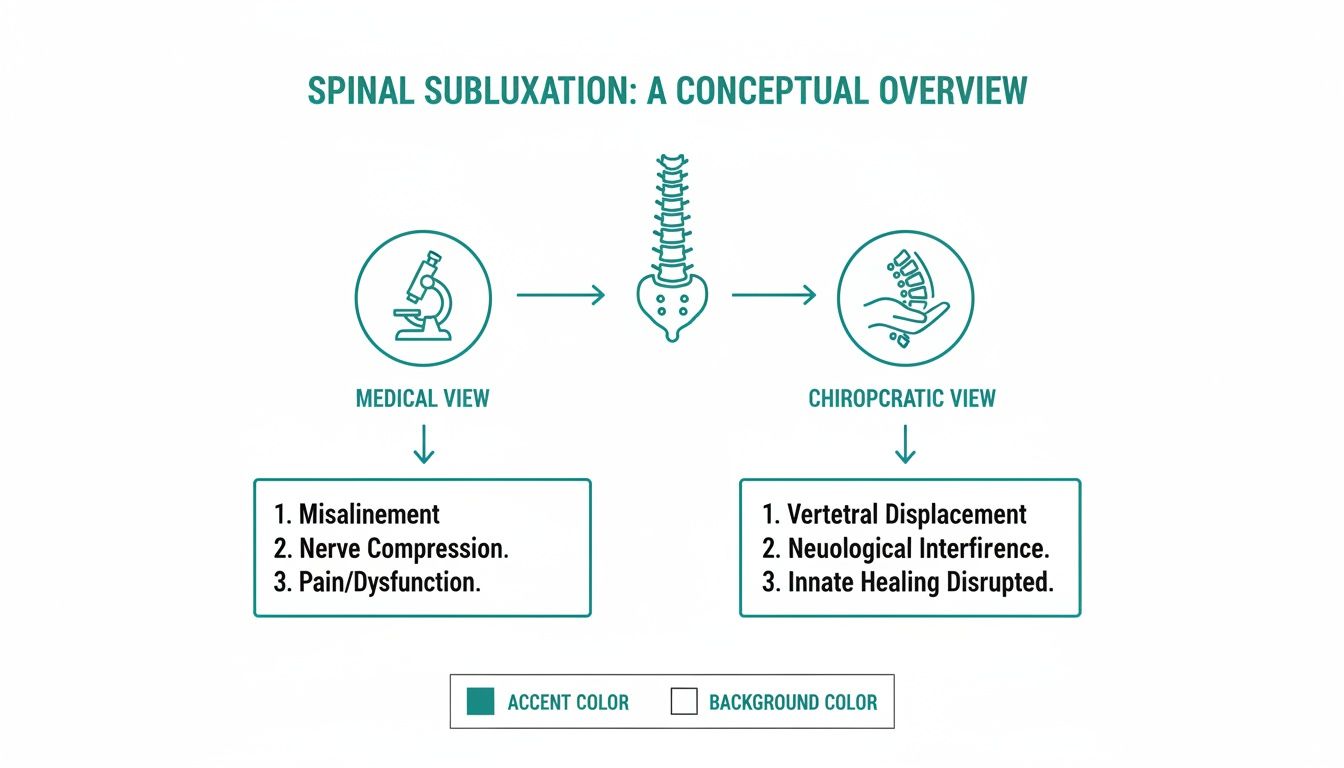
As you can see, both the medical and chiropractic models offer valuable insights for keeping your spine healthy and working as it should.
Now, let's switch gears. Chiropractors look at subluxation through a functional lens. They often use the term vertebral subluxation complex (VSC) to describe a more subtle problem: a vertebra that isn't moving correctly or has shifted slightly, putting pressure on the delicate nerves exiting the spine.
Going back to our door analogy, this is like a hinge that's perfectly screwed in but is rusty or tight. The door looks fine, but it squeaks, sticks, and takes extra effort to open and close. It’s a functional issue, not a structural collapse. This kind of misalignment might not be obvious enough to be flagged as a "partial dislocation" on an X-ray, but its impact on the nervous system can be huge.
The core idea in chiropractic is that even these small functional shifts can interfere with the critical communication pathway between your brain and the rest of your body, potentially contributing to a whole host of health problems that go far beyond just back pain.
These functional issues usually aren't caused by a single, dramatic injury. Instead, they often build up over time from the stresses of daily life. Things like chronic poor posture at your desk, repetitive movements on the job, or even long-term emotional stress can cause muscles to tighten and gradually pull vertebrae out of their ideal position.
The entire goal of chiropractic care is to find and correct these functional misalignments. By doing so, the aim is to restore proper nerve function and create an environment where the body can heal itself more effectively. You can learn more about this process in our guide on how chiropractic adjustments work.
Spinal subluxations rarely just happen overnight. More often than not, they’re the slow-burn result of all the different forces your body deals with day in and day out.
A good way to think about it is like the alignment on your car's tires. A single big pothole can knock everything out of whack instantly, but so can thousands of tiny bumps and constant, uneven pressure over months of driving. It’s the same with your spine.
These daily triggers generally fall into three buckets of stress, each capable of gradually pulling your vertebrae out of place. Figuring out which ones are at play is the first real step toward getting to the root of your pain and keeping it from coming back.

This is the most obvious cause, the one we can all point to. Physical stress covers everything from sudden, jarring events (macro-traumas) to the subtle, repetitive strains that sneak up on us (micro-traumas). Either way, they can overwhelm your body’s ability to cope, forcing vertebrae out of their healthy alignment.
Examples of Macro-Traumas:
But honestly, it's the micro-traumas we barely register that often cause the most chronic problems. These little repetitive strains create patterns of tension that slowly but surely pull your spine out of alignment.
Common Micro-Traumas Include:
Everything you put into your body has a direct effect on its structure. We call this "chemical stress," which is just a way of describing how your diet and environment can fuel inflammation, weaken your body's tissues, and make you far more vulnerable to physical injury.
Picture your joints like the hinges on a garden gate. If that gate is constantly exposed to salty, corrosive air, the hinges are going to rust, stiffen, and eventually seize up. A poor, inflammatory diet does something very similar inside your body.
Chronic inflammation can degrade cartilage, weaken ligaments, and lead to persistent muscle tightness. This creates an internal environment where vertebrae are more easily pulled out of alignment and are less able to hold their correct position.
The biggest culprits here are pretty common:
This internal stress makes your spine fragile. A minor physical strain that you might have normally shrugged off can suddenly be the one thing that pushes a vertebra over the edge into a subluxation.
Let's be clear: emotional stress isn't just "in your head." It creates very real, very physical changes in your body. When you're anxious or overwhelmed, your brain flips the "fight or flight" switch, flooding your system with stress hormones like cortisol.
This response instantly makes your muscles tighten up, especially in your neck, shoulders, and lower back. It’s an ancient survival mechanism. The problem is, when stress becomes chronic, those muscles never fully relax.
Think about clenching your fist. You can do it for a minute, no problem. But what if you held it that way for weeks on end? Your hand would become incredibly stiff, sore, and wouldn't work right. That's exactly what's happening to your postural muscles under chronic stress.
This constant, unrelenting muscle tension pulls and pulls on your vertebrae. Over time, that sustained force can be enough to literally shift a vertebra out of its proper place, creating a subluxation. This can kick off a vicious cycle: emotional stress causes physical misalignment, which creates pain and nerve irritation, which in turn just adds more fuel to your stress.
Figuring out if you have a spinal subluxation isn’t a guessing game. It's a careful, methodical process that lets a skilled practitioner identify the true source of your pain or dysfunction. We don't just focus on the spot that hurts; instead, we combine a detailed conversation, a hands-on physical exam, and sometimes advanced technology to get the full story of your spinal health.
It all starts with listening to you. Your health history is packed with clues—old injuries, your daily work habits, even the specific way your symptoms feel. This conversation lays the groundwork for a truly thorough physical evaluation.
This is where an expert's trained hands make all the difference. The physical exam goes far beyond a quick posture check. It's a series of specific orthopedic and neurological tests designed to see how well your body is actually working.
During this exam, we're looking at a few key things:
This comprehensive approach helps us distinguish a simple muscle pull from a more complex vertebral subluxation that's impacting your nervous system. For a deeper dive into this process, check out our article on how chiropractors know where to adjust.
While a physical exam is essential, modern chiropractic care often incorporates technology to add another layer of precision. Here at Bonesetters, we use the FDA-cleared PulStar system, a computer-assisted tool that removes any subjectivity from the analysis.
The PulStar device uses gentle impulses to analyze the mobility of each joint in your spine, measuring its response with incredible accuracy. This gives us objective, measurable data showing exactly which joints are stiff or stuck, confirming a subluxation with scientific evidence.
This technology allows us to see precisely which spinal segments are compromised. It transforms the diagnosis from a professional opinion into a data-driven conclusion, ensuring your treatment is targeted right where you need it most.
Sometimes, we need to see what’s going on under the surface to understand the full picture. Diagnostic imaging, like X-rays, provides a structural blueprint of your spine, revealing details that a physical exam simply can't.
An X-ray can clearly show:
Combining these images with our physical and computer-assisted findings completes the diagnostic puzzle. And recent research highlights just how common these underlying problems are. A major 2022 study looked at MRI scans from hundreds of chiropractic patients and found that an astonishing 91% of cervical spine scans and 89% of lumbar scans showed abnormalities like disc degeneration, which are components of subluxation. Across the entire study of 1,851 people, the overall prevalence of vertebral subluxation was 78.55%—a clear sign of how widespread these functional issues really are. You can read the full research on vertebral subluxation prevalence.
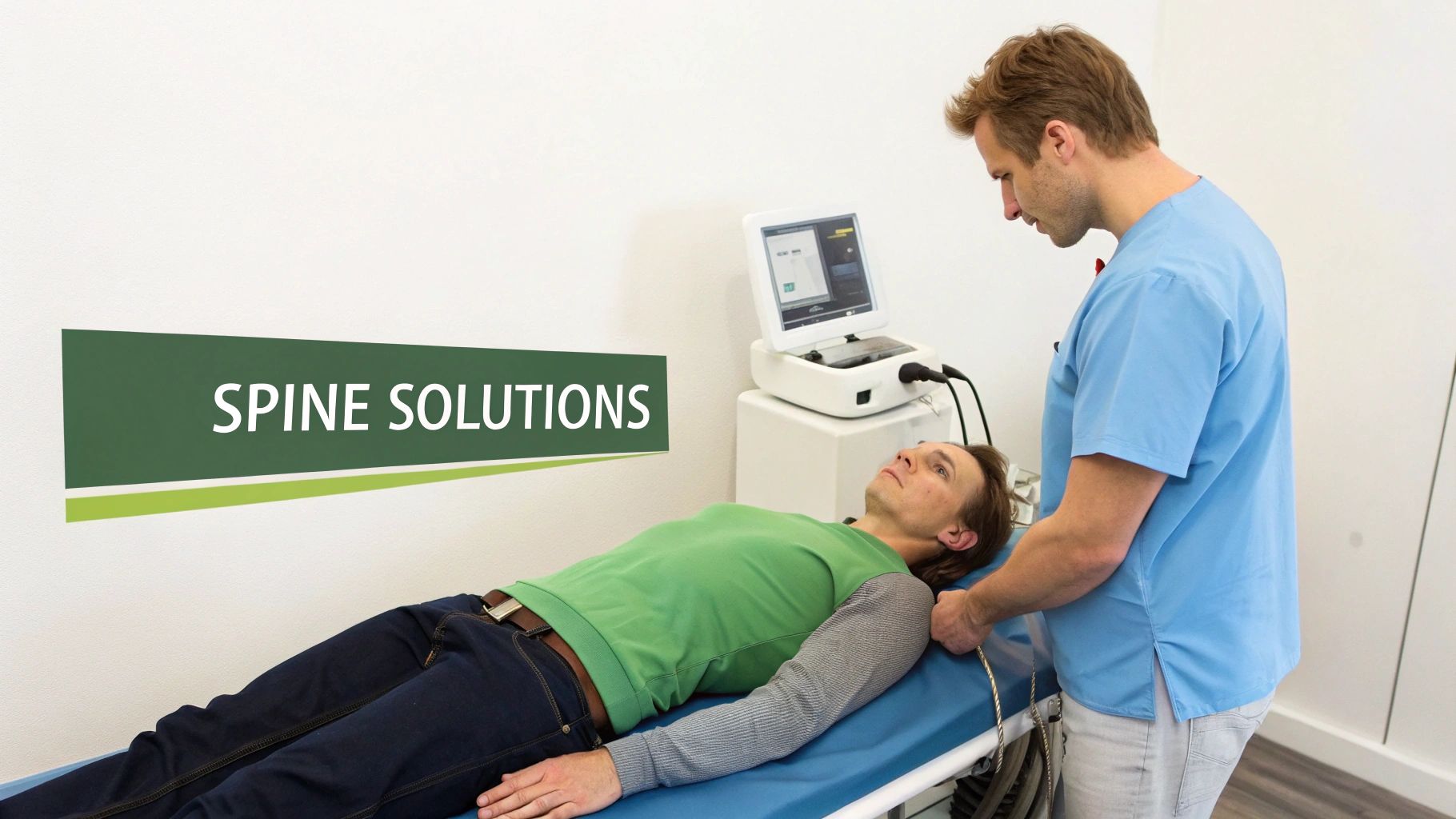
Once we've pinpointed a spinal subluxation, the next step is gentle, precise correction. Our goal isn't just about chasing away the immediate pain; it's about getting your spine and nervous system back to functioning correctly for long-term health and stability.
Modern care has come a long way from the "one-size-fits-all" adjustment. We now use advanced technologies that bring targeted relief without any forceful twisting or popping.
These methods get right to the root of the mechanical problem, whether it's a compressed disc or a stiff, stuck joint. By addressing the source, we can take the pressure off the nerves, dial down inflammation, and give your body the chance to heal itself—the way it's meant to. This is about lasting results, not quick fixes.
For a lot of people, the pain from a subluxation comes directly from pressure on the spinal discs. Think of these discs as little jelly-filled shock absorbers cushioning the bones in your spine. When a vertebra shifts out of place, it can squeeze a disc, causing it to bulge or herniate and press on sensitive nerves. This is what causes problems like sciatica or pain shooting down your arm.
Spinal Decompression Therapy is a fantastic non-surgical solution for this exact issue. You simply lie on a specialized table while a computer-controlled system applies a gentle, rhythmic pull to your spine. This action creates negative pressure inside the disc.
This negative pressure does two incredible things:
It’s a gentle but powerful way to relieve the pressure that causes so much chronic pain, allowing the disc to heal naturally.
One of the biggest leaps forward in chiropractic care is the use of instrument-assisted adjustments. The PulStar system is a perfect example of this, offering a level of precision that’s simply not possible with hands-on techniques alone. It’s an FDA-cleared device that gives us a data-driven way to correct spinal subluxations.
Instead of the traditional "cracking," the PulStar uses a handheld instrument to send a series of gentle, precise impulses directly to the stuck vertebra. The system's computer measures how the joint responds in real time, automatically tweaking the force and frequency until it senses the joint moving freely again.
This method is not only incredibly precise but also exceptionally comfortable. It makes chiropractic care a great option for everyone, including seniors, children, and people in acute pain who might be nervous about a manual adjustment.
This technology ensures we're targeting the exact spot that needs it, restoring motion and relieving nerve interference with minimal force.
While adjustments fix the structural problem, we can also speed up your recovery by helping your body heal at the cellular level. Class IV Cold Laser Therapy is an advanced treatment that uses specific wavelengths of light to penetrate deep into damaged tissues like muscles, ligaments, and nerves.
This light energy gives the mitochondria—the powerhouses of your cells—a major boost, setting off a chain reaction of healing effects.
Key Cellular Benefits:
This therapy provides immediate relief by tackling pain and inflammation head-on, all while creating the perfect internal environment for your body to recover for good. To dive deeper, you can check out our full guide on using cold laser therapy for back pain.
Of course, a holistic approach doesn't stop at the clinic door. Restoring proper movement patterns through physical therapy and mobility work is key to preventing future problems. Tools like using floss bands for improved mobility can be a great addition when used with professional guidance. By combining precise in-office treatments with smart self-care, we can build a powerful strategy to not just correct a subluxation but to build a stronger, healthier spine for the long haul.
It's completely normal to have questions as you start digging into the details of spinal subluxation. Getting a handle on how your spine works is the first real step toward taking back control of your health. Let’s tackle some of the most common questions we hear, clearing up any confusion so you can feel confident about your path to feeling better.
That's a great question. While the muscle aches around a stuck joint might ease up for a little while, a true vertebral subluxation is a mechanical problem that almost never fixes itself. Your body is incredibly adaptive and will try to compensate by tightening nearby muscles to create a sort of natural brace.
The problem is, this is just a temporary fix. It can lead to chronic stiffness, limited motion, and a whole new set of problems down the road. Without a professional correction, the nerve interference and joint dysfunction simply don't go away. Over time, this can actually speed up wear and tear on the joint, paving the way for conditions like osteoarthritis. Getting a proper diagnosis is the only way to achieve real, lasting healing instead of just managing the symptoms.
Absolutely. When performed by a licensed Doctor of Chiropractic, treatment is overwhelmingly safe and effective. Chiropractic care has come a long way, and today we have a wide variety of techniques—many of which are incredibly gentle and precise. This allows us to customize care for every single person's needs and comfort level.
For example, we often use computer-assisted instruments like the PulStar system. This technology lets us deliver a highly targeted adjustment with absolutely no "popping" or "twisting." It's a fantastic, comfortable option for everyone from kids to seniors, and even for people who are in a lot of pain.
There’s no one-size-fits-all answer here; the recovery timeline is as unique as you are. How long it takes really depends on a few key factors:
Some people feel a huge sense of relief after just a handful of visits. For more stubborn, long-standing issues, we might map out a dedicated care plan over several weeks or months. The goal isn't just to correct the misalignment but to stabilize the spine and retrain the surrounding muscles to prevent the problem from coming back.
The vast majority of people find chiropractic adjustments to be a relief, not a pain. Instead of hurting, most patients describe an immediate feeling of ease, less pressure, and a welcome increase in their range of motion. Especially with gentle techniques and computer-guided tools, the force we use is minimal, comfortable, and aimed right where it needs to go.
You might feel a little bit of mild soreness afterward, similar to how you’d feel after a good workout. That's perfectly normal—it's just your body adapting to its new, proper alignment, and it usually fades very quickly.
At Bonesetters, we're committed to giving you clear answers and gentle, effective solutions for your spinal health. If you’re tired of temporary fixes and want to address the root cause of your discomfort, we're here to help. Schedule your consultation today to get started.