

Sciatica isn't a diagnosis on its own. Instead, think of it as a symptom—a very specific kind of radiating pain that signals something is irritating the sciatic nerve. People often describe it as a sharp, shooting, or burning sensation that starts in the lower back, travels through the buttock, and continues down the back of the leg.
To get a real handle on sciatica, you have to picture the sciatic nerve itself. Imagine it's a major electrical cable—the longest and widest one in your entire body. It’s formed from several nerve roots that exit your lower spine, which then bundle together to run through your hip and buttock area. From there, it travels down each leg, branching off to power muscles and provide feeling all the way to your toes.
When something puts pressure on this "cable," it's like a roadblock on a superhighway. The nerve signals get jumbled, leading to the pain, numbness, or weakness we call sciatica.
If you’re dealing with this, you're certainly not alone. It's estimated that between 10% and 40% of people will experience sciatica at some point in their lives. On an annual basis, new episodes affect anywhere from 1% to 5% of the population, which translates to millions of individuals every year. You can learn more about the widespread nature of sciatica and its impact from global health studies.
The sciatic nerve is a workhorse, handling both movement and sensation for a huge part of your lower body.
When something compresses or inflames this nerve, it's a bit like a kink in a garden hose. The flow of signals is choked off, causing problems further down the line. That searing pain is your body’s alarm system screaming that the nerve is in trouble.
It’s crucial to remember that "sciatica" isn't the injury itself. It's the collection of symptoms—the pain, tingling, numbness—that arise because the sciatic nerve is being pinched or irritated. Finding the source of that irritation is the whole game when it comes to lasting relief.
Now that you have a picture of the nerve pathway, we can start looking at the common culprits. Things like herniated discs or spinal narrowing often create these "roadblocks." By figuring out exactly what's causing the pressure, we can build a smart, targeted plan to get you feeling better.
This table gives you a quick snapshot of the most common ways sciatica shows up.
| Symptom Type | Common Description |
|---|---|
| Pain | A sharp, shooting, or burning sensation that travels down one leg. Rarely affects both. |
| Numbness | A "pins-and-needles" feeling or complete loss of sensation along the nerve path. |
| Tingling | Often described as a prickling or buzzing feeling, similar to when a limb "falls asleep." |
| Weakness | Difficulty moving the leg or foot; may cause a "foot drop" or make it hard to stand on tiptoes. |
| Location | Pain typically starts in the lower back or buttock and radiates down the back of the thigh and leg. |
Recognizing these classic signs is the first step. If this sounds like what you're experiencing, it's a strong clue that your sciatic nerve is involved.
Even though sciatica shoots pain down your leg, the real problem almost always starts in your lower back. Your spine is made of stacked bones (vertebrae) with cushiony shock absorbers (discs) between them. When any of these parts shift, wear down, or change shape, they can clamp down on the sciatic nerve roots, and that's when the trouble begins.
These structural issues are, by far, the most common reason people experience sciatica. Getting a handle on how they happen is the first step toward finding relief that fixes the source of the pressure, not just numbing the pain signals it sends down your leg.
This concept map helps visualize how different spinal problems all lead to the same outcome: nerve irritation and sciatica symptoms.
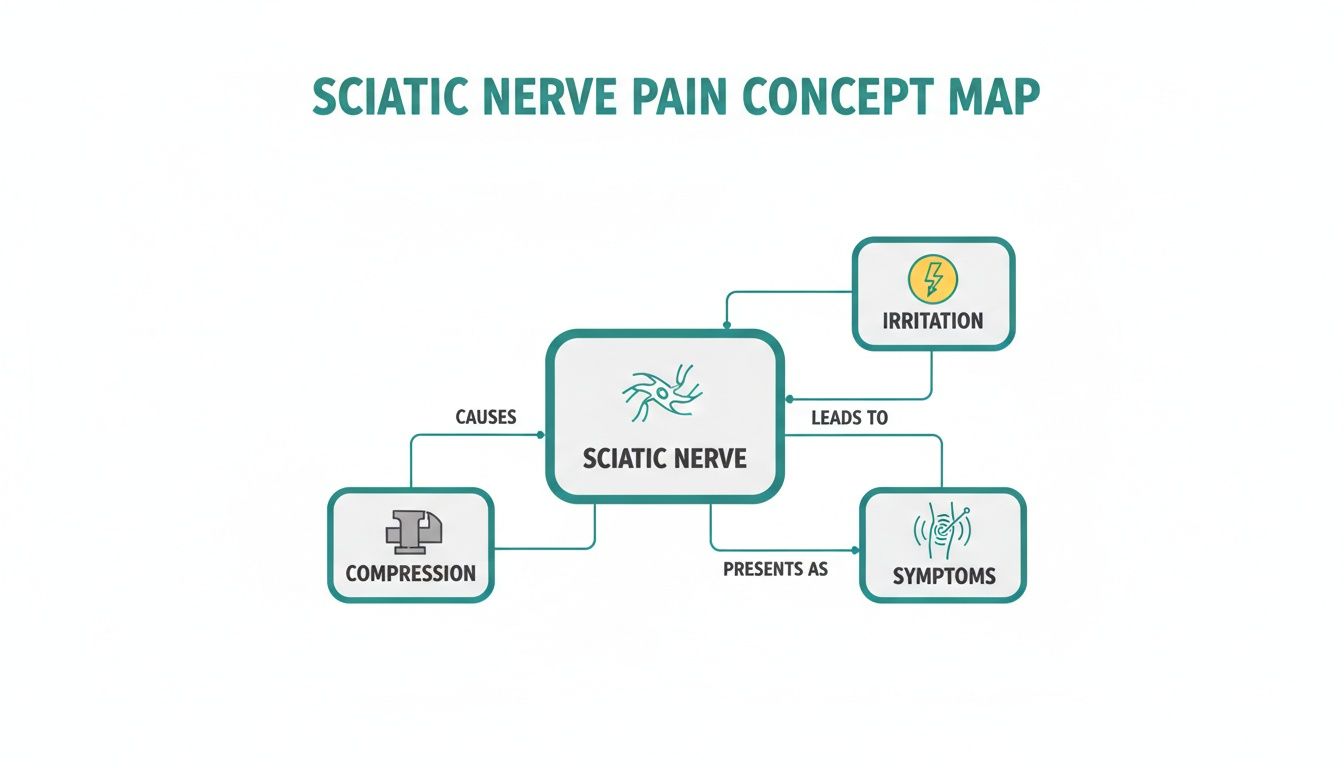
As you can see, whether it’s a disc, a bone, or even a muscle, the final common pathway is nerve irritation. This is what produces that all-too-familiar pain, tingling, and numbness.
A herniated disc—sometimes called a slipped or ruptured disc—is one of sciatica's most notorious culprits. Your spinal discs have a tough, rubbery outside and a soft, gel-like inside. The best analogy is a jelly donut. If the outer layer gets a tear, the jelly center can squeeze out.
When this happens in your spine, that gel-like material can press directly on a sciatic nerve root. It’s a double whammy: the physical pressure is bad enough, but the material itself is also full of inflammatory chemicals that further irritate the nerve.
This is why sitting, coughing, or sneezing can make sciatica flare up. These actions increase pressure inside the disc, causing it to bulge out even more and poke that already-angry nerve. You can learn more about powerful, non-surgical disc herniation treatment options that directly address this issue.
Another frequent offender is lumbar spinal stenosis. "Stenosis" is just a medical term for narrowing. In this condition, the spinal canal—the main channel that houses your spinal cord and nerve roots—gradually gets tighter.
Imagine the spinal canal is a tunnel and your nerves are cars trying to pass through. Spinal stenosis is like the tunnel walls slowly closing in, creating a traffic jam and putting a squeeze on everything inside.
This narrowing usually happens over time due to age-related changes:
People with stenosis often find their pain gets worse with standing or walking but feels better when they lean forward. That forward bend, like pushing a shopping cart, temporarily creates a little more room in the spinal canal.
Spondylolisthesis is a condition where one vertebra slips forward over the one below it. If you go back to the image of stacked building blocks, this is what happens when one block slides out of alignment.
This slippage can pinch the nerve root right where it tries to exit the spine. The instability from the misplaced bone also puts a lot of extra strain on the discs and joints, adding inflammation and pain to the mix.
Key Insight: Whether it's a leaky disc, a narrowing canal, or a slipping bone, the underlying problem is a lack of space. The sciatic nerve root gets compressed, leading to the painful signals that define sciatica. Effective treatment focuses on restoring that space.
Bone spurs, also called osteophytes, are small, smooth bumps of extra bone that often form on the edges of joints affected by osteoarthritis. They're your body's attempt to repair joint damage. While many bone spurs cause no issues, their location in the spine is everything.
If a spur grows into the spinal canal or into the little windows where nerve roots exit (the foramen), it acts like a hard pebble pressing on the soft sciatic nerve. This constant pressure can trigger unrelenting sciatica. Research shows that while many things can cause low back pain, about 10% of cases involve sciatica stemming from structural issues like these. You can find more details on the prevalence and causes of sciatica from Fortune Business Insights.
While your spine is the usual suspect in most sciatica cases, the investigation shouldn't stop there. Sometimes, the real culprit is hiding outside the spinal column altogether, tucked away in the intricate network of muscles in your hips and pelvis.
Think about the sciatic nerve's journey after it exits the low back. It has to travel deep through the buttock, weaving past—and sometimes right through—several muscles. If any of these muscles get tight, inflamed, or start to spasm, they can squeeze that nerve just as forcefully as a herniated disc, creating the exact same shooting pain down your leg.
This is precisely why a meticulous diagnosis is so critical. If the problem is a tight hip muscle, all the back treatments in the world won't fix it.

The most famous of these extra-spinal issues is Piriformis Syndrome. The piriformis is a small, pear-shaped muscle deep in your buttock, connecting the base of your spine (the sacrum) to the top of your thigh bone. Its main job is to help you rotate your hip outward.
Here’s the crucial part: the sciatic nerve’s standard route is to pass directly underneath this muscle. For a small percentage of people, an anatomical quirk means the nerve actually pierces right through the piriformis, making them especially vulnerable to this problem.
When that muscle gets too tight or spasms, it can physically clamp down on the sciatic nerve. This condition, sometimes called "deep gluteal syndrome," is notorious for perfectly mimicking classic sciatica from a disc bulge, often leading to a frustrating misdiagnosis and treatments that don't help. You can dive deeper by learning more about piriformis syndrome and how chiropractic can help.
So, what makes the piriformis muscle angry?
Key Takeaway: If your MRI of the lower back comes back clean but you're still battling sciatic pain, Piriformis Syndrome should be high on the list of suspects. It's a classic example of why the source of the problem isn't always where you feel the pain.
While Piriformis Syndrome gets most of the attention, other issues around the hip and pelvis can also irritate the sciatic nerve. A truly comprehensive diagnosis means looking beyond the most common cause to rule out these less frequent, but just as disruptive, possibilities.
Other potential sources include:
Knowing about these potential causes reinforces the importance of a whole-body approach. The only way to create a treatment plan that actually works is to accurately pinpoint what's putting pressure on that nerve—whether it’s a disc in your back, a bone spur in your spine, or a tight muscle in your hip.
It's easy to think sciatica comes out of nowhere—one wrong twist and suddenly you're in agony. But more often than not, a specific event like a disc herniation is just the final straw. A whole host of personal and lifestyle factors can slowly make your spine more vulnerable over time.
Think of it like a forest fire. A single lightning strike might start the blaze, but it’s the dry, windy conditions that allow it to rage. Understanding these underlying risk factors isn't about placing blame; it's about empowering you to make smarter choices for your long-term spinal health.
When you know what makes you more susceptible, you can take targeted steps to protect your back before a minor strain becomes a major problem.
As the years go by, our spines naturally change. The gel-like discs that cushion our vertebrae begin to lose some of their water content. They become a bit stiffer and less forgiving, which makes them more prone to tearing or herniating.
This is also why conditions like spinal stenosis (the narrowing of the spinal canal) and bone spurs are much more common as we get older. It's the result of a lifetime of cumulative stress on the spine. But this doesn't mean pain is a foregone conclusion. Proactive care to support your discs and keep your spine aligned can go a long way in offsetting these age-related risks.
Carrying extra body weight puts a significant, constant strain on your lower back. Every extra pound you carry is magnified in terms of the force it exerts on your spinal discs and joints, which can speed up that wear-and-tear process.
Pair that with a desk job, and you've got a recipe for trouble. Sitting for prolonged periods compresses your lumbar discs. It also weakens the very muscles that are supposed to support your spine—your core and glutes—while tightening up your hip flexors, which can pull your pelvis out of its natural alignment. This combination creates the perfect storm for low back issues that can easily lead to sciatica.
Important Insight: It’s rarely just one thing. Research highlights that a complex mix of factors, including poor body mechanics at work, psychological stress, and even socioeconomic status, can dramatically increase the odds of developing chronic sciatica. You can learn more about the complex risk factors associated with sciatica.
It’s not just sitting that’s a problem. Jobs that involve heavy lifting, frequent twisting, or operating vibrating machinery also place you at a higher risk. These activities can cause thousands of tiny traumas to the spine over time, eventually leading to a more significant injury.
And a few common lifestyle habits can have a surprisingly big impact:
Smoking: Nicotine constricts blood vessels, and that includes the tiny ones that feed your spinal discs. This effectively starves them of the oxygen and nutrients they need to stay healthy and heal, making them brittle and much more likely to get damaged.
Diabetes: This condition doesn't just affect blood sugar; it can impair your body's ability to manage inflammation. Over time, it can also cause direct nerve damage (diabetic neuropathy), making you more vulnerable to all kinds of nerve-related pain, including sciatica.
Recognizing these risks is the first critical step. By addressing them head-on, you can actively reduce the load on your spine and significantly lower your chances of ever having to deal with the debilitating pain of sciatica.
Figuring out the exact cause of sciatica isn't about guesswork. Your doctor’s most powerful tools aren't fancy scanners but a good conversation and a hands-on physical exam. This crucial first step ensures that any treatment you receive is aimed squarely at the real source of your pain.
The whole process starts with a detailed patient history. Your doctor needs to understand the story of your pain, so they’ll ask very specific questions. You should be ready to talk about where it hurts, what the pain feels like (is it a sharp jolt, a dull ache, or a burning sensation?), what makes it worse, and what might make it feel better. This conversation helps your doctor start connecting the dots, giving them a good idea of whether they're dealing with something like a herniated disc versus a muscular issue like piriformis syndrome.
After you've talked, your doctor will guide you through a series of physical and neurological tests. These aren't just random movements; each test is specifically designed to check the health of your sciatic nerve and, in a safe way, see if they can recreate your symptoms. This helps confirm that the nerve is definitely involved.
One of the most revealing tests is the straight leg raise (SLR). You'll lie on your back, and your doctor will slowly and gently lift your painful leg. If that simple motion brings on the all-too-familiar pain shooting down your leg, it's a very strong sign that a nerve root in your lower back is being pinched, most likely by a herniated disc.
Why This Matters: A positive straight leg raise is the classic sign of true sciatica. It tells your doctor that the problem is almost certainly starting in your spine, allowing them to focus their investigation and rule out other causes of leg pain.
Next, your doctor will check your neurological function. This part of the exam is about finding subtle clues that the nerve signal is being blocked or weakened by the compression.
This typically involves a few key checks:
Many people assume they need an MRI right away, but that’s rarely the case. For the vast majority of people with sciatica, an accurate diagnosis can be made from the history and physical exam alone. Doctors are trained to rely on this hands-on evaluation first.
Scans like an MRI are reserved for specific circumstances:
This methodical, step-by-step approach ensures your diagnosis is as accurate as possible, which is the only way to build a treatment plan that will actually work for you.
Once we’ve pinpointed the real source of your sciatica, the roadmap to relief becomes much clearer. Instead of just chasing symptoms with generic advice, we can focus on targeted, non-surgical treatments that get to the heart of the problem—whether it's a herniated disc, spinal stenosis, or a stubborn muscle.
The goal here isn’t a temporary fix. It’s about creating lasting change by physically taking the pressure off that irritated nerve. This means using advanced therapies designed to correct the specific structural issue, allowing your body to finally heal the right way.
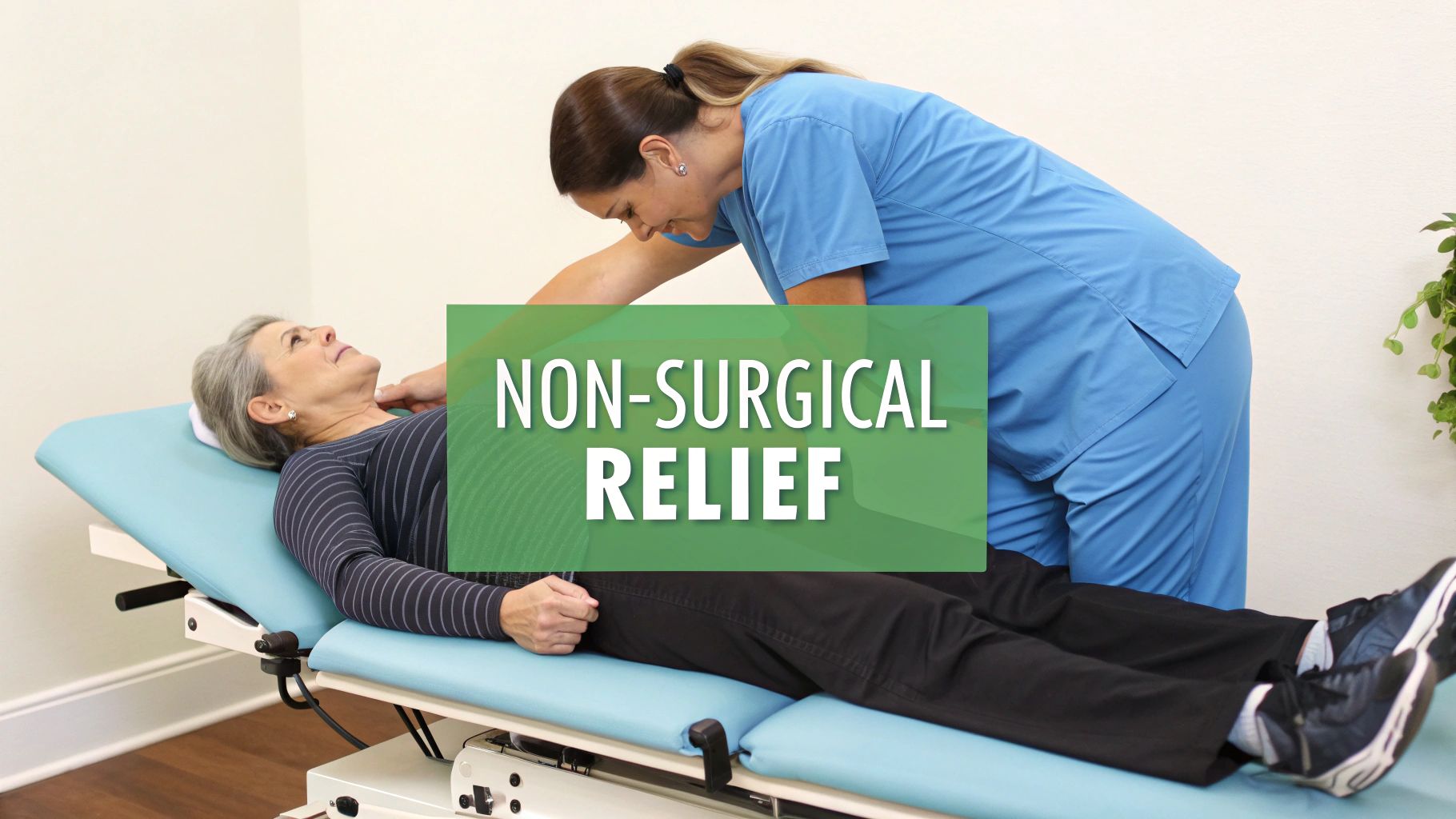
To better understand how these modern therapies work, let's compare some of the most effective non-surgical options available today. Each has a unique way of addressing the root cause of sciatic pain.
| Treatment Method | How It Works | Best For |
|---|---|---|
| Spinal Decompression | Gently stretches the spine to create negative pressure within the discs, pulling bulging material away from the nerve and drawing in nutrients for healing. | Herniated or bulging discs that are directly compressing a nerve root. |
| Computer-Guided Adjustments | Uses sophisticated sensors to find restricted spinal joints and applies precise, gentle impulses to restore proper motion without forceful twisting or popping. | Patients who need highly specific adjustments, especially when the area is very inflamed and sensitive. |
| Class IV Cold Laser Therapy | Employs specific light wavelengths to penetrate deep into tissues, stimulating cellular repair, reducing inflammation, and improving blood flow. | Reducing deep inflammation, accelerating tissue healing, and managing pain associated with nerve irritation. |
These treatments are often used in combination because they address different aspects of the same problem—structural issues, nerve pressure, and inflammation—creating a powerful, synergistic effect for faster and more complete relief.
When a herniated or bulging disc is behind your sciatica, the root of the problem is a simple lack of space. Spinal decompression therapy is a non-invasive treatment built specifically to solve this. Think of it as gently and methodically stretching your spine, creating a subtle vacuum-like effect inside the problematic disc.
This negative pressure accomplishes two incredible things. First, it can help coax the herniated disc material back toward its center, pulling it away from the sciatic nerve it’s been pressing on. Second, it floods the disc with oxygen, water, and vital nutrients—all of which are absolutely essential for long-term healing.
Spinal decompression is a game-changer for disc-related sciatica because it directly counteracts the compressive forces that caused the injury in the first place. It is a calculated method for creating the ideal environment for a damaged disc to heal naturally.
While traditional chiropractic adjustments are effective, modern technology allows for a level of precision and gentleness that was never possible before. Systems like the FDA-backed PulStar use sophisticated computer analysis to identify the exact spinal segments that are stuck or out of alignment.
Instead of a manual thrust, the system delivers a series of tiny, precise impulses right to the targeted joint. This approach is not only incredibly comfortable but also highly specific. It ensures the corrective force is applied exactly where it's needed to restore healthy motion and take pressure off the nerve. This precision is especially crucial when you're dealing with an already inflamed sciatic nerve, as it gets the job done without aggravating the sensitive area.
Calming down inflammation is a huge part of getting an angry sciatic nerve to settle down. While an ice pack can provide surface-level relief, Class IV cold laser therapy works on a much deeper, cellular level. This treatment uses specific wavelengths of light energy that penetrate deep into the tissues surrounding the nerve.
This light energy stimulates the mitochondria—the tiny "powerhouses" inside your cells. The result?
When therapies like decompression and laser are combined with the right kind of targeted movement, the results can be profound. For ideas on safe and effective exercises, our guide on the best stretches for sciatica relief is a great resource. These gentle, supportive approaches work together, creating a powerful healing synergy and a clear path away from sciatic pain without resorting to invasive procedures.
When you're dealing with sciatica, a lot of questions pop up. Getting clear, no-nonsense answers can give you peace of mind and help you take control of your recovery. Let's tackle some of the most common questions I hear from my patients.
In some cases, yes. An acute flare-up of sciatica can sometimes calm down on its own within a few weeks, especially with a bit of self-care like gentle movement and avoiding things that stir it up.
But here’s the crucial part: if the root problem is a significant mechanical issue, like a herniated disc or spinal stenosis, the pain will likely stick around or keep coming back. Lasting relief isn't about waiting for the pain to fade; it's about fixing what's causing the nerve pressure in the first place.
Key Insight: Don't confuse the pain disappearing with the problem being solved. If the underlying structural issue isn't addressed, you're leaving the door open for another flare-up down the road. It's always better to be proactive for long-term spine health.
True sciatica follows a very specific roadmap. The pain almost always starts in your low back or buttock and travels down the back of one leg, often going past your knee. People describe it as a sharp, shooting, or electric-like pain—very different from a simple muscle ache.
If your pain follows this distinct nerve path and you're also getting sensations like tingling, numbness, or weakness in that same leg, there's a very high chance you're dealing with sciatica.
Sitting puts a massive amount of pressure on the discs in your lower back—up to 40% more than when you're standing.
If a bulging or herniated disc is the culprit behind your sciatica, sitting literally squeezes that damaged disc, forcing it to bulge out even more and press harder on the sciatic nerve. This is exactly why long periods of sitting, especially with a slumped posture, are a classic trigger for sciatic pain.
It's clear that people are desperate for answers. Online searches for sciatica have exploded over the last 10 years, with a 2-fold increase on Google and an incredible 6-fold increase on YouTube. Millions are looking for real solutions. You can discover more insights about this trend and what it means for public health.
At Bonesetters Critical Chiropractic, we don't just chase symptoms—we find and fix the root cause of your pain using proven, non-surgical methods. If you're done with temporary fixes and want real, lasting relief, we're here to help.
Take the first step and schedule a consultation with us today. Let's get you back to living your life comfortably.