

Imagine your spine is like a major highway system for your body's communication network. Your brain sends vital messages down this highway—the spinal cord—and nerves branch off at every level, delivering instructions to every part of your body. A spinal subluxation is like a traffic jam on this highway. It happens when a spinal bone, or vertebra, loses its normal position or movement, creating interference that slows down or distorts those crucial nerve signals.
If you've heard the term "subluxation," you might have encountered two very different definitions, which can be confusing. It's a classic case of the same word meaning different things to different professionals.
In a hospital or an orthopedic specialist's office, a subluxation is a big deal—it means a joint is partially dislocated. Think of a shoulder that's not quite "in," but not fully "out" either. It's a structural problem, usually caused by an injury, that's often painful and clearly visible on an X-ray.
In chiropractic, however, we're typically talking about something more subtle: a vertebral subluxation. This isn't about a major dislocation but rather a functional problem. It’s a spinal joint that has become stuck, misaligned, or isn't moving correctly, which in turn irritates the surrounding nerves.
Think of it like a garden hose. When the hose is straight, water flows freely. But if you put a small, almost unnoticeable kink in it, the flow of water is restricted. A vertebral subluxation acts just like that kink, interfering with the flow of information through your nervous system and potentially causing problems over time.
To clear things up, it helps to see the two definitions side-by-side. One describes a significant structural displacement, while the other focuses on a functional issue affecting nerve communication.
| Aspect | Chiropractic View (Vertebral Subluxation) | Medical View (Orthopedic Subluxation) |
|---|---|---|
| Primary Issue | Functional: A spinal joint is misaligned or "stuck," affecting nerve function and biomechanics. | Structural: An incomplete or partial dislocation of a joint. |
| Cause | Can result from repetitive stress, poor posture, minor impacts, or even chemical/emotional stress. | Typically caused by acute trauma, like a fall or a sports injury. |
| Visibility | Not always visible as a "dislocation" on X-rays; identified by motion and physical exams. | Clearly visible on imaging (X-ray, MRI) as a joint displacement. |
| Focus of Care | Restoring proper movement and nerve function to improve overall body health and communication. | Stabilizing the joint and addressing the immediate structural damage and pain. |
Understanding this distinction is crucial because the approach to care is entirely different. One isn't necessarily "right" and the other "wrong"—they are simply describing two different conditions.
This diagram helps illustrate the chiropractic concept of how a spinal misalignment can lead to nerve interference.
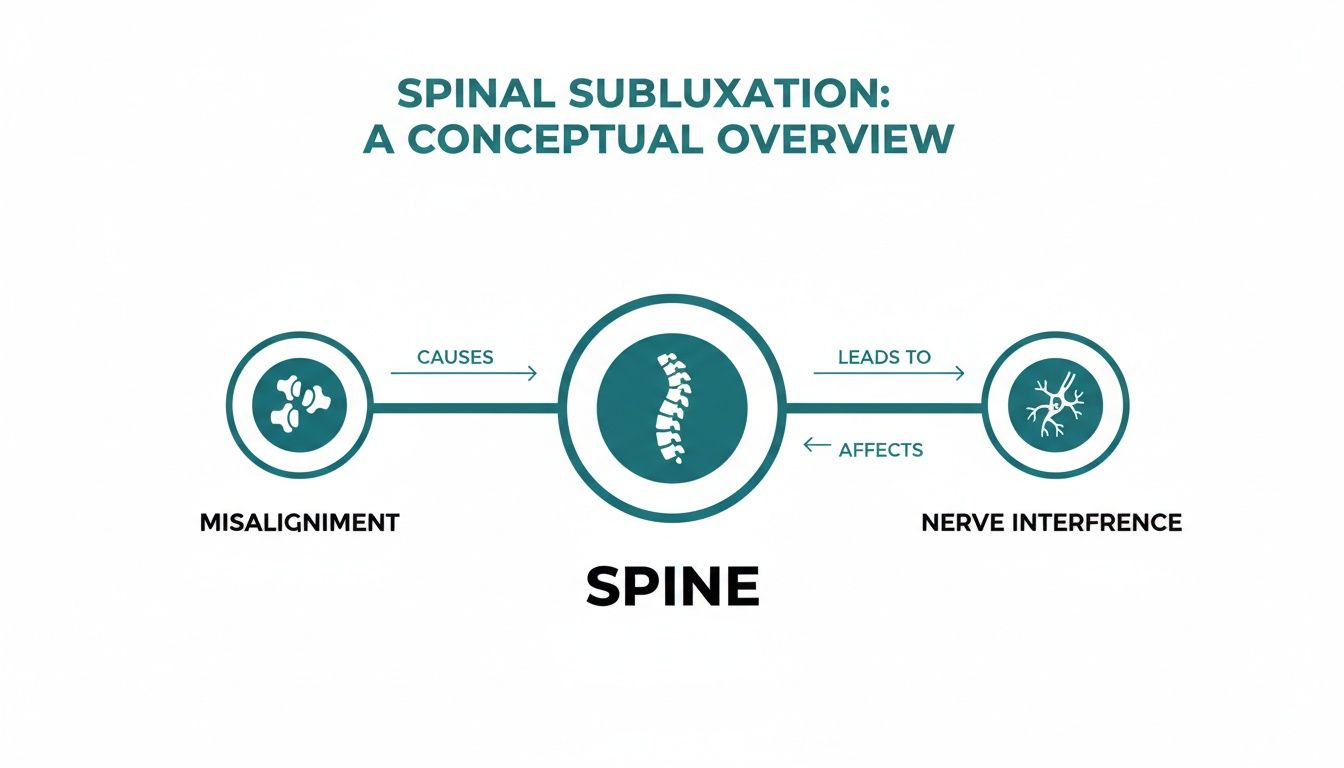
As you can see, the problem starts with a misalignment, which then creates a ripple effect, disrupting the body's master communication system.
Grasping the functional view of vertebral subluxation is key to understanding why you might be experiencing seemingly unrelated health issues. Things like chronic headaches, sciatica, digestive troubles, or numbness and tingling in your arms and legs can often be traced back to these subtle "traffic jams" in your spine.
A vertebral subluxation isn't just about a bone being out of place; it's about the neurological and physiological consequences of that misalignment. Correcting it restores the body’s ability to regulate and heal itself.
By focusing on identifying and correcting these underlying functional issues, we can move beyond just chasing symptoms. The goal is to clear the lines of communication between your brain and your body, which gives your system the best possible chance to function, heal, and thrive.
To really wrap your head around what subluxations of the spine are, you first have to appreciate the incredible piece of engineering they affect. Your spine isn't just a stack of bones; think of it more like a sophisticated, flexible tower. Each block in that tower is a vertebra, and nestled between them are soft, gel-like cushions called intervertebral discs that absorb the shocks of daily life.
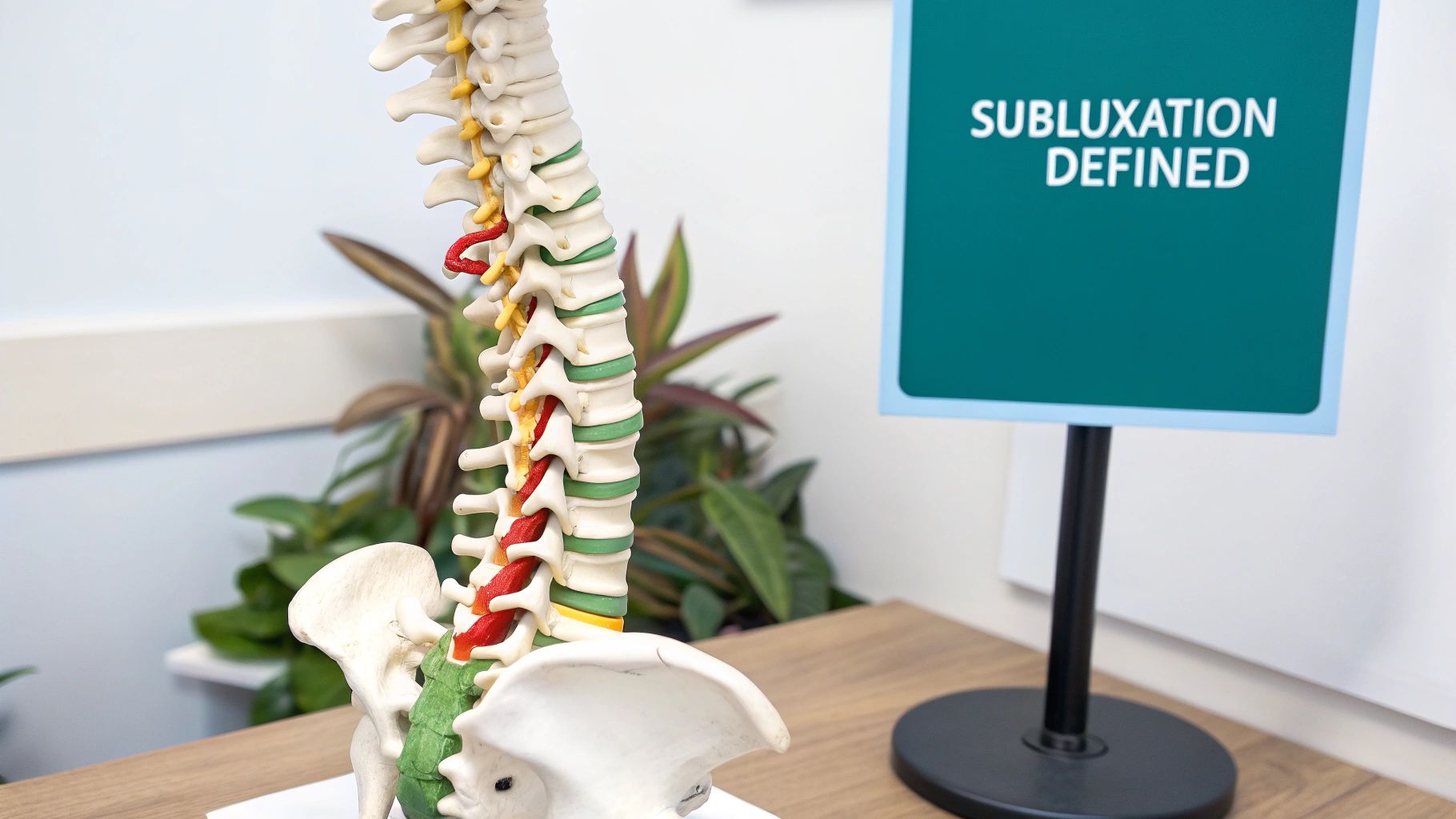
This whole setup has one primary job: protecting the most critical communication highway in your body, the spinal cord. This master cable runs right through the center of the vertebrae, with smaller nerves branching off at every level to control literally everything you do, from breathing to wiggling your toes.
When this intricate system is lined up correctly and moving smoothly, your body just works better. But a subluxation throws a wrench in the works. It’s what happens when one or more of these vertebrae get knocked out of their proper position, disrupting that delicate harmony and potentially interfering with nerve signals.
Spinal misalignments rarely just pop up overnight. They’re usually the slow-burn result of cumulative stress that wears down your body's ability to bounce back. In the world of chiropractic, these stressors are famously grouped into the "Three T's," giving us a straightforward way to understand where subluxations come from.
Traumas (Physical Stress): This is the one most people think of first. It includes the big stuff like car accidents, bad falls, or a rough tackle in a game. But far more often, it’s the sum of countless "micro-traumas"—small, nagging stresses that add up. Think about your posture while slouched at a desk all day, the repetitive motion of your job, or the now-infamous "tech neck" from staring down at your phone.
Thoughts (Emotional Stress): Your state of mind has a surprisingly direct impact on your physical body. When you're dealing with chronic stress, anxiety, or frustration, your body gets stuck in "fight or flight" mode. This makes your muscles, especially around your neck and back, clench up. Over time, that constant tension can literally pull your vertebrae out of place.
Toxins (Chemical Stress): This category covers all the biochemical stuff. A diet heavy on processed foods, sugar, and unhealthy fats can fuel systemic inflammation, which is terrible for joint health. Likewise, exposure to environmental pollutants or other chemicals puts stress on your body at a cellular level, messing with its ability to maintain its structure and heal properly.
The reality is, most subluxations aren't caused by one dramatic event you can point to. They're the result of the Three T's piling on top of each other in our day-to-day lives. This compounding effect is why so many people end up with chronic pain that seems to have appeared out of thin air.
Take the modern office worker, for example. They might spend eight hours a day sitting with less-than-ideal posture (Trauma), hunched over a laptop. At the same time, they're juggling tight deadlines and a high-pressure workload, which leads to constant mental strain (Thoughts).
A sedentary job combined with chronic work stress creates a powerful recipe for spinal subluxation. The physical strain of poor posture and the emotional strain of stress work together, pulling the spine out of alignment and leading to symptoms like neck pain, headaches, and low back stiffness.
These stressors feed off each other, creating a vicious cycle. The initial physical stress gets magnified by emotional tension, which in turn causes more muscle guarding and stiffness. Before you know it, your spine has adapted to this dysfunctional pattern, and the subluxation becomes a chronic problem.
This is why understanding what subluxations of the spine are means looking beyond a single injury. It’s about taking a hard look at the mix of physical, emotional, and chemical stressors in your life that are contributing to the problem. Once you identify and start addressing those root causes, you can finally get on the path to real, lasting relief.
Spinal subluxations rarely happen in silence. Your body is great at sending out warning signals, but they can be surprisingly diverse and easy to brush off or misinterpret. Learning to recognize these signs is the first real step toward fixing the root cause, rather than just chasing the symptoms.
The experience of a subluxation isn’t a one-size-fits-all problem. It shows up differently depending on where the misalignment is and which nerves are being affected. To make sense of it all, we can group these warning signs into three main categories.

This is where most people first notice something is wrong. When a spinal joint isn't moving the way it should, the immediate area usually lets you know about it.
These signs often feel like:
This localized discomfort is your body's most basic alarm system. It's signaling that the joint mechanics are off and inflammation is likely building up right at the source.
When a subluxation starts to irritate a nerve as it exits the spine, the symptoms don't stay put. Instead, they can travel along the entire path of that nerve, causing trouble far from the actual misalignment in your back.
Think of it like a malfunctioning traffic light at a major intersection; the backup doesn't just snarl that one spot but creates jams for miles. In the same way, a single subluxation can create a cascade of radiating symptoms. We actually break down how this nerve-related pain works in our guide on what is radiating pain.
Common examples of radiating symptoms include:
These radiating symptoms are clear signs that the issue has gone beyond just muscle or joint pain—it's become neurological. The communication highway between your brain and body is being disrupted.
This is perhaps the most overlooked category of all—systemic issues you'd never think to connect to your spine. Because the nervous system coordinates virtually every function in your body, interference can lead to some widespread problems. For instance, a misalignment in the upper neck can irritate nerves that influence blood flow to the head, often contributing to tension headaches or even migraines.
A subluxation is more than a spinal issue; it's a neurological issue. Nerve interference can disrupt functions throughout the body, leading to symptoms like digestive problems, dizziness, or chronic fatigue that may seem unrelated to your back.
This is also where the concept of the "silent subluxation" becomes so important. A spinal joint can be stuck and dysfunctional long before it actually starts producing obvious pain. You might not feel any discomfort at all, but the underlying nerve interference can still be quietly affecting your organ function, immune response, or energy levels.
This isn't just theory; it’s a well-documented clinical reality. For example, one significant study of patients with rheumatoid arthritis found that 44% had subluxations in their cervical spine. What's alarming is that many were asymptomatic—they felt no pain, yet these misalignments were actively compromising their spinal stability and nerve function. You can explore the complete findings of this important research on asymptomatic subluxations.
Recognizing these diverse warning signs—from a simple stiff neck to seemingly unrelated systemic issues—is key. They are all clues pointing toward an underlying problem in your spine that needs attention.
Figuring out the exact location of a spinal subluxation isn’t a guessing game. It’s a systematic process that combines a careful, hands-on examination with some pretty impressive technology. Before we can even think about addressing your symptoms, we need to build a complete picture of your health. This is how we ensure your care is safe, specific, and designed just for you.
It all starts with a detailed conversation. This isn't just a quick chat about your back pain. We’ll dive deep into your health history, talking about old injuries, the physical demands of your job, and even the emotional stresses that can cause muscles to tighten and pull your spine out of alignment.
Next comes the hands-on physical exam. I'll assess your posture, watch how you walk and move, and check the range of motion in your spine. This is where I can feel for areas of restricted movement, tenderness, or muscle imbalances that give us the first clues about where a subluxation might be hiding.
While a physical exam is absolutely essential, we pair it with objective data to see exactly what’s happening between each spinal joint. For this, we use the PulStar system, a computer-guided diagnostic tool that gives us an incredible level of precision.
Think of it like tapping gently along your spine with a highly sensitive instrument. The PulStar does just that, sending a soft mechanical impulse into each vertebra. The system then measures how that joint responds—whether it's moving freely like it should, or if it's "stuck" and rigid.
This gives us real-time, objective data that shows up on a screen as a graph of your spinal function. It pinpoints the exact location and severity of any restrictions without guesswork or radiation. Honestly, it’s a game-changer for getting the adjustment just right.
In some situations, we need a clearer look at your spinal structure, and that's when imaging like X-rays or MRIs becomes necessary. These tools help us rule out other potential problems, see the extent of any joint degeneration, and understand the full picture of what’s going on.
An MRI, for example, lets us see the discs, nerves, and soft tissues in stunning detail. It can confirm the impact a misalignment is having on surrounding structures, providing undeniable evidence of the physical changes tied to a vertebral subluxation.
What’s truly eye-opening is just how common these issues are. Research using MRI scans has revealed a stark reality: abnormalities consistent with vertebral subluxation components are present in 91% of cervical spines and 89% of lumbar scans. This data shows that spinal misalignments aren't a rare thing—they're a significant and widespread health concern. You can read more about the global burden of vertebral subluxation here.
By combining a detailed history, a thorough physical exam, and computer-guided analysis, we can confidently zero in on the root cause of your symptoms. To learn more about how this information guides the treatment itself, you might find our article on how chiropractors know where to adjust helpful. This level of precision is what allows for incredibly specific, gentle, and effective adjustments that restore function and help your body get back to healing itself.
Once we've pinpointed a spinal subluxation, the next step is building a treatment plan that fits you. The goal isn't just to mask the pain for a little while. It's about getting to the heart of the mechanical and neurological issues to restore your body's function and truly improve your quality of life. Modern, evidence-based care combines several advanced therapies that are gentle, precise, and highly effective.
A key part of this approach is Computer-Guided Adjustments using the FDA-cleared PulStar system. Forget the traditional "cracking" or manual twisting you might be picturing. This technology uses a handheld instrument to deliver a series of light, targeted impulses directly to the misaligned vertebra. The system’s computer gives real-time feedback, showing us exactly where the problem is and confirming when it's corrected. This makes for an incredibly safe and comfortable experience.
Sometimes, the problem goes deeper than a simple joint restriction, especially when spinal discs are involved. Conditions like bulging or herniated discs can cause that searing, radiating pain—think sciatica—because the disc itself is pushing on a sensitive nerve root.
For these situations, Spinal Decompression therapy is a game-changer. It's a non-surgical treatment where you lie on a specialized table that gently and rhythmically elongates your spine. This controlled stretching creates a negative pressure, almost like a vacuum, inside the disc.
This vacuum effect accomplishes two critical things:
By decompressing the spine, we can take the mechanical pressure off the nerves that are causing so much pain and dysfunction. It’s a foundational therapy for anyone suffering from sciatica or disc-related pain in their legs or arms.
To get you back to feeling your best, we often need to address the inflammation and nerve pain directly, beyond just adjusting the joints and decompressing the discs. This is where targeted, energy-based therapies can make a huge difference in speeding up your recovery.
Class IV Cold Laser Therapy is a non-invasive treatment that uses specific wavelengths of light to penetrate deep into injured tissues. This light energy gets your cells working harder to reduce inflammation, relieve pain, and accelerate repair. It’s fantastic for calming down irritated nerves and soothing sore muscles.
For that stubborn, nerve-related pain—the burning, tingling, or numbness of neuropathy—Horizontal Stimulation Therapy is another powerful tool. This therapy uses unique electrical frequencies to target and quiet down overactive or damaged nerve fibers, offering relief when other treatments might fall short.
A truly personalized plan will often combine these different therapies. For example, a single session might start with a precise PulStar adjustment to restore joint mobility, followed by spinal decompression to relieve pressure on a disc, and finish with cold laser therapy to tackle inflammation. If you want to understand more about the primary treatment, our guide explains in detail how chiropractic adjustments work.
This integrated strategy ensures we address every component of the subluxation—the misaligned bone, the pinched nerve, and the inflamed tissue. To support your progress, you might also want to explore these natural ways to support joint comfort and mobility as part of a holistic approach. When you combine professional care with smart self-care, you give your body the best possible chance to heal and thrive.

It's completely normal to have a lot of questions when you're dealing with spinal issues. Let's walk through some of the most common things patients ask when they first hear the term "spinal subluxation."
It's a nice thought, but unfortunately, it's rare. While a simple muscle ache might resolve with time, the actual joint misalignment of a subluxation usually needs a helping hand.
Your body is amazing at adapting and trying to work around the problem. But leaving the underlying mechanical issue unaddressed often leads to bigger problems down the road—think chronic pain, stubborn muscle imbalances, and nerve irritation that just won't quit.
This is probably the number one concern we hear, and the answer almost always surprises people: no, it shouldn't be painful. Gone are the days of forceful twisting and cracking.
Modern approaches, especially those using sophisticated instruments like the PulStar, are incredibly gentle. They use precise, light taps to encourage the joint back into its proper motion. Most patients find the process comfortable and often feel a sense of relief right away.
The entire point of an adjustment is to restore function and take pressure off the system. It's a therapeutic process designed to make you feel better, not worse.
That’s a great question. The easiest way to think about it is that a "pinched nerve" is the symptom, while a vertebral subluxation is often the cause.
When a spinal joint gets stuck or misaligned (the subluxation), it can directly irritate or put pressure on the nerve that passes nearby. That nerve interference is what creates the pain, tingling, or numbness we call a pinched nerve. By correcting the subluxation, we can give the nerve the space it needs to function properly again.
There's no one-size-fits-all answer here, as every person's body is different. How long it takes to see lasting results really depends on a few things:
Some people feel a world of difference after just a few visits. For others with more long-standing or complex issues, it might take a more structured course of care to build stability and achieve a true correction.
At Bonesetters Critical Chiropractic, our focus is on creating personalized plans that get to the root of your pain. If you're ready to move beyond temporary fixes and find a lasting solution, schedule your consultation and let's get you back on the road to health.