

For those living with vertigo, the world often feels like an unpredictable and unstable place. The sensation that the room is spinning while you are standing perfectly still is not just disorienting; it can be debilitating. Simple tasks like driving to the grocery store, focusing on a computer screen for work, or even walking down a hallway become significant challenges. This loss of balance often leads to anxiety and a shrinking of one's world, as the fear of an episode can keep sufferers homebound.
Many individuals turn to medication to manage these symptoms, often prescribed anti-nausea drugs or vestibular suppressants. While these pharmaceutical options can provide temporary relief from the nausea associated with dizziness, they often act as a band-aid rather than a cure. Medication rarely addresses the mechanical or neurological root causes of the dizziness, meaning the underlying issue remains unresolved even if the spinning sensation is momentarily dampened.
Fortunately, there is a natural path to stability that looks beyond symptom management. This post explores how finding vertigo chiropractor near me offers a non-invasive, drug-free solution for many vertigo sufferers.
The body maintains balance through a complex communication network involving the eyes, sensory nerves, and the inner ear, known as the vestibular system. Fluid-filled canals within the inner ear detect head movement and send signals to the brainstem to coordinate balance and eye position. When these signals are interrupted or scrambled, the brain receives conflicting information about where the body is in space, resulting in the false sensation of movement or spinning known as vertigo.
While many assume all vertigo originates in the ear, a specific type known as cervicogenic vertigo stems directly from issues in the neck. The cervical spine, particularly the upper region, is dense with proprioceptors—sensors that tell the brain where the head is positioned relative to the body. Misalignments in the upper spine can irritate the nerves leading to the ears and brainstem, sending faulty data that mimics inner ear problems and causes significant dizziness.
Distinguishing between the sources of dizziness is the first step toward relief. Conditions like Benign Paroxysmal Positional Vertigo (BPPV) are often triggered by specific head movements and last for short bursts, while Meniere's disease typically involves hearing loss and tinnitus alongside severe vertigo attacks.

Vertigo Chiropractic Care
The top two bones in the neck, the Atlas (C1) and the Axis (C2), are anatomically unique compared to the rest of the spine. They support the weight of the skull and allow for a wide range of head movement, but they are also the most freely movable and vulnerable vertebrae. Their location is critical because they sit directly adjacent to the brainstem, acting as a gateway for the spinal cord and crucial nerves that govern autonomic functions, including balance.
Because the Atlas and Axis are so mobile, they are susceptible to misalignment from injuries, poor posture, or accidents. Even a slight rotation or tilt in these vertebrae can put pressure on the brainstem or restrict proper blood flow to the head. This mechanical stress disrupts the neural pathways required for spatial awareness, confusing the brain and resulting in the sensation of spinning or unsteadiness.
It is common for vertigo patients to experience symptoms beyond just dizziness, such as cognitive fatigue or "brain fog." This occurs because the misalignment affecting balance is often impacting the same neurological pathways responsible for cognitive processing and concentration. When the brainstem is under stress from the upper cervical spine, mental clarity suffers, highlighting that the issue is deeply neurological rather than just a localized ear problem.
When searching for relief, it is important to understand that not all chiropractic care is the same. A general chiropractor typically focuses on mobilizing the entire spine to improve range of motion and reduce pain. However, an upper cervical specialist focuses specifically on the delicate craniocervical junction—the top of the neck—using precise protocols to correct misalignments that are too subtle for general manipulation but significant enough to cause vertigo.
Finding the right provider requires using specific language during an online search. Instead of just looking for a general chiropractor, patients should use terms like "upper cervical chiropractor," "NUCCA," or "Atlas Orthogonal" alongside phrases like "vertigo chiropractor nearby."
Since vertigo is primarily a neurological dysfunction involving the brain's interpretation of signals, the right clinic should emphasize neurology. Patients should look for provider websites that discuss the nervous system, brainstem function, and objective testing. A focus on restoring neurological integrity rather than just cracking bones suggests the practitioner understands the physiological root of vertigo.
At Bonesetters Critical Care Chiropractic, the approach to vertigo begins with high-tech diagnostics. The clinic utilizes advanced imaging techniques and comprehensive neurological assessments to identify the exact location and degree of spinal misalignment. This level of detail allows the doctors to pinpoint issues that general screenings might miss, offering answers to patients who have been told their tests are "normal" despite their symptoms.
Many vertigo sufferers are hesitant about chiropractic care due to a fear of aggressive twisting or popping of the neck. This clinic utilizes specialized instruments and techniques to deliver precise, low-force adjustments without any violent manipulation. This gentle approach is crucial for patients who are already suffering from severe dizziness and nausea, ensuring the treatment does not exacerbate their condition.
The ultimate goal of the care provided is to remove interference from the nervous system. By correcting the structural position of the upper neck, pressure is taken off the brainstem and nerves, allowing the body's natural equilibrium to return. This restoration offers hope for those who have exhausted other medical options, shifting the focus from symptom suppression to true physiological healing.
The diagnostic journey begins with a conversation that goes far beyond current symptoms. The doctor will ask detailed questions about past head traumas, car accidents (even minor fender benders), falls, or extensive dental work. These events, sometimes occurring years prior, are often the historical triggers for the structural shifts that eventually manifest as chronic vertigo.
To correct the spine with the necessary precision, standard X-rays are often insufficient. The process typically involves 3D imaging or precision upper cervical X-rays designed to visualize the exact three-dimensional angle of the Atlas misalignment. This data allows the doctor to calculate a vector for correction that is mathematically precise and tailored to the individual patient's anatomy.
Before any treatment begins, objective data on nervous system function is gathered. This involves specific assessments such as Romberg's test to evaluate balance, gait analysis to observe walking patterns, and thermal scanning to detect inflammation along the spine.
Patients looking for vertigo solutions often encounter the Epley maneuver. This is a common physical therapy technique primarily used for BPPV to move loose calcium crystals, known as canaliths, out of the semicircular canals of the inner ear. By moving the head through a series of specific positions, gravity helps guide these crystals back to a chamber where they no longer disturb the balance sensors.
While the Epley maneuver treats the inner ear directly, upper cervical chiropractic adjustments treat the nerve supply that regulates the ear and brain communication. If the issue is not loose crystals but rather nerve interference causing the ear to malfunction, the Epley maneuver will likely fail to provide lasting relief.
It is helpful to understand that if the Epley maneuver has been performed correctly but hasn't provided relief, the issue may likely be in the neck rather than the ear crystals. In some complex cases, a patient may suffer from both BPPV and cervicogenic vertigo, requiring a dual approach. However, for persistent, unexplained dizziness where physical therapy has failed, the upper cervical spine is often the overlooked culprit.
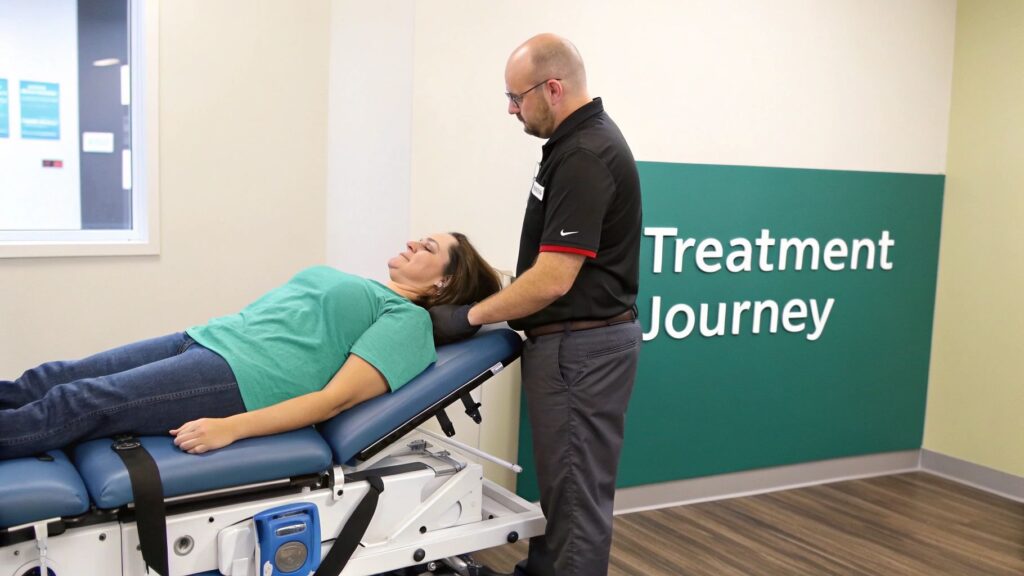
Vertigo Chiropractic Treatment
Managing the internal environment of the body can play a supportive role in reducing dizziness. Dehydration and high sodium intake can alter the fluid volume and pressure within the inner ear, potentially exacerbating symptoms of conditions like Meniere's disease.
There is a direct link between psychological stress, physical tension, and vertigo flare-ups. Stress causes the muscles of the neck and shoulders to tighten, which can pull on the cervical vertebrae and aggravate existing misalignments. Incorporating relaxation techniques such as deep breathing, meditation, or gentle stretching can help keep cervical muscles loose and reduce the frequency of episodes.
How one sits and sleeps has a profound impact on the stability of the upper neck. Maintaining a neutral neck position while working at computers—keeping the screen at eye level—prevents strain on the upper cervical spine known as "tech neck." Similarly, using a supportive pillow that keeps the spine aligned during sleep is essential for preventing the vertebrae from shifting back out of alignment overnight.
Recovery from chronic vertigo is rarely an instant fix, as the brain needs time to recalibrate. After a misalignment is corrected, the brain must relearn how to process the correct signals coming from the vestibular system. This period of neuroplasticity requires patience, as the body transitions from a state of compensation back to a state of true balance.
As the healing process begins, patients should be prepared for the phenomenon known as "retracing." As the nerves "wake up" after years of interference and the body undergoes structural changes, there may be temporary fluctuations in symptoms. This is not a sign of regression but rather an indication that the nervous system is actively reorganizing and healing old injuries.
The ultimate goal of upper cervical care is not just to stop the spinning for a day, but to achieve long-term stabilization. This means holding the alignment for extended periods so that the ligaments and muscles can strengthen in the correct position. Long-term success is measured by how long a patient can hold their adjustment, ensuring the vertigo does not return.
The connection between the upper neck and the body's balance system is profound. For many, the spinning sensations of vertigo are not caused by an inner ear infection or a permanent disease, but by a mechanical misalignment interfering with neurological signals. Specialized upper cervical chiropractic care offers a logical, non-invasive solution that addresses this root cause directly.
Persistent vertigo is not something anyone should have to simply "live with." If medication and standard therapies have failed to provide relief, investigating the cervical spine could be the missing link in recovery. Those suffering from dizziness are encouraged to schedule a consultation with a qualified upper cervical specialist to see if a misalignment is the source of their struggle.
Bonesetters: Critical Care Chiropractic Clinic
https://maps.app.goo.gl/ekdeZy1WhR7UTJNPA
15510 Olive Blvd, Chesterfield, MO 63017
(636) 735-3599
https://bonesetters.org/