
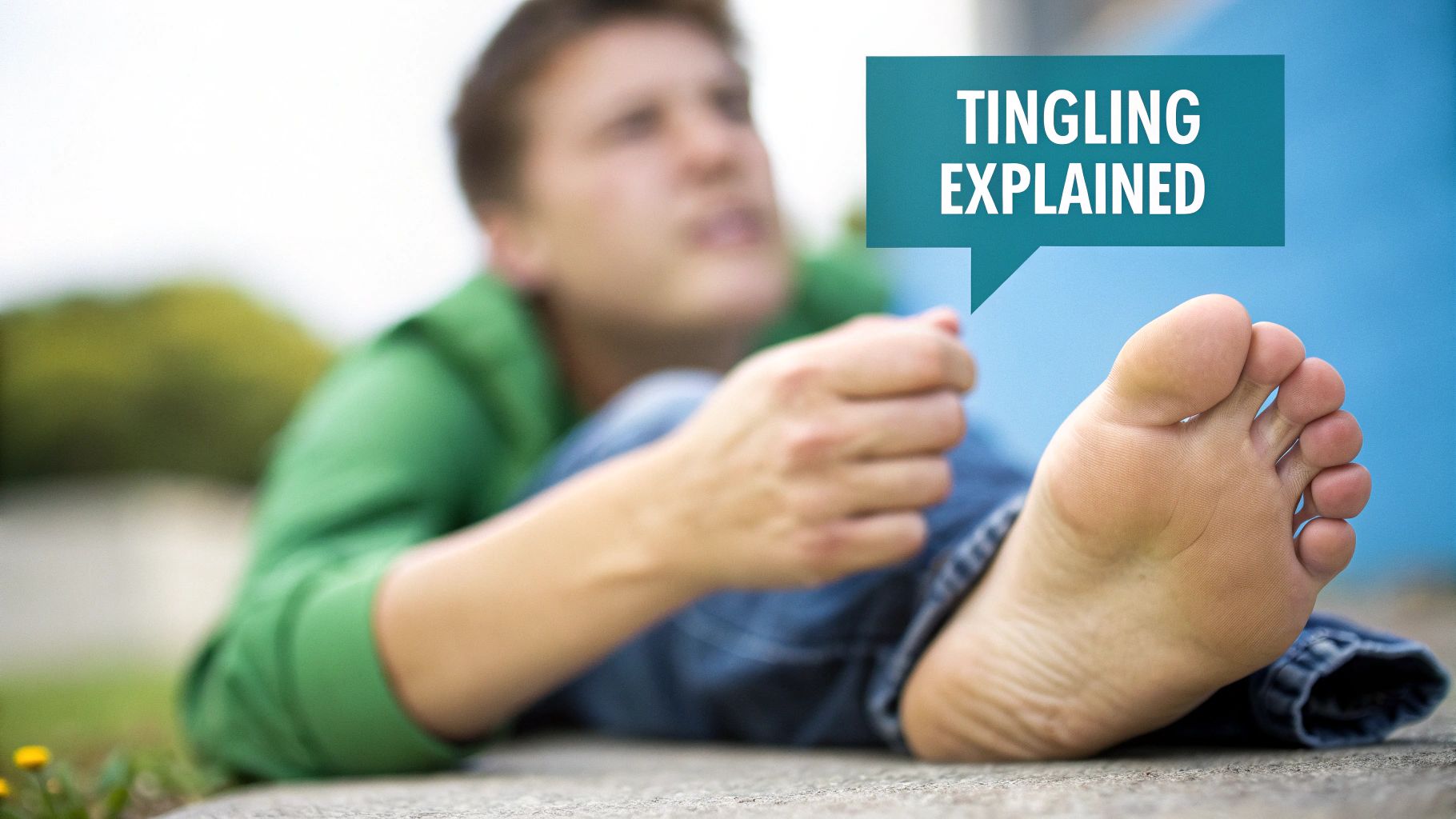
That "pins and needles" feeling you get in your hands and feet is often more than just a passing annoyance. Think of it as a direct message from your body's nervous system. The main reasons for tingling hands and feet causes boil down to nerve interference, whether it's from something simple like temporary pressure, actual nerve damage, or a lack of crucial nutrients. This sensation, known in the medical world as paresthesia, is a clear sign that nerve signals are getting mixed up somewhere along the line.
Imagine your nervous system is the body's complex electrical grid. Your nerves are the wires, faithfully carrying messages between your brain and your limbs. When you feel that tingling, it’s like there's static on the line, causing a distorted signal. Sometimes, the cause is obvious—you fell asleep on your arm and temporarily pinched a nerve, cutting off the signal.
But when that tingling sensation sticks around or keeps coming back, it’s often a clue that there’s a deeper issue affecting the peripheral nerves. These are the nerves that branch out from your brain and spinal cord to the rest of your body.
By far, the most frequent culprit behind persistent tingling is a condition called peripheral neuropathy. That’s a technical term, but it just means there's some kind of damage to those outer nerves. This damage messes with that communication highway, creating jumbled signals that your brain reads as tingling, numbness, or sometimes even a sharp, burning pain.
Peripheral neuropathy isn't one specific disease; it's more of an umbrella term that describes a symptom of many different health problems. And it's incredibly common. Epidemiological data reveals that about 2.4% of the world's population deals with some form of peripheral nerve disorder. That number jumps to roughly 8% for people over 60, showing just how prevalent it becomes as we age. You can dive deeper into these nerve disorder findings from the National Institutes of Health.
The specific way your tingling feels can actually offer some clues about what might be going on. Not all "pins and needles" are created equal, and paying attention to the details can be a huge help when you talk to a healthcare professional about your symptoms.
The table below gives a quick look at different types of tingling sensations and their potential implications, helping you better understand your symptoms.
| Sensation Type | Common Description | Potential Implication |
|---|---|---|
| Pins & Needles | Like a limb "falling asleep"; prickly and sharp. | Often related to temporary nerve compression or circulation issues. |
| Burning | A hot, sharp, or searing feeling, sometimes with tingling. | Frequently associated with nerve damage, like in diabetic neuropathy. |
| Numbness | A complete or partial loss of sensation. | Can indicate more significant nerve compression or damage. |
| Electric Zaps | Sudden, sharp, shock-like sensations. | May point to an irritated or "misfiring" nerve root. |
| Creepy-Crawly | A feeling like insects are crawling on or under the skin. | Sometimes linked to nerve irritation or certain metabolic conditions. |
Knowing these distinctions can make your conversation with a specialist much more productive, helping them narrow down the possibilities more quickly.
Tingling is your body's check-engine light for the nervous system. While it can be triggered by something minor, persistent tingling warrants a closer look to ensure the underlying "engine" is healthy and functioning correctly.
This guide is here to help you start decoding those signals. We'll walk through the common causes of tingling in the hands and feet—from body-wide conditions like diabetes to mechanical problems like pinched nerves—so you can better understand what your body is trying to tell you.
That nagging pins-and-needles sensation is more than just a passing annoyance. It’s a direct message from your body's complex nerve network, a kind of static on the line that tells you something is disrupting communication. To get to the bottom of what causes tingling in hands and feet, we have to play detective and investigate what's interfering with these delicate pathways.
The culprit could be anything from a body-wide health condition to a simple physical blockage. Let's walk through the most common reasons why your nerves might be sending these scrambled signals.
One of the most notorious causes of chronic tingling is diabetic peripheral neuropathy. This happens when persistently high blood sugar levels slowly poison your nerves, especially the longest ones that have to travel all the way to your hands and feet.
Think of your nerves as electrical wires coated in a protective plastic insulation. Over time, excess sugar in your bloodstream corrodes this insulation and damages the tiny blood vessels that feed the nerves oxygen and nutrients. Starved of this essential support, the nerves start to malfunction. They misfire, sending out confusing signals that your brain reads as tingling, burning, or numbness.
The connection between diabetes and nerve damage is incredibly strong. In fact, diabetes mellitus is a leading cause of tingling in the extremities, and its prevalence is on a steep rise. In 2019, an estimated 463 million people around the world had diabetes, a number expected to climb to 700 million by 2045. For a closer look at these statistics, you can find more information about the global impact of diabetes on pmc.ncbi.nlm.nih.gov. This makes managing blood sugar not just a daily task, but a critical mission for protecting your long-term nerve health.
Your nervous system is a high-performance machine, and just like any engine, it needs the right fuel to run properly. When you're running low on certain key vitamins, nerve damage and those all-too-familiar tingling sensations can be the direct result.
The undisputed MVP for nerve health is Vitamin B12. Your body absolutely needs it to create and maintain the myelin sheath—that protective nerve coating we just talked about. A B12 deficiency is like trying to run your body’s electrical grid with frayed, exposed wires. Signals get lost, distorted, or just short-circuit entirely.
A Vitamin B12 deficiency can be particularly sneaky. It often develops slowly over years, and tingling in the hands and feet is frequently one of the very first signs that your body’s nerve-insulating material is breaking down.
Other B vitamins, like B1 (thiamine) and B6 (pyridoxine), are also crucial. While a lack of B1 can trigger neuropathy, it's also worth noting that too much B6, usually from taking too many supplements, can actually be toxic to nerves and cause the very symptoms you're trying to avoid.
Sometimes, the problem isn't your body's chemistry but its physical mechanics. Nerves can get pinched, compressed, or trapped by the bones, muscles, and ligaments around them, which irritates them and messes up their signals. It's just like getting a kink in a garden hose—the flow of water (or in this case, nerve impulses) is choked off.
This kind of compression can happen in a few key spots:
These mechanical problems are often tied to repetitive movements, bad posture, or an old injury, but they all boil down to one thing: physical pressure is stopping a nerve from doing its job.
Your nerves don't exist in a vacuum; they depend on the rest of your body's systems to thrive. When those other systems are in trouble, your nerves are often the first to send out an SOS.
Poor circulation is a major culprit. Conditions like Peripheral Artery Disease (PAD) cause arteries to narrow, drastically cutting down blood flow to your limbs. Without a steady supply of oxygen-rich blood, nerves can't function correctly and start sending out distress signals as tingling and numbness. It’s like a town losing its power supply—things start shutting down fast.
On another front, some autoimmune disorders can cause the body to turn on itself. With conditions like lupus, rheumatoid arthritis, or Guillain-Barré syndrome, the immune system mistakenly attacks healthy tissues, including the nerves or their protective myelin sheath. This "friendly fire" causes inflammation and damage that scrambles nerve signals.
Finally, don't overlook your medicine cabinet. Certain medications, especially some used for chemotherapy, as well as specific antibiotics and blood pressure drugs, can cause nerve damage as a side effect. This is called drug-induced neuropathy. It's always a good idea to talk to your doctor about any new or worsening tingling, as it could be linked to a prescription.
By pinpointing the true root cause—whether it’s metabolic, nutritional, mechanical, or something else—you and your doctor can build a smart, targeted plan to silence the static and get your nervous system communicating clearly again.
Figuring out what’s causing that tingling in your hands and feet is a bit like being a detective. Your doctor's first job is to gather all the clues from your body and health history to solve the mystery. It’s a step-by-step process designed to zero in on why your nerves are sending those confusing "pins and needles" signals. Knowing what to expect can make the whole experience much less stressful.
It all starts with a simple conversation. Seriously. Your doctor will want to know the whole story—when the tingling began, what it actually feels like (is it more of a burn, a buzz, or outright numbness?), and what makes it better or worse. This chat is followed by a hands-on neurological exam.
During the exam, they’ll check things like your reflexes, muscle strength, balance, and how you respond to different sensations, like a light touch or a vibration from a tuning fork. This physical map helps them narrow down which nerves might be misfiring and how significant the issue is.
Sometimes, the initial exam points in a few different directions. That’s when your doctor will need more concrete data to confirm what’s going on. Think of it like a mechanic who, after listening to an engine, needs to plug in the diagnostic computer to get the full story.
The most common first step is a set of blood tests. A simple blood draw can tell us a surprising amount about the potential causes of your tingling hands and feet, checking for things like:
This infographic breaks down how some of the most common culprits are found.

As you can see, ruling out systemic issues like high blood sugar or nutrient gaps is often the first, and most crucial, move before we start looking for a physical pinch or blockage.
What if the blood work comes back normal, but the tingling persists? If we suspect a specific nerve is being compressed or damaged, we’ll move on to tests that measure your nerve function directly. These are designed to check the health of your body's "electrical circuits."
Electromyography (EMG) and Nerve Conduction Studies (NCS) are two tests that work as a team. The NCS tests how fast and strong electrical signals travel down your nerves, while the EMG listens to the electrical activity in your muscles to see if they're getting the message.
Here’s an easy way to think about it: The NCS is like an internet speed test for your nerves, flagging any slowdowns or outages. The EMG then checks if the device connected to the internet—your muscle—is working correctly. These tests are the gold standard for diagnosing conditions like carpal tunnel syndrome, peripheral neuropathy, or radiculopathy (a pinched nerve in the spine).
Finally, if we think a structural issue is the culprit—like a bulging disc pressing on a nerve—we’ll turn to imaging. An MRI gives us a crystal-clear picture of your spine and soft tissues, revealing any physical blockage that’s causing trouble.
To help you feel prepared, here’s a quick overview of what the diagnostic journey usually looks like.
| Diagnostic Step | What It Involves | What It Helps Uncover |
|---|---|---|
| Medical History & Symptom Review | A detailed conversation with your doctor about your symptoms, lifestyle, and medical background. | Patterns, triggers, and potential risk factors (e.g., diet, family history, recent injuries). |
| Neurological Exam | Physical tests of your reflexes, muscle strength, balance, and sensation. | Which nerve pathways are affected and the severity of the nerve dysfunction. |
| Blood Tests | A simple blood draw to analyze various health markers in a lab. | Systemic causes like diabetes, vitamin B12 deficiency, thyroid issues, or autoimmune markers. |
| EMG / Nerve Conduction Studies | Mild electrical pulses are used to measure nerve signal speed and muscle response. | The exact location and extent of nerve damage or compression (e.g., carpal tunnel, neuropathy). |
| Imaging (MRI/CT Scan) | Lying in a machine that uses magnets or X-rays to create detailed images of your body. | Structural problems like herniated discs, spinal stenosis, or tumors pressing on nerves. |
By combining these methods, your doctor can move from a long list of possibilities to a precise diagnosis, which is the first and most important step toward finding effective, lasting relief.
Most of the time, that pins-and-needles sensation is your body’s way of signaling a chronic, slow-burning issue. But every so often, it’s a full-blown emergency alarm. It's absolutely vital to know how to tell the difference.
Think of it this way: some nerve sensations are like a low-battery warning, but others are like a smoke detector blaring. Ignoring the alarm can have devastating consequences, as it could point to a medical emergency like a stroke or severe nerve compression where every second matters.
If tingling or numbness hits you out of the blue and brings along any of the following friends, it’s time to call 911 or get to the nearest emergency room. Don't wait.
These are the specific signs that demand immediate medical attention:
When these symptoms appear together and suddenly, it often means blood flow to the brain or spinal cord has been dangerously interrupted. In these situations, every minute counts. Getting help fast can dramatically change the outcome and prevent permanent damage.
While it's important to understand the many chronic tingling hands and feet causes, knowing these emergency signs gives you the power to act when it matters most.
Once we’ve figured out why you're experiencing that tingling in your hands and feet, we can build a plan to get you relief. The good news is that many of the most effective strategies don’t involve surgery. Instead, we focus on healing the underlying nerve problem by reducing pressure, calming inflammation, and giving your nerves the support they need to start repairing themselves.
Think of a nerve like a garden hose with a heavy stone sitting on it. The water (nerve signal) can't get through properly. You can try to turn up the faucet, but that won't fix the real issue. The goal of these treatments is to gently lift that stone off the hose, allowing everything to flow freely again.
If the tingling stems from a physical problem like a herniated disc or spinal stenosis, the nerve is literally being squeezed. For this, Spinal Decompression Therapy is an incredibly precise and gentle solution. It uses a highly specialized table that applies a subtle, computer-controlled pulling force to your spine.
This slow and steady action carefully separates the vertebrae, creating a small vacuum inside the discs. This effect can help pull bulging or herniated disc material back where it belongs, taking direct pressure off the nerve roots that lead down to your arms, hands, legs, and feet. For many people, this brings almost immediate relief from the tingling, numbness, and pain. To get a better sense of the process, you can read more about decompression of the cervical spine and see how it works.
Simply put, spinal decompression creates breathing room for your nerves. By gently increasing the space between your bones, we can stop the constant irritation that’s scrambling your nerve signals.
This approach is a game-changer for people dealing with:
Taking the pressure off is step one. Step two is actively healing the nerve tissue at a cellular level. Several therapies are designed to reduce inflammation and give your cells the energy they need to regenerate—a critical step in reversing nerve damage from conditions like peripheral neuropathy.
One of our most powerful tools is Class IV Laser Therapy. This isn't a cutting laser; it’s a therapeutic one that uses specific wavelengths of light to penetrate deep into your tissues without breaking the skin. Your cells absorb this light energy, which kick-starts their internal engines. This process ramps up blood flow, dials down inflammation, and boosts metabolic activity, helping damaged nerves heal much faster. The result is often a significant drop in those frustrating tingling and burning sensations.
We also have other specialized tools to support nerve recovery:
No therapy in the world can work effectively if your body is missing the raw materials it needs to heal itself. That’s why Nutritional Counseling is the bedrock of any successful nerve-health plan, especially when the tingling is tied to a deficiency or a metabolic issue like diabetes.
A smart nutritional plan can correct key shortfalls, like a lack of Vitamin B12, which is absolutely essential for maintaining the protective coating around your nerves. We also focus on building an anti-inflammatory diet to quiet down the systemic irritation that makes neuropathy so much worse. When you give your body the right building blocks, you create an internal environment that actively supports nerve repair. This combination of mechanical relief, cellular healing, and smart nutrition is what truly offers a path toward lasting freedom from tingling hands and feet.

While getting a professional diagnosis is non-negotiable, you have more power than you think when it comes to managing those frustrating tingling sensations. Simple, consistent daily habits go a long way in supporting your nerve health, boosting circulation, and calming the irritation that causes pins and needles.
Think of these at-home strategies as your first line of defense. They work hand-in-hand with any clinical care you receive, giving you a sense of control and providing real, tangible relief.
It’s easy to overlook, but your workspace and posture can be sneaky culprits behind nerve compression. If you spend your days at a desk, repetitive strain and awkward angles are often the root cause of tingling.
Take a hard look at your setup. Is your keyboard positioned so your wrists can stay straight? Does your chair actually support your lower back? These small adjustments matter. But even the perfect setup isn't enough without regular movement.
Getting up frequently to walk and stretch is critical. You can also incorporate simple movements right at your desk to keep blood flowing to your hands and feet:
These little actions break up the stagnation that aggravates nerve symptoms. If your issues trace back to your lower back, like sciatica, specific stretches can be a game-changer. We have a full guide on how to relieve sciatica pain naturally with targeted routines.
The food on your plate provides the literal building blocks for nerve function and repair. A diet packed with the right nutrients can help protect the delicate myelin sheath—the insulation for your nerves.
Try to fill your diet with foods rich in B vitamins, antioxidants, and omega-3 fatty acids.
Your diet is one of the most powerful tools you have for managing inflammation and supporting your nervous system from the inside out. Every meal is a chance to provide the nutrients your nerves need to thrive.
Great options include leafy greens like spinach, lean proteins like salmon and chicken, plus nuts, seeds, and avocados. If you're dealing with or at risk for diabetes, keeping your blood sugar stable through a balanced diet is the single most important thing you can do to prevent neuropathy. It’s also wise to limit alcohol, as too much is directly toxic to nerve tissue.
It's completely normal to have questions when your body starts sending strange signals like tingling in your hands and feet. Let's walk through some of the most common concerns to help you make sense of what you might be experiencing.
Yes, it absolutely can. Think of anxiety as your body's alarm system—the "fight or flight" response. When that alarm gets pulled, your breathing can become shallow and quick, a process called hyperventilation.
This change in breathing messes with the oxygen and carbon dioxide levels in your blood, causing blood vessels to tighten up. That constriction reduces blood flow to your extremities, and voilà—you get that pins-and-needles sensation. It’s a very real physical symptom that can pop up during a panic attack or linger with chronic anxiety.
Most of the time, yes. If you’ve ever woken up with a “dead arm,” you know the feeling. Sleeping in an awkward position can easily compress a nerve, temporarily cutting off its communication and blood supply. The tingling you feel is the nerve "waking back up" once you move.
But if this becomes a nightly ritual, or if the tingling is paired with weakness, it's worth a closer look. Conditions like carpal tunnel syndrome often flare up at night, so persistent morning tingling is a classic sign that shouldn't be ignored.
You should definitely book an appointment if the tingling isn't just a brief annoyance but has become persistent, seems to be getting worse, or brings along other troubling symptoms. Be on the lookout for red flags like:
A little tingling now and then is usually nothing to worry about. But when it sticks around, your body is telling you something is consistently irritating your nervous system. Getting a proper evaluation is the only way to figure out what's really going on and find the right path forward.
By getting a diagnosis, you can stop worrying and start doing something about the root cause. It's the most important step you can take to protect your nerve health and get back to feeling normal.
At Bonesetters Critical Chiropractic, we focus on getting to the bottom of nerve-related symptoms and treating them without surgery. If you're ready to find lasting relief from tingling, numbness, or burning, learn more about our patient-focused approach at https://bonesetters.org.