
Hearing the word "spondylolisthesis" for the first time can be a bit jarring. If you've just received this diagnosis, let's break down what it actually means. In simple terms, it's a condition where one of the bones in your spine—a vertebra—slips forward over the one directly below it. This can throw your spine's natural alignment out of whack. While it sounds serious, spondylolisthesis chiropractic care provides a safe, gentle, and non-surgical way to manage the pain and get you moving comfortably again.
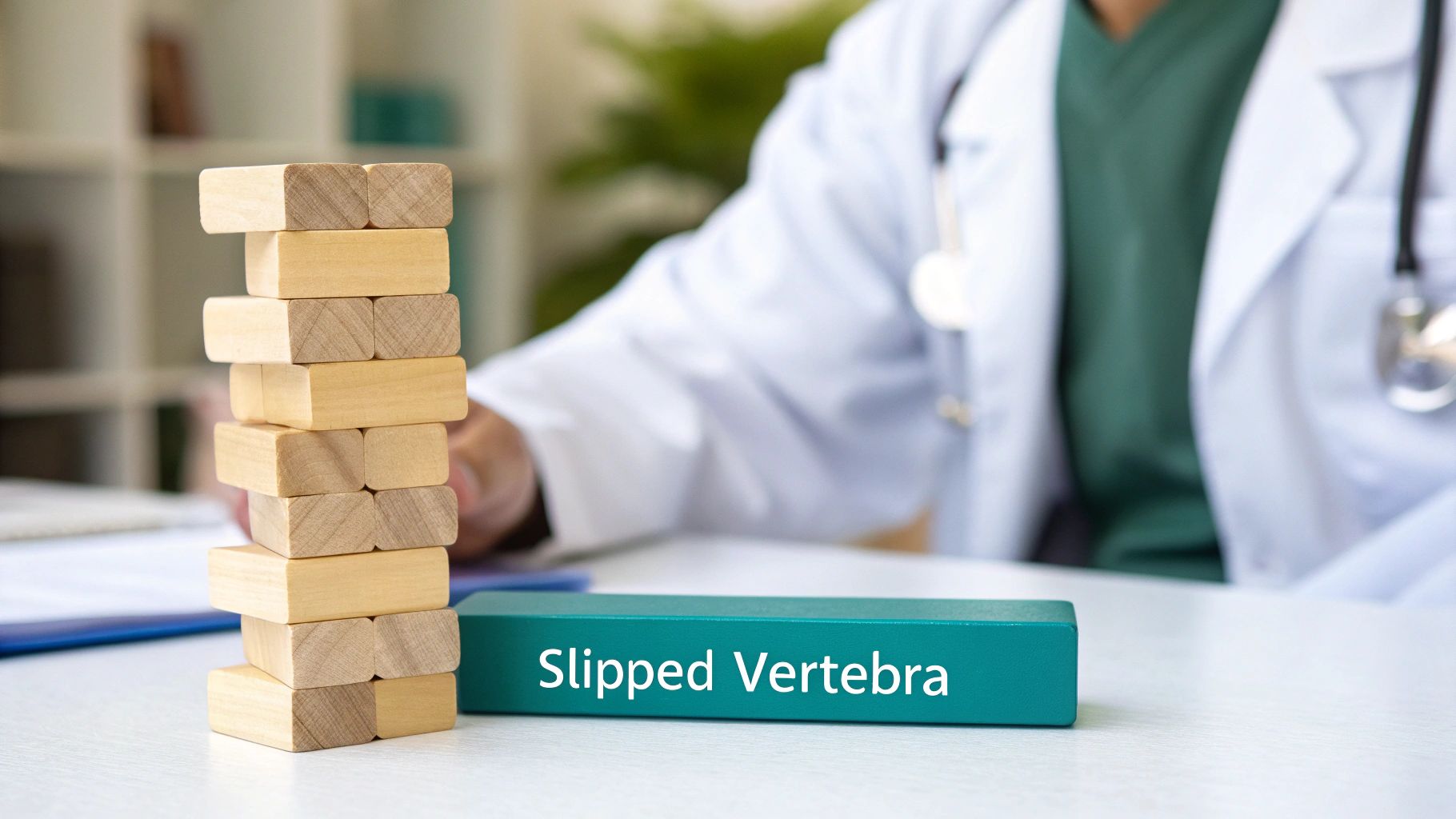
Think of your spine as a neat stack of building blocks. Each vertebra should sit perfectly balanced on the one beneath it. Spondylolisthesis is what happens when one of those blocks slides forward, making the whole structure unstable. This slippage is most common in the lower back, or lumbar spine, particularly at the L5 vertebra, which is the very last one before your sacrum.
This forward shift isn't just a simple alignment problem; it triggers a domino effect. The displaced vertebra can start to crowd the spinal canal, pinching the delicate nerves that branch out to the rest of your body. It's this nerve pressure that is often the real culprit behind the nagging lower back pain, sciatica-like leg pain, or that frustrating numbness and tingling you might be feeling.
To get a clear picture of what's going on, doctors classify spondylolisthesis using a grading system. This simply measures how far the vertebra has slipped forward. Knowing the grade helps us tailor the perfect treatment plan for your specific situation.
The good news? The vast majority of people have a Grade 1 or 2 slip. These cases almost always respond beautifully to conservative, non-surgical approaches like the specialized chiropractic care we offer here.
It's important to know that our goal isn't to physically shove the slipped vertebra back into place. Instead, chiropractic care focuses on restoring healthy movement to the surrounding spinal joints, taking pressure off the nerves, and calming the inflammation caused by the instability.
Spondylolisthesis can happen for a few different reasons, from something you're born with to an injury from overuse. The two most common types we see are isthmic and degenerative.
Isthmic spondylolisthesis usually shows up in younger people, especially athletes. Think of gymnasts or football linemen who repeatedly arch their backs. All that stress can cause a tiny fracture in a specific part of the vertebra (the pars interarticularis), which creates the instability that allows it to slip forward.
On the other hand, degenerative spondylolisthesis is more of an age-related issue. Over the years, the discs that cushion our spine can thin out, and the joints that guide spinal motion can get worn down by arthritis. This natural wear and tear can weaken the spine's support system, letting a vertebra slip forward even without a fracture.
No matter what caused it, the instability and nerve pressure are what create the symptoms. By getting to the root of these issues with gentle, targeted therapies, spondylolisthesis chiropractic care can help your body heal, dial down the pain, and get you back to living your life.
Getting an accurate diagnosis is the most important first step toward getting relief. Think of it like a map for a road trip—without one, you’re just guessing which way to go. Your journey to feeling better starts with a deep-dive evaluation to connect the dots between your symptoms and what’s really going on with your spine.
Your first visit with us is all about you. We'll sit down and talk through your medical history and daily life—what makes the pain flare up, and what, if anything, brings you a bit of relief. From there, we’ll move into a detailed physical and neurological exam to check your posture, range of motion, muscle strength, and reflexes.
This hands-on evaluation helps us see how the slipped vertebra is affecting your body's mechanics. We're looking for the classic signs that often point directly to spondylolisthesis, such as:
This process gives us a strong working theory. But to be certain, we need to see what's happening on the inside.
To truly understand the specifics of your condition, we rely on imaging like X-rays or MRIs. These tools give us the undeniable proof we need to build a safe and effective chiropractic care plan for your spondylolisthesis. X-rays are the gold standard for confirming the diagnosis and, crucially, for determining the grade of the vertebral slip.
An MRI can give us an even clearer picture, showing if the slipped bone is pinching nerves or putting pressure on the surrounding discs and soft tissues. This is vital. It helps us see not just that you have a slip, but how it's causing your unique set of symptoms.
A precise diagnosis does more than just give your pain a name. It pinpoints the exact location and severity of the instability, ensuring every therapy we use is targeted, gentle, and designed to support your body's healing—not make the problem worse.
This understanding is powerful. When you can see on your own X-ray how that Grade 2 slip is directly causing the sciatica you feel every time you stand up, the treatment plan suddenly makes complete sense. We stop chasing symptoms and start correcting the root mechanical issue.
This diagnostic precision is the key to our targeted care plans. In fact, specific chiropractic protocols have shown incredible potential for structural improvement. One study documented how a patient's Grade II vertebral slip, measuring 13.3 mm, was reduced to just 2.4 mm—that’s an 82% reduction—over the course of care. This wasn't a temporary fix; it was a measurable, structural change. You can read the research to see just how much chiropractic biophysics can influence spinal alignment.
A lot of people think that a chiropractor's job with spondylolisthesis is to just shove that slipped vertebra back into place. It’s an understandable assumption, but it’s not how we work at all. Our approach is much more sophisticated and gentle, aimed at fixing the real problem: the instability and pain that the slippage is causing.
Instead of trying to force a bone back into alignment, our goal is to restore stability and healthy function to the entire area. Think of it this way: when one gear in a machine is out of whack, it puts stress on all the surrounding parts. We work to fix the resulting instability, take the pressure off pinched nerves, and calm down inflammation. This creates the best possible environment for your body to start healing itself.
Our focus is on improving the way the joints above and below the slipped vertebra are moving. By getting those areas working properly again, we can take the load off the unstable segment. This naturally helps tight muscles relax, reduces inflammation, and gives those irritated nerves some much-needed breathing room.
The cornerstone of our care is gentle, precise adjustments. Forget about any aggressive "cracking" you might have seen on YouTube. These are careful movements designed to improve how your vertebrae and discs handle daily stress and movement, with safety and stability as the top priorities.
Here’s how we do it:
The core idea is simple: A stable spine that functions well is a spine that doesn't hurt. We don't chase the slipped vertebra; we build a stronger, more supportive system around it.
You can't fix a complex problem like spondylolisthesis with just one tool. That's why we use a "multimodal" approach, which is just a way of saying we combine several different therapies that work together to tackle your pain, inflammation, and instability from multiple angles.
For example, one therapy might focus on calming inflammation while another works on strengthening the muscles that support your spine. This integrated strategy is backed by research showing it delivers better results for people with vertebral slippage. In one case study, a patient with a slipped vertebra in the neck found complete relief after a three-month plan combining gentle manipulation, traction, and specific exercises. You can read more about the research behind multimodal chiropractic care at the Journal of the Canadian Chiropractic Association.
By never using a direct, high-force push on the unstable vertebra, we keep the treatment both safe and effective. Frankly, trying to force an unstable bone is risky and just doesn't work. Our gentle methods respect your spine's condition while guiding it back to health. We dive deeper into the science of this in our article on how chiropractic adjustments work.
This focus on stability and function helps many of our patients get back to their lives without needing surgery. By addressing the root mechanical problems, we empower your body to manage the condition on its own, leading to real, lasting pain relief. It’s all about building strength and resilience from the inside out.
When you're dealing with a slippage in the spine, a one-size-fits-all approach just won't cut it. To get real, lasting relief from spondylolisthesis, we go beyond standard adjustments. We bring in a team of specialized therapies that work together to calm your pain, reduce inflammation, and, most importantly, build genuine stability where your spine needs it most.
Think of it like fixing the foundation of a house. You need more than just a hammer. You need specific tools for specific jobs, all working in concert to make the structure solid again. That's exactly how we approach your care.
The diagram below shows how everything we do—from relieving pain to calming nerves—is all in service of one primary goal: making your spine stable and strong for the long haul.
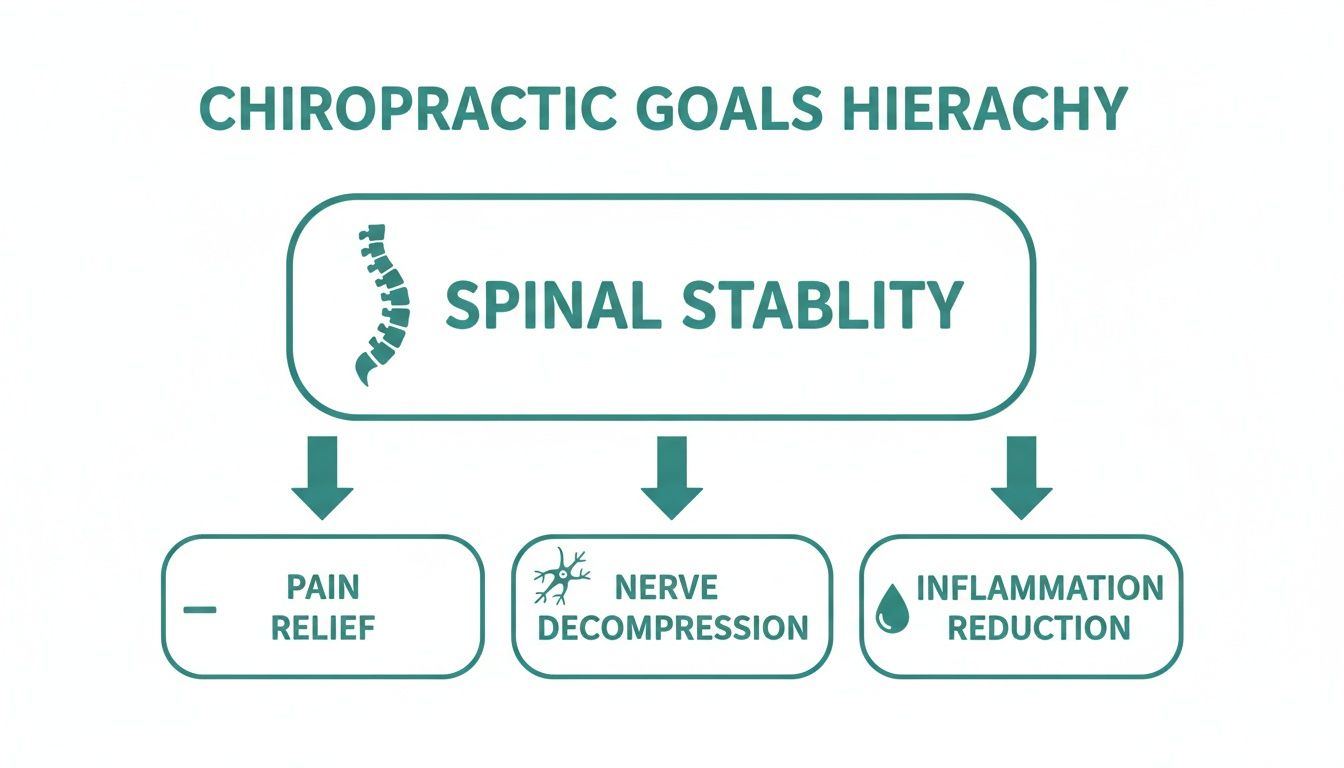
While getting you out of pain is always a top priority, our real focus is on rebuilding the underlying stability so the pain doesn't come back.
To give you a clearer picture of our toolkit, here’s a quick overview of the advanced, non-surgical treatments we rely on to help our patients with spondylolisthesis.
| Treatment Modality | How It Works | Primary Benefit for Spondylolisthesis |
|---|---|---|
| Spinal Decompression | Creates gentle, negative pressure in the spine to draw in healing nutrients and take pressure off nerves. | Decompresses pinched nerves causing sciatica and leg pain without any forceful movements on the unstable area. |
| PulStar Adjustments | Uses computer analysis to deliver precise, low-force impulses to dysfunctional joints around the slip. | Safely restores motion to the surrounding spinal segments without directly adjusting the unstable vertebra. |
| Class IV Laser Therapy | Uses specific light wavelengths to penetrate deep into tissue, stimulating cellular repair and reducing inflammation. | Accelerates the healing of damaged ligaments and muscles while providing powerful, natural pain relief. |
| Horizontal Stimulation | An advanced form of electrical muscle stimulation that retrains and strengthens deep core stabilizing muscles. | Rebuilds the "natural brace" around your spine, providing better support and reducing daily stress on the slipped bone. |
Each of these therapies offers a unique benefit, and when combined, they create a powerful healing effect that addresses spondylolisthesis from every angle. Let's dig a little deeper into how each one helps you.
One of our most effective tools is non-surgical spinal decompression. This therapy gently elongates your spine, creating a subtle vacuum effect inside the discs. This is huge, as it helps pull nutrients, oxygen, and water back into the disc to promote healing.
More importantly for spondylolisthesis sufferers, it creates more space for the nerves that are being pinched, which is often the source of that debilitating sciatica and leg pain. It provides relief without any twisting or popping. If you want to learn more about how this works, take a look at our detailed guide on the spinal decompression chair.
With a condition based on instability, precision is absolutely critical. This is why we use the PulStar system. It’s an FDA-cleared technology that lets us perform incredibly precise and gentle adjustments without any of the traditional twisting.
The PulStar uses a computer to analyze how each joint in your spine is moving (or not moving) and then delivers tiny, targeted impulses to restore healthy function.
This is the key: we can improve the mechanics of the vertebrae above and below the slip without ever having to apply a direct, forceful thrust to the unstable segment itself. It’s a smarter, safer, and far more comfortable approach for this specific condition.
This precision is a non-negotiable part of our protocol for spondylolisthesis. It ensures we're helping, not harming.
Inflammation is a huge driver of pain and a major roadblock to healing. To combat this, we use Class IV Laser Therapy. This isn't a scary surgical laser; it's a "cold laser" that uses specific wavelengths of light to penetrate deep into the muscles and ligaments of your lower back.
This light energy gives your cells a major boost, kicking your body’s own healing mechanisms into a higher gear. The benefits are threefold:
This therapy is completely painless and works on a cellular level to create the ideal environment for healing to happen.
Finally, a stable spine demands strong, well-coordinated muscles. The problem is, pain from spondylolisthesis often causes the deep core muscles—the ones that act like a natural weightlifting belt for your spine—to shut down.
Horizontal Stimulation Therapy is an advanced electrical stimulation designed to wake these muscles back up. It helps re-educate them, improving their strength and endurance so they can do their job properly. A stronger core provides much-needed support for the unstable vertebra, taking the strain off your joints and helping to prevent future flare-ups.
Starting any new treatment can feel a little daunting, but knowing what's ahead can make all the difference. Your recovery from spondylolisthesis isn't just a single fix; it's a journey we'll take together through distinct, logical phases. Each step builds on the last, carefully guiding you from immediate relief to long-term spinal health.
A good way to think about it is like rehabbing a sprained ankle. Your first priority is to get the swelling down and stop the throbbing. Next, you slowly work on getting your flexibility and strength back. Finally, you learn exercises to keep it strong and prevent it from happening again. We follow that same common-sense path for your spine.
Our first job is simple: get you out of pain. In this initial phase, all our attention is on calming down the inflammation and taking the pressure off the nerves that are causing your worst symptoms, like that nagging low back pain or sciatica shooting down your leg.
We'll use gentle treatments designed to soothe the area and give your nerves some breathing room. The goal here is to make you comfortable enough for your body to switch into healing mode. Most of our patients start feeling a real difference in their pain within the first few weeks.
Once the fire is out, we can start rebuilding the foundation. This is the corrective phase, where we get to the root of the problem. We’ll work on improving how your spine moves, restoring healthier function to the joints around the slipped vertebra, and, most importantly, strengthening the deep core muscles that act like a natural brace for your back.
This is where you'll be most active in your care. It's a mix of precise, gentle adjustments and specific therapies aimed at building real strength and resilience. Sticking with your appointments and doing your part is key here—we are essentially teaching your body how to support itself in a stronger, more stable way.
True healing goes beyond just feeling better; it’s about getting better. While pain relief is the first step, our ultimate objective is to achieve lasting structural improvement and functional stability, helping you avoid future flare-ups.
After all the hard work, the final phase is about protecting your investment in your health. You can think of this as preventative maintenance for your spine. Your visits will become less frequent as we shift our focus to keeping your spine healthy and reinforcing all the great progress you've made.
This stage is all about empowering you to stay well for the long haul. And the results speak for themselves. Clinical data shows that this approach works, with studies revealing that about 95% of spondylolisthesis patients see the most improvement they’re going to get within 90 days of starting care.
In fact, a huge analysis of over 1,000 cases found the average time to hit that peak improvement was just 29 days, over about 12 visits. You can dive deeper into these chiropractic care findings on spondylolisthesis to see the research for yourself.
While the advanced therapies you get in our office are a huge piece of the puzzle, what you do between appointments is just as important. Lasting spinal stability isn't built in an hour-long session; it's forged through consistent, daily habits. By making a few smart lifestyle tweaks and committing to the right exercises, you become an active partner in your own healing.
Think of it this way: our in-office treatments are like getting a professional tune-up for the mast of a ship. But the exercises and daily habits? That’s you, strengthening the rigging that holds the mast steady through the storms of everyday life. Combining professional care with your personal effort is where the real magic happens.
A huge part of managing spondylolisthesis is simply learning what not to do. Certain movements can put way too much stress on that unstable vertebra, triggering pain and setting back your progress.
Key Activities to Modify or Avoid:
Beyond movement, simple ergonomic tools can make a world of difference. For instance, using a quality Icare Reform lumbar support in your car or office chair helps maintain a healthy spinal curve, reducing strain while you sit. It's an easy way to turn hours of passive sitting into active support for your back.
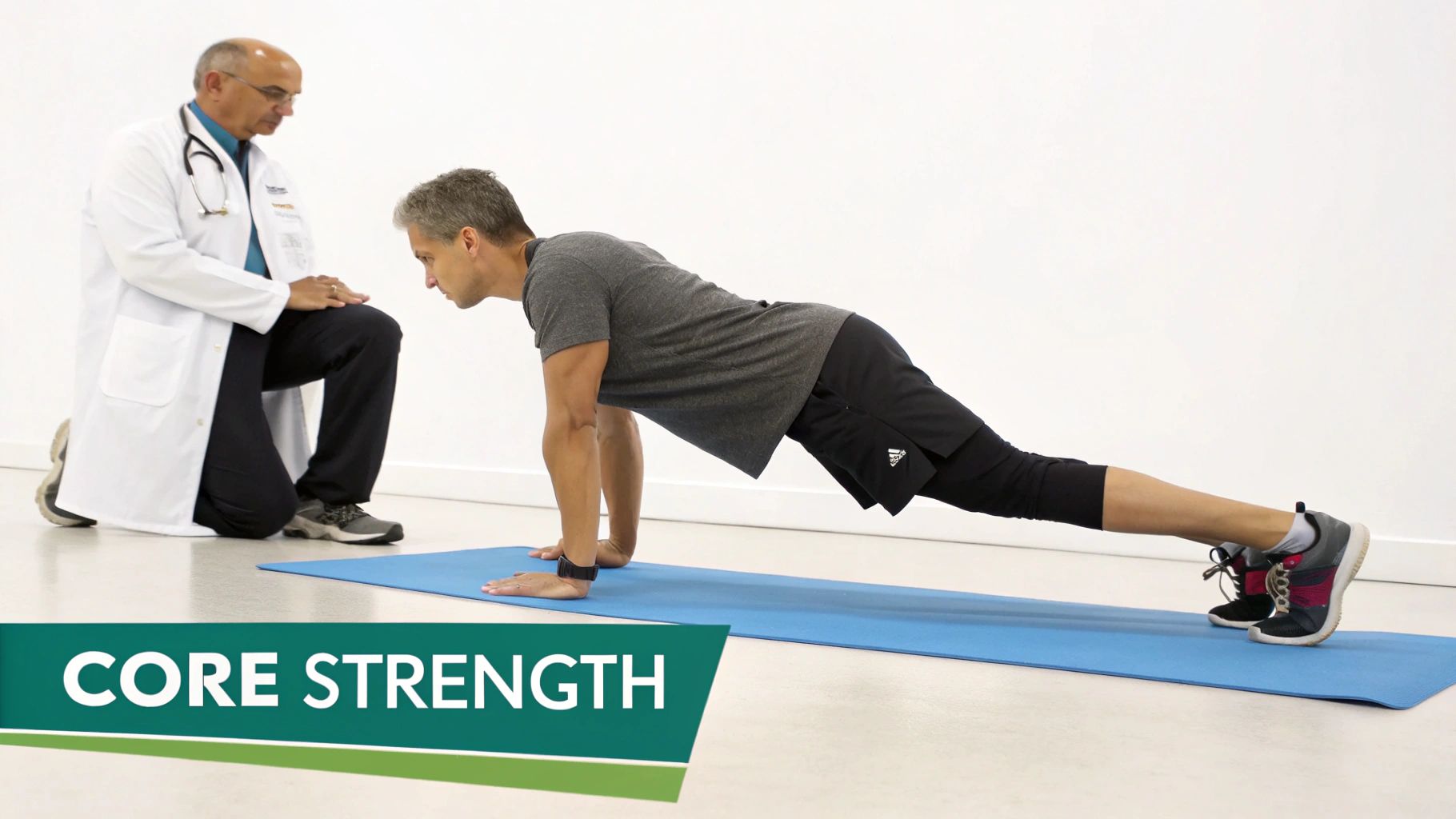
Strengthening the muscles that surround your spine is absolutely non-negotiable for long-term stability. A strong core acts like a natural corset, bracing your spine and taking pressure off the affected area. But—and this is a big but—not all core exercises are safe for spondylolisthesis.
The goal is to build strength without arching or stressing the lower back. We focus on exercises that promote a "neutral" spine—the position where your back is at its strongest and most stable.
Here are a few foundational exercises we often start our patients with. The key is to move slowly and with control. If you feel any sharp pain, stop immediately.
Pelvic Tilts: Lie on your back, knees bent, feet flat on the floor. Gently tighten your stomach muscles to press your lower back flat against the floor, feeling your pelvis tilt up slightly. Hold for 5-10 seconds, then release. This is a fantastic way to wake up those deep core muscles.
Bird-Dog: Get on your hands and knees. Keeping your back perfectly flat (imagine a cup of water resting on it), extend one arm straight forward and the opposite leg straight back. Hold for a moment without letting your lower back sag, then slowly return and switch sides.
Glute Bridges: Lie on your back with your knees bent. Squeeze your glutes and lift your hips off the floor until you form a straight line from your shoulders to your knees. This strengthens the glutes and hamstrings, which are critical support muscles for your lower back.
These are a perfect starting point. When you're ready for more, you can check out our guide to the best exercises for lower back pain relief, which has other great options we can adapt specifically for your condition.
It’s only natural to have a lot of questions when you’re thinking about a new way to handle your health. Deciding to try chiropractic care for your spondylolisthesis is a big step, and we want you to feel completely confident and informed before you begin.
Here are some of the most common questions we hear from patients just like you.
This is probably the most important question we get, and it goes right to the heart of what makes our care different. The answer is simple: we never perform a direct, forceful adjustment on an unstable, slipped vertebra. That would be completely counterproductive.
Instead, we use gentle, precise methods like our computer-guided PulStar adjustments to restore healthy movement in the joints above and below the problem area. This approach is not only safe but also incredibly effective at taking the pressure off the unstable segment.
This is another valid concern. Our entire treatment plan is built to avoid that very outcome. We specifically avoid any aggressive twisting or popping motions that could put stress on your spine.
Everything we do, from spinal decompression to recommending core strengthening exercises, is designed to enhance your spine's stability. Our job is to support the area and help your body heal, not to introduce more stress.
The goal of our care isn't to physically shove the slipped vertebra back into place. That's a common misconception. Instead, we work to improve your overall spinal function, relieve pressure on your nerves, and build up the muscular support system around the spine. This creates a stable, strong, and pain-free environment for you to live in.
Everyone's body is unique, so there’s no one-size-fits-all timeline. However, our care plans are structured in phases to give you a clear idea of what to expect.
When you're dealing with back pain, it can be tough to know who to see. Understanding the roles of different healthcare professionals is key to making the right choice for you. To get a better grasp of your options, this resource offers a helpful breakdown: Chiro And Physio Difference: Which Is Right For Your Pain.
Ultimately, getting better is a partnership. We bring the expertise, the advanced technology, and a clear plan for your recovery. Your commitment to showing up and doing your part at home is what truly brings that plan to life. We’re here to guide you every step of the way, making sure you feel secure and empowered from your very first visit.
At Bonesetters Critical Chiropractic, we are committed to providing a clear, safe, and effective path to relief. If you have more questions or are ready to see if our specialized care is right for you, schedule your consultation today at https://bonesetters.org.