

A sacroiliac joint adjustment is a hands-on, non-surgical treatment that gets to the root of a very common, yet often misdiagnosed, type of low back pain. The goal is simple: to correct misalignments and bring back healthy movement to the SI joints, which are the critical link between your spine and pelvis. By addressing the core mechanical problem, this specific approach can offer lasting relief from chronic pain in the low back, hips, and even down the legs.
Think of your sacroiliac (SI) joints as the body's foundational cornerstone. They are heavy-duty shock absorbers, transferring all the weight and force from your upper body down to your legs every single time you move. But when this vital connection gets stuck (hypomobility) or becomes too loose (hypermobility), the whole structure is thrown off balance. The result is persistent, often frustrating pain.

This issue, called sacroiliac joint dysfunction (SIJD), is more widespread than you might think. It's the sneaky culprit behind a huge chunk of chronic low back pain cases, affecting an estimated 13% to 30% of sufferers. One eye-opening clinical study found that a full 33.3% of participants with low back pain actually had SIJD.
Women, in particular, tend to be more affected, often dealing with more intense neuropathic pain and a greater loss of daily function. This risk is especially high during and after pregnancy, thanks to hormonal shifts that loosen the pelvic ligaments. These SI joint pain findings highlight just how significant this condition is.
Pinpointing SI joint pain can be a real challenge because its symptoms love to impersonate other conditions—especially sciatica. But unlike true sciatica, which comes from a pinched nerve in the lumbar spine, SI joint pain is generated right at the joint itself.
The pain can show up in a few key ways:
Because the symptoms can be so misleading, getting an accurate diagnosis is absolutely crucial. Mistaking SI joint dysfunction for a disc herniation can lead you down a path of ineffective treatments and needless frustration.
To get a better handle on this kind of pain, check out our guide explaining what is radiating pain.
One of the biggest points of confusion is distinguishing SI joint pain from sciatica. They can feel incredibly similar, but their origins—and therefore their treatments—are completely different.
| Symptom | SI Joint Dysfunction | Sciatica (Lumbar Origin) |
|---|---|---|
| Primary Pain Location | Low back (below the beltline), buttock, hip, groin | Starts in the low back or buttock, follows a distinct nerve path |
| Pain Character | Dull, aching, or sharp and stabbing | Sharp, shooting, burning, or "electric shock" sensation |
| Radiation Pattern | Typically stops at the back of the thigh; rarely goes below the knee | Often travels down the leg, past the knee, and into the foot or toes |
| Numbness/Tingling | Uncommon, but can occur in the thigh | Very common along the nerve path, affecting the leg and foot |
| Muscle Weakness | Rare, not a primary symptom | Can cause weakness in the leg or foot (e.g., "foot drop") |
| Triggers | Standing up, stair climbing, rolling in bed, single-leg stance | Sitting for long periods, bending forward, coughing, sneezing |
This table is a good starting point, but a thorough physical examination by a professional is the only way to know for sure what's causing your pain.
Getting to the root cause of your pain is the first step toward finding a real solution. An SI joint adjustment isn't about just chasing symptoms; it's about correcting the underlying mechanical fault. This dysfunction can be kicked off by a handful of common culprits, each throwing the joint's delicate mechanics out of whack.
Key Triggers for SI Joint Dysfunction:
By zeroing in on these triggers, a sacroiliac joint adjustment offers much more than a temporary patch. It’s a targeted strategy designed to restore your body’s mechanical stability, fix the core problem, and get you back to living without pain.
Low back pain is tricky. Not every ache or twinge in that area points to your SI joint, and an adjustment isn't some magic bullet for all back problems. Figuring out if this is the right approach for you involves some good old-fashioned detective work to make sure we've found the true culprit behind your pain.
It's about much more than just pointing to where it hurts. The process has to be methodical.

We start by simply talking—getting a detailed history of your symptoms, your lifestyle, and any old injuries that might be part of the story. From there, a specialist will move on to a hands-on physical exam, looking at your posture and using specific orthopedic tests designed to "ask" the SI joint if it's the source of the trouble. The goal is to isolate it from other usual suspects like the lumbar spine or hip.
To get a clear diagnosis, we rely on a set of proven orthopedic exams. These aren't just passive movements; they involve applying targeted pressure and guiding your body into specific positions to see if we can reproduce your exact pain.
Some of the go-to tests include:
The real aim of these tests is to build a strong, conclusive case. If three or more of these specific tests come back positive, it's a very strong indicator that the SI joint is the primary pain driver. That makes you an excellent candidate for a targeted adjustment.
While every person is different, we see certain patterns. Some people, because of their activities or life stages, consistently get fantastic results from SI joint adjustments. These are often folks who put repeated, specific stress on their pelvic region day in and day out.
You might be an ideal candidate if you are:
Women, in particular, seem to deal with these issues more often. In fact, some research on low back pain sufferers found that 69% were female, with SI joint problems being a common diagnosis among them. Other anatomical studies point to pregnancy having a lasting effect on joint stability, which helps explain why postpartum women are so susceptible. You can dig into the research on sex differences in SI joint pain to learn more.
Knowing when not to perform an adjustment is just as important as knowing when to do one. A patient-first philosophy always means putting safety above all else and never forcing a treatment that isn’t appropriate.
An SI joint adjustment is generally not the right call in these situations:
This is exactly why a thorough initial exam is non-negotiable. It’s our chance to rule out any of these red flags, ensuring that any treatment you receive is not only effective but, most importantly, safe for you.
When you hear "joint adjustment," you might instinctively think of the classic pops and cracks associated with chiropractic care. While that’s part of the story, today's approach to a sacroiliac joint adjustment is much more refined, offering gentle yet powerful ways to restore proper movement and find real pain relief.
The goal is always the same: to carefully guide a stuck or misaligned SI joint back into its sweet spot. It's like realigning a door that's just a little bit off its hinges—once it’s set right, it moves smoothly and quietly. To get there, practitioners generally follow two main paths: time-tested manual techniques and advanced, instrument-assisted technology.
Manual adjustments are the hands-on foundation of chiropractic care. These techniques aren't about brute force; they rely entirely on the practitioner's skilled touch and deep understanding of the body's mechanics to deliver a precise, controlled force right where it's needed. They work because they directly address the physical restriction that’s causing the pain.
One of the most trusted and effective manual methods is the side-posture drop technique.
Here’s a quick rundown of what that involves:
Mastering this technique is both an art and a science, taking years of practice. And that "pop" you sometimes hear? It's just the release of gas from the joint fluid, much like when you crack your knuckles. It’s harmless and not the goal of the adjustment itself.
While manual adjustments are a fantastic tool, technology has brought an incredible level of precision and gentleness to the table. Instrument-assisted methods are a great alternative for patients who might be a little nervous about manual thrusts or for tricky cases that need an exceptionally targeted touch.
Think of it like a skilled carpenter using a traditional hammer versus a high-precision pneumatic nail gun. Both get the job done, but the modern tool offers incredible control, consistency, and comfort.
This is where advanced systems like the FDA-backed PulStar come into play. Instead of a single manual thrust, the PulStar uses a handheld device to deliver a series of gentle, computer-guided impulses directly to the restricted joint.
The PulStar system is a big step forward in chiropractic technology because it doesn't just treat the joint—it analyzes it in real-time.
The best part for many patients is how gentle it is. There’s no twisting, popping, or cracking at all. Most people just feel a light tapping sensation, which makes for a very comfortable experience. This precision also ensures that only the dysfunctional joint is treated, leaving healthy areas alone.
To get a better feel for the science behind all this, you can learn more about how chiropractic adjustments work and the principles that make them effective. Whether it's through skilled hands or advanced technology, the objective is always to find the safest, most comfortable, and most effective path to restoring your body's natural alignment and getting you back to feeling great.
Walking into a clinic for the first time can be a little intimidating, especially when you're in pain. I find that pulling back the curtain on the entire process—from the initial chat to what happens after the adjustment—helps put my patients at ease. A sacroiliac joint adjustment isn't a single event; it's a journey with a clear beginning, middle, and end, all designed to get you moving comfortably again. Knowing what’s coming helps you feel in control and become a true partner in your own recovery.
The real work actually starts before any adjustment happens. Your first visit is all about discovery. We'll sit down and talk through your history and symptoms, followed by a hands-on physical exam. This is the detective work phase, where we pinpoint if the SI joint is truly the culprit behind your pain and confirm that an adjustment is the best path forward for you.
Once we've confirmed the diagnosis, the next step is to create your personal game plan. This isn't a one-size-fits-all approach. We'll map out the recommended number of visits and talk about the specific techniques we'll use, whether it's a manual adjustment or an instrument-assisted method. This is your chance to ask every question you have, share your goals, and really get why we're recommending a particular approach.
My goal for this first visit is to build a solid foundation of trust. You should walk out feeling like you’ve been heard and that you have a clear, logical plan. We’ll also cover exactly how we pinpoint the right spot to treat, a process we dive into deeper in our guide on how chiropractors know where to adjust.
When it's time for the adjustment, many people are surprised by how gentle it can be, especially with a tool like the PulStar system. Forget any ideas about forceful cracking or twisting. What you'll actually feel is a series of light, precise taps right over the joint, all guided by real-time computer analysis.
Patients often describe the sensation as a soft, quick pulse or a gentle tapping. The beauty of the computer feedback is that it allows us to see exactly how the joint's movement is improving with each tiny impulse, making sure the treatment is both effective and comfortable. The whole session is typically very quick and focused, all about restoring function without adding stress.
This image shows the difference between traditional hands-on adjustments and the modern, computer-guided approach.
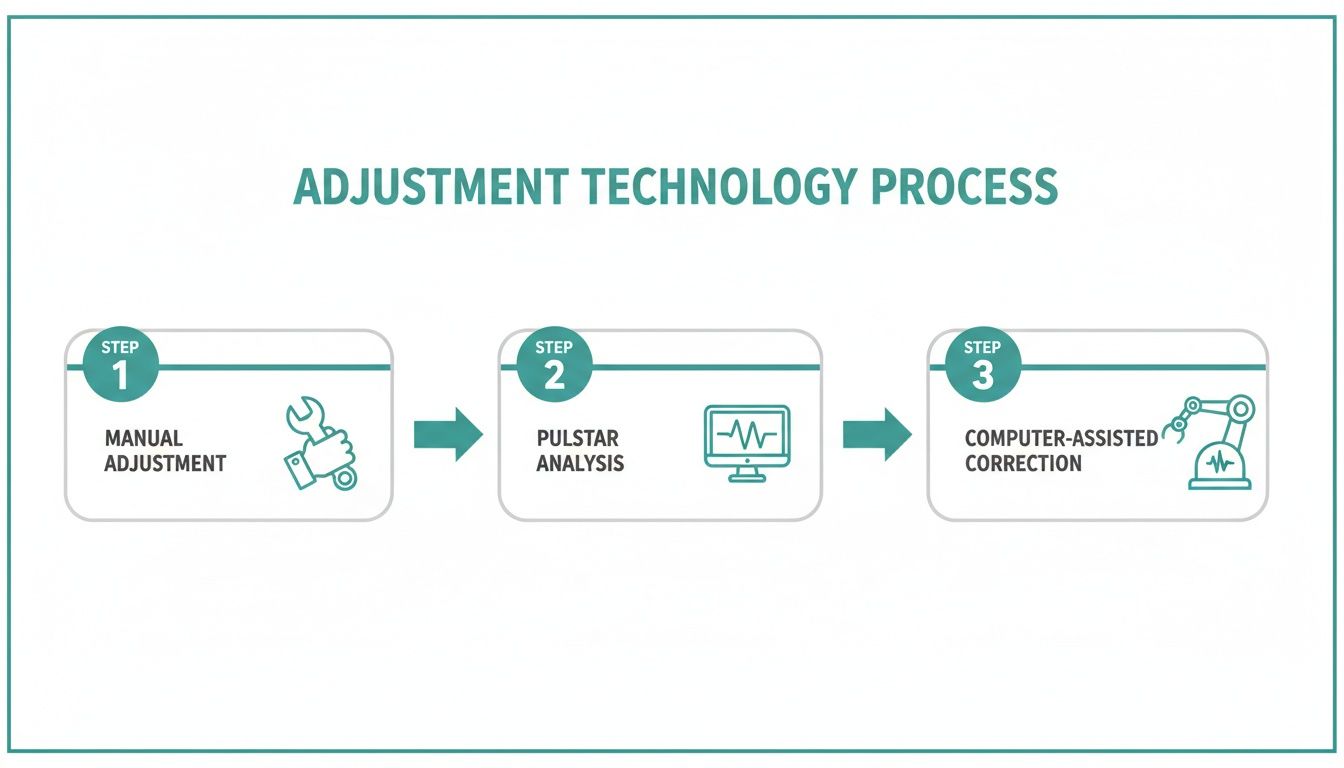
As you can see, technology like PulStar weaves analysis and correction together, giving us a data-driven way to get your joints working properly again.
Right after the session, it's common to feel an immediate sense of relief. You might notice you can move a little easier or that the nagging pain has dialed down a notch. It’s also perfectly normal to feel some mild soreness or a new awareness in the muscles around the area—much like you'd feel after a good workout. That’s just your body responding as it adapts to its new, healthier alignment.
It's important to remember that lasting stability is a process, not a one-time event. Just as one workout doesn't build lasting fitness, a single adjustment often provides initial relief while a series of treatments helps retrain the joint and surrounding muscles for long-term stability.
I'll always send you home with specific instructions to help your body heal. This might include simple stretches, using an ice pack, or holding off on heavy lifting for a day or two. And don't forget the other 8 hours of your day! Optimizing your sleep is a huge part of recovery. Investing in the best mattress for lower back pain sufferers can make a world of difference by supporting your spine while you rest. By following through with each step, you're not just putting a band-aid on a symptom—you're rebuilding a strong foundation for a pain-free life.
Trying to "tough out" SI joint pain is a bit like driving a car with a misaligned tire. At first, it's just a minor annoyance. But over time, that slight imbalance starts wearing down other, more expensive parts. Your body works the same way, and ignoring that initial pain can set off a chain reaction of problems that are much harder to solve later on.
When your SI joint is unstable, your body instinctively tries to protect itself and keep you moving. To do this, other muscles and joints are forced to pick up the slack. This is a process called compensation. Your hip flexors might tighten up, your hamstrings suddenly feel overworked, and you might even notice a change in your gait.
This compensation creates a domino effect. All that new stress on your hips, knees, and lumbar spine can lead to pain and inflammation in places that were perfectly fine before. What began as a specific ache in your low back can morph into a widespread, chronic pain issue that impacts your entire lower body.
When the pain becomes unbearable and other treatments haven't worked, some people are guided toward SI joint fusion surgery. This is a major procedure where surgeons use screws and plates to permanently lock the joint. While it can be a last resort for severe, traumatic instability, it's a permanent decision with serious drawbacks that everyone should weigh carefully.
The surgery itself is a significant event, often followed by a long and difficult recovery. You can expect weeks, if not months, of limited mobility, demanding physical therapy, and the risk of post-surgical complications.
Sacroiliac joint fusion permanently changes how your body moves. It doesn't restore natural function—it eliminates it. This can transfer an enormous amount of stress to the surrounding joints, especially the lumbar spine and the opposite SI joint, often creating a brand new problem in the process of "fixing" the old one.
This transfer of stress isn't just a theory; it's a well-documented reality. Research has shown that after a fusion on one side, a shocking 21% of patients end up needing the same surgery on their other side. Even more concerning, over 90% of these follow-up surgeries happen within just 18 months.
The data points to clear risk factors, too. For instance, having a previous fusion at the L5-S1 level in your spine more than doubles your chances of needing that second SI joint surgery. These statistics highlight a critical point: SI joint stress is often a two-sided problem, and locking down one joint just forces the other to take on the entire mechanical load. You can read the full research on contralateral SI joint fusion rates to see the data for yourself.
To put this in perspective, let's compare the two approaches directly.
| Factor | Chiropractic Adjustment (e.g., PulStar) | Surgical SI Joint Fusion |
|---|---|---|
| Approach | Non-invasive; restores natural joint mobility and alignment. | Invasive; permanently locks the joint with hardware (screws, plates). |
| Goal | Correct the root mechanical issue to restore function. | Eliminate motion entirely to stop pain signals. |
| Recovery | Minimal to no downtime; patients often feel immediate relief. | 6-12 months for full recovery; involves significant pain and rehab. |
| Risks | Minimal; may include temporary soreness. | Infection, nerve damage, hardware failure, adjacent segment disease. |
| Outcomes | Aims to preserve and improve natural biomechanics for long-term health. | Can create new stress on other joints, leading to a 21% reoperation rate. |
This high reoperation rate makes a powerful case for trying every effective, non-surgical option first. A precise sacroiliac joint adjustment isn't just about getting rid of the pain you feel today; it’s a proactive strategy. By restoring proper mechanics, we address the cause of the instability without the risks, recovery, and potential for future surgeries that come with fusion. It’s all about preserving your body’s natural design to help you avoid a lifetime of compounding problems.
Deciding to finally do something about your SI joint pain is a big step, and it's completely normal to have questions. You want to know what you're getting into, what it will feel like, and most importantly, if it will actually work. Let's walk through some of the most common questions we hear from patients, so you can feel confident and clear about the path ahead.
This is the big question, and the honest answer is: it's different for everyone. How quickly you feel better depends on your specific situation—how long you’ve been in pain, how severe the joint problem is, and your overall health. That said, it's not at all unusual for patients to get off the table after their very first session and notice a real decrease in pain and an immediate improvement in how they move.
That initial relief often comes from simply getting a "stuck" joint moving correctly again. But getting that relief to last is a process.
Think of it like getting a car out of a ditch. The first adjustment is the tow truck pulling you back onto the road—you get immediate results. But to keep the car running smoothly, you still need to check the alignment and tire pressure.
We get it—the thought of an "adjustment" can sound intimidating. Your comfort is our absolute top priority, and you can put that worry to rest. Modern, gentle techniques are specifically designed to be easy on your body. This is especially true when we use instrument-assisted methods like the PulStar system.
Instead of a single, heavy-handed movement, this technology delivers a series of soft, precise impulses. Most people describe it as a light tapping or a gentle pulsing sensation right where it's needed. Honestly, most are surprised by how relaxing it feels.
The big difference here is that you won't hear any of the loud "popping" or "cracking" sounds that people often associate with traditional chiropractic adjustments. The focus is all on finesse and precision, not force.
It's completely normal to feel a little bit of muscle awareness or mild soreness afterward, kind of like how you feel after trying a new workout. That's just a sign that your body is adapting to its new, healthier alignment, and it almost always fades within a day or so.
Our goal is always a long-term solution, not just a temporary patch. A successful sacroiliac joint adjustment is the critical first step—it gets the joint mechanics right, which is the foundation for everything else.
But to get truly durable results, we have to look at why the joint became unstable in the first place. Was it from weak supporting muscles? Poor posture? An old injury?
To keep the pain from creeping back in, your care plan will likely go beyond the adjustment itself and include:
By fixing the joint's function and giving you the tools to take care of it, we dramatically reduce the chances of the pain ever coming back.
While general chiropractic is fantastic for a wide range of issues, a specialized approach for SI joint dysfunction brings a more focused and technologically advanced game plan to the table. This is especially crucial for stubborn, chronic cases that haven't gotten better with other treatments.
The key differences really come down to the depth of the diagnosis and the precision of the tools we use.
A Specialized Approach at a Glance:
| Aspect | General Chiropractic | Specialized Care (e.g., Bonesetters) |
|---|---|---|
| Technology | Often relies on traditional manual adjustment techniques. | Integrates FDA-backed technology like PulStar for measurable, computer-guided adjustments. |
| Analysis | Primarily relies on practitioner's manual feel and experience. | Uses digital analysis to create a real-time graph of joint mobility, pinpointing the exact restriction. |
| Precision | Effective but depends on the art and force of a manual thrust. | Delivers highly targeted, consistent impulses for a gentle and perfectly repeatable treatment. |
| Integration | May focus mainly on the spinal adjustment itself. | Often combines adjustments with complementary therapies like laser or spinal decompression for a complete recovery plan. |
This integrated model ensures we're looking at the whole picture, from the joint mechanics down to the surrounding soft tissues. It's a system built on evidence, designed to produce measurable results and give you a clear path out of pain, even if you've been stuck with it for years.
At Bonesetters, we believe in getting to the root cause of your pain with precision, technology, and a plan built just for you. If you're tired of temporary fixes and ready for lasting relief from SI joint pain, we invite you to see how our evidence-based approach can help. Schedule your consultation today and take the first step toward reclaiming your comfort and getting back to your life.