

If you've just been told you have a herniated disc, your mind might immediately jump to the worst-case scenario: surgery. But I want you to take a deep breath, because the path to getting better is usually much simpler and less invasive than you think.
The truth is, the vast majority of people find lasting relief with non-surgical treatment for a herniated disc. This guide is built on one simple, powerful fact: effective, evidence-based therapies can help your body heal itself and get you back to living your life.
Just hearing the words "herniated disc" can be scary, conjuring images of debilitating pain and complex operations. But for most people, the reality is far more hopeful. The medical community is in wide agreement that a conservative, non-surgical approach should always be the first line of defense.
Our goal isn’t just to mask your symptoms. It's to create the ideal environment for your body to do what it does best—heal.
This healing framework is all about three key actions:
Modern therapies get right to the root of the problem. We’re not interested in temporary fixes; we want to guide you toward genuine, lasting relief. This patient-first philosophy isn't just a belief—it's backed by a mountain of clinical data.
A massive study looking at over 277,000 patients with lumbar disc herniations delivered some incredible news: a staggering 97.0% of them were successfully treated with non-operative care.
Think about that. Only a tiny fraction—just 3.0%—ended up needing surgery after trying conservative options first. These numbers are why a non-surgical path isn't just an alternative; it's the gold standard. You can explore the full research on herniated disc treatment outcomes for a deeper dive into the data.
Seeing the different treatment journeys side-by-side can really put things into perspective. While surgery absolutely has its place for a small number of specific, severe cases, the non-surgical route offers a gentle, restorative process that partners with your body’s natural healing power.
This table gives you a quick comparison of what to expect from each path.
| Aspect | Non-Surgical Treatment Path | Surgical Treatment Path |
|---|---|---|
| Approach | Addresses root causes like pressure and inflammation to promote natural healing. | Directly removes or alters the disc material that is compressing a nerve. |
| Timeline | Gradual improvement over weeks to months, with a focus on long-term stability. | Often provides rapid initial relief but involves a longer recovery period. |
| Risks | Minimal and generally limited to temporary soreness or discomfort. | Includes infection, nerve damage, anesthesia complications, and potential instability. |
| Recovery | Little to no downtime; patients can often continue daily activities. | Requires significant downtime, rehabilitation, and restrictions on activity. |
As you can see, the non-surgical approach is designed to build lasting spinal health from the ground up, making it the clear and preferred first step for almost everyone.
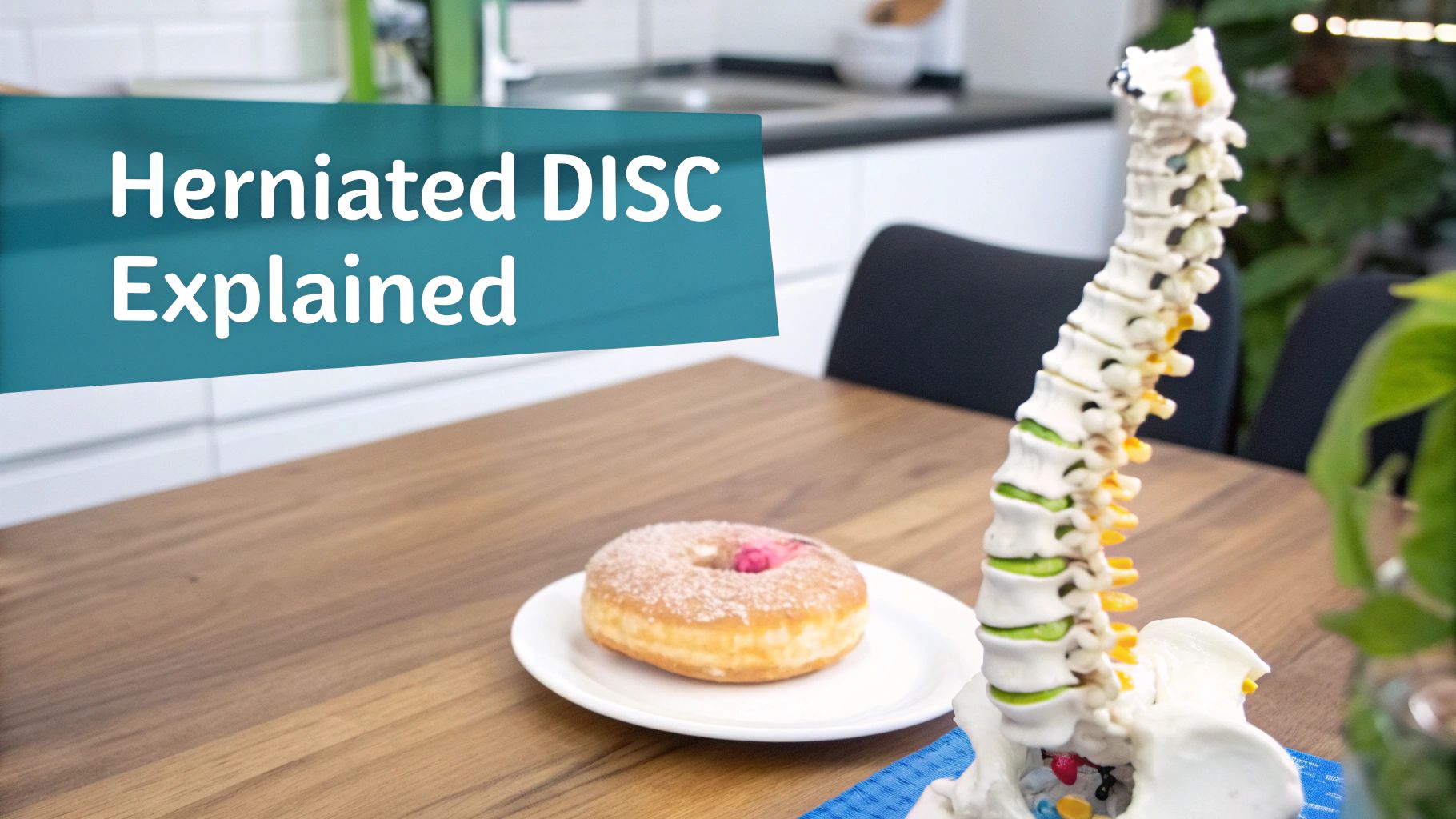
Before we can get into how a non surgical treatment for herniated disc brings relief, it’s really helpful to understand what’s actually going on in your spine. It’s less complicated than it sounds, and the best way I’ve found to explain it is with a simple analogy: a jelly donut.
Your spinal discs are the natural shock absorbers between each of your vertebrae, and they’re built a lot like that donut. Each one has a tough, fibrous outer layer (the annulus fibrosus), which is like the doughy outside. Inside is a soft, gel-like center (the nucleus pulposus)—this is the "jelly." These discs are essential for cushioning your spine as you move, bend, and twist.
A herniated disc happens when a tear or weak spot forms in that tough outer wall, allowing some of the jelly-like center to squeeze out. This bulge is the "herniation," and where it ends up is what causes all the trouble.
Here’s the key thing to understand: it’s usually not the tear itself that causes the most intense symptoms. The real problem starts when that escaped disc material pushes into the spinal canal and presses against a nerve. These nerves are like the body’s electrical wiring, constantly sending signals between your brain and your limbs.
Think of it like someone stepping on a garden hose. When that disc material compresses a nerve, the flow of information is pinched off. This interruption is what triggers that cascade of pain, numbness, or weakness that can feel so debilitating.
The specific symptoms you feel depend entirely on which nerve is being compressed and how much pressure it’s under. This is why no two herniated disc cases are exactly alike.
A herniated disc isn't a sign of a "broken" back. It's a specific mechanical problem where displaced disc material irritates a nerve. The goal of non-surgical care is to gently correct this mechanical issue, giving the nerve space to heal and the body a chance to recover naturally.
One person might have sharp, localized back pain, while another feels almost nothing in their back but has excruciating pain shooting down their leg. It all comes down to the location of that nerve pressure.
The type of pain you're experiencing and where you feel it are crucial clues that tell us what’s happening. Pinpointing this helps us create a treatment plan that addresses the specific source of your problem.
Here are a few common patterns we see:
Once you see that a herniated disc is fundamentally a problem of pressure and inflammation, it’s easy to see why the most effective treatments are the ones that relieve that pressure. This is the entire foundation of a successful non surgical treatment for herniated disc—it’s designed to fix the cause, not just mask the symptoms.
Finding real, lasting relief from a herniated disc without surgery isn’t about a single magic bullet. It's about a smart, strategic approach that works with your body's natural healing ability. I often tell my patients to think of it like tending a garden—you can't just command a plant to grow, but you can give it the perfect soil, water, and sunlight it needs to flourish. That's exactly what we're doing for your spine: creating the ideal environment for it to heal itself.
This entire process rests on three foundational ideas that work together in harmony. First, we need to create space with Decompression. Next, we have to put out the chemical fire with Inflammation Reduction. And finally, we lock in the progress and prevent future injury with Stabilization.
At its core, herniated disc pain is almost always a pressure problem. The "jelly" that has squeezed out of the center of your disc is now crowding a very sensitive nerve, and that nerve is screaming for help. This is what causes that searing pain, sciatica, or debilitating numbness. Logically, the first and most important step is to get that pressure off the nerve.
Spinal decompression therapy does this by gently, almost imperceptibly, stretching the spine. This creates a tiny bit of negative pressure—like a subtle vacuum—inside the disc. This gentle suction helps coax the bulging disc material back toward the center and away from the nerve it's been irritating. It’s an immediate mechanical relief.
The goal here is simple but powerful: give the injured disc and pinched nerve room to breathe. It's the critical first step that opens the door for all the other healing to take place.
This process does something else just as important. It allows vital nutrients, oxygen, and water to flood back into the disc. These are the raw materials your body needs for repair, but they can't get past the blockade when the disc is constantly being squashed. Decompression opens up those supply lines and kickstarts the body's own repair crew.
While pressure is the mechanical trigger, it’s inflammation that’s fanning the flames of your pain. When that disc material leaks out, it releases a cocktail of inflammatory proteins that are incredibly irritating to the surrounding nerves. This chemical irritation is why the pain can feel so relentless and severe, even when you're just sitting still.
So, taking the pressure off is only half the battle. We also have to calm that chemical firestorm. This is where therapies like our Class IV laser come in. The laser sends healing light energy deep into the damaged tissues, which tells the cells to ramp down inflammation and speed up repair. It effectively soothes the angry nerve, bringing down the pain and creating a much better environment for healing.
Tackling both the pressure and the inflammation at the same time is the key. It means we’re not just chasing symptoms; we’re addressing the problem from every angle. And the evidence shows this conservative approach really works. A major study in the Spine Journal found that up to 90% of patients got better without surgery in about six weeks, with 70% seeing their leg pain significantly decrease. You can read the full study on herniated disc outcomes yourself to see the data.
Once we’ve taken the pressure off and the inflammation is under control, we get to the final, crucial pillar: stabilization. Getting you out of pain is our immediate priority, but keeping you that way is our long-term mission. This is where we focus on rebuilding strength and proper function in the muscles that support your entire spinal column.
Stabilization isn't just one thing; it's a combination of:
This final stage is what turns a temporary fix into a permanent solution. By building a strong and stable foundation, you drastically lower the risk of this ever happening again. For some practical next steps, take a look at our guide on the best exercises for lower back pain relief.
Now that we've covered the big picture of healing—Decompression, Inflammation Reduction, and Stabilization—let's get into the specific therapies that make it all happen. Think of this as your modern toolkit for fixing a damaged disc. Each tool has a specific job, but they shine when used together, tackling the root cause of your pain and giving your body a real chance to heal.
These methods are the best of what non surgical treatment for herniated disc has to offer. We're moving way beyond temporary pain relief to get you measurable, lasting results. Let's break down exactly how each therapy works, what it feels like, and why it’s a non-negotiable part of a successful recovery plan.
Picture a dried-out kitchen sponge. To get it soft and useful again, you need to let it soak up water and expand. Non-surgical spinal decompression works on a very similar idea for your spinal discs. It's the absolute cornerstone for handling the mechanical pressure that's causing all that herniated disc pain.
During a session, you'll lie on a specialized table while a computer-guided system applies a very gentle and precise pulling force to your spine. This isn't some aggressive, medieval stretch; it's a slow, rhythmic motion that feels incredibly relieving. Honestly, many of our patients doze off during treatment.
This gentle pull creates negative pressure—basically a vacuum effect—right inside the problem disc. This little vacuum is a game-changer for two reasons:
This graphic really shows how decompression, calming inflammation, and creating stability all work in harmony to help your disc fully heal.
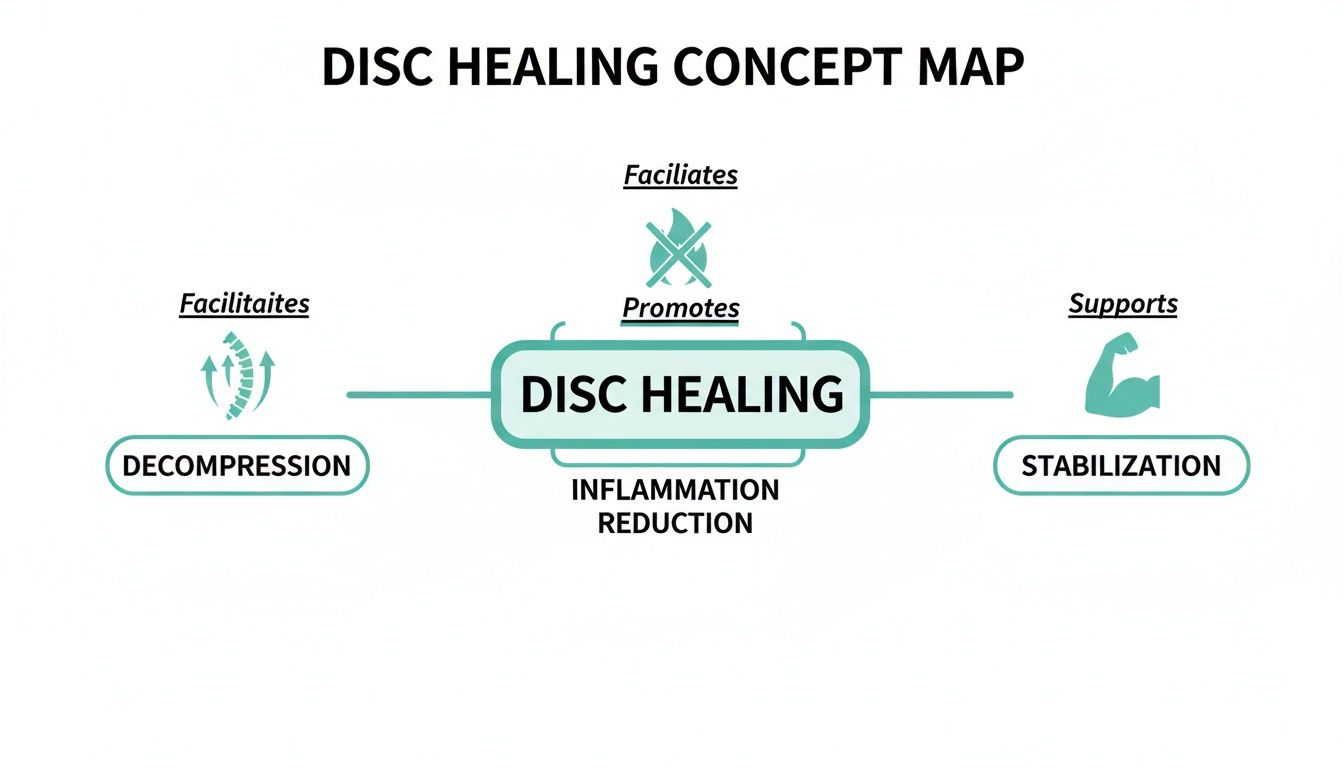
As you can see, true recovery isn't about one magic bullet. It’s a coordinated strategy to take off the pressure, soothe the irritation, and build lasting strength. You can get a better feel for what people experience by checking out our collection of spinal decompression therapy reviews.
While decompression fixes the "pressure" problem, Class IV Laser Therapy takes on the "chemical" problem: inflammation. When disc material leaks out, it releases inflammatory proteins that are incredibly irritating to nearby nerves. That's where that relentless, burning pain comes from.
Class IV Laser Therapy uses specific wavelengths of light that can penetrate deep into the tissues around your spine. We’re not talking about a hot, surgical laser here. This is a "cold" laser that creates a gentle, soothing warmth.
This light energy kicks off a process in your cells called photobiomodulation. In simple terms, it's like giving your cells a massive energy drink. The results are profound:
Think of it as jump-starting your body's own repair crew, giving them the extra power they need to put out the inflammatory fire fast.
Once the pressure is off and the inflammation is calming down, we need to get your spine moving correctly again. This is where precision-based adjustments come in. Forget any old-school ideas about forceful twisting or cracking. Modern technology gives us a much smarter, gentler way.
We use a system called the PulStar, which is backed by the FDA, to analyze your spine's motion one joint at a time. A handheld instrument sends tiny impulses into each vertebra and measures how it responds, instantly showing us which areas are "stuck" or restricted.
This technology lets us deliver targeted, low-force adjustments exactly where you need them—no twisting or cracking required. It’s a comfortable, safe, and incredibly effective way to restore healthy movement.
By correcting these underlying mechanical issues, we make sure your whole spine is working as a team. This takes the constant stress off the injured disc and surrounding muscles, which is key to preventing re-injury and building a stable foundation for the long haul.
Last but not least, you can't rebuild a house without the right materials. The same goes for your body. The tissues that make up your discs, ligaments, and muscles are built from the food you eat. This is why nutritional counseling is such a vital, and often overlooked, piece of the puzzle.
Chronic inflammation isn't just in your back; it can be a system-wide problem driven by your diet. We help you find and add foods that are natural inflammation fighters, like those packed with omega-3s, antioxidants, and other powerful plant nutrients.
We also make sure you're getting enough of the key building blocks your body needs for tissue repair, including:
When you bring all these therapies together, the results can be remarkable. A 2023 case series looked at patients who combined non-surgical spinal decompression with chiropractic care. The findings showed they achieved 90% symptom improvement within two months and were back to their normal activities in three. This is what a structured, multi-pronged approach can do.
Walking into a new doctor's office can be nerve-wracking, especially when you're dealing with debilitating pain. I get it. A quality first visit for non surgical treatment for a herniated disc shouldn't be about a quick, in-and-out adjustment. It’s a deep dive, a fact-finding mission to figure out exactly what’s going on and build a solid game plan to get you better.
It all starts with a conversation. We'll sit down and talk, and this is your time to tell me everything—what the pain feels like, when it started, what you've tried that helps or hurts, and how this whole thing is messing with your life. We'll also go through your health history to see the full picture.
Once I have your story, we move on to a thorough hands-on exam. This isn't just about prodding the sore spot. We're looking at your body's mechanics as a whole system to see how everything is moving and working together. Sometimes, the root of the problem isn't where the pain is.
You can expect us to go through a few key things:
This detailed evaluation is what allows us to connect the dots between your symptoms and the specific mechanical issue causing them.
The last piece of the puzzle is looking at any imaging you might have, like MRIs or X-rays. Seeing the actual structure of your spine helps confirm the disc herniation's location and severity. When we combine what we see on the images with what we found during your exam, we can build a truly customized recovery strategy.
Think of your first visit as building a partnership. It's where we take your goals and my clinical experience to draw a clear, effective roadmap for your healing. You should walk out of that first appointment feeling like you’ve been heard and have a confident path forward.
Choosing the right doctor is a huge part of this process. You need someone who is committed to this kind of detailed, patient-focused approach. For more tips on finding the right fit, our guide on how to choose a chiropractor has some great advice. Ultimately, this first visit lays the entire foundation for getting you out of pain and back to your life.
While we see incredible results with non-surgical treatments for herniated discs, my first priority is always your health and safety. It's crucial to know the rare but serious symptoms that mean you need an immediate medical evaluation.
These "red flags" point to severe nerve compression that could cause permanent damage if ignored. Think of it like a smoke detector—you hope it never goes off, but you need to know what the alarm sounds like.
A major warning sign is muscle weakness that gets worse over a short time. This isn't about feeling a little tired; it's a real, noticeable loss of strength. The classic example of this is foot drop.
You might find it hard, or even impossible, to lift the front of your foot. People often describe it as their foot "slapping" the ground when they walk. To compensate, they might lift their knee high, like they're climbing stairs, just to avoid tripping. This is a clear sign that the nerve controlling those muscles is in serious trouble.
A little bit of weakness can be normal with a herniated disc, but weakness that is getting progressively worse is a different story. It means the nerve isn't just irritated—it's being damaged, and quick action is critical.
The most urgent red flag is a rare condition called Cauda Equina Syndrome. This is a true medical emergency that happens when the bundle of nerves at the very end of your spinal cord gets squeezed so hard that it shuts down sensation and function below the waist.
Be on high alert for these specific symptoms:
If you experience these symptoms, especially with your back or leg pain, you need to go to the emergency room right away. Knowing these critical signs helps you make the right call when it matters most.
As you start to look at your options, it's completely normal to have questions about what the healing process really looks like. Knowing the practical side of a non surgical treatment for herniated disc can give you the confidence you need to take that next step. Here are some straightforward answers to the questions we hear every day in our clinic.
Everyone's body heals on its own timeline, but we see a fairly consistent pattern. Most of our patients start to feel a real, noticeable drop in their pain within the first couple of weeks of consistent care.
The first phase is all about putting out the fire—calming down the intense pain and getting pressure off that pinched nerve. Once we’ve achieved that, our focus shifts to stabilizing your spine and building strength to prevent this from happening again. A full-circle plan designed for lasting relief typically takes anywhere from several weeks to a few months, depending on how severe the disc injury is and how closely you follow the program.
Your body has a remarkable capacity for healing. In some cases, the bulged part of the disc can actually shrink on its own over time, a process called resorption. The problem with a "wait and see" approach, though, is that it completely ignores the underlying mechanical issues that caused the disc to herniate in the first place.
Things like spinal misalignments, constant pressure from poor posture, and muscle imbalances don't just disappear. If you don't address these root causes, the odds of the pain coming back—or developing new problems as your body tries to compensate—are incredibly high. Our job is to create the perfect environment for your body to heal correctly and for good.
Simply put, we don't want the disc to just scar over in a dysfunctional position. The goal is to guide it toward healing in a way that restores proper function and prevents future episodes.
This is a big one, and I want to be very clear: no, absolutely not. Our therapies are specifically designed to be gentle, comfortable, and relieving. The entire point is to get you out of pain, not cause more of it.
Insurance coverage for chiropractic care and related therapies can really vary from plan to plan. The good news is that most modern insurance plans recognize how effective these treatments are and do offer some level of coverage.
Any good clinic will take the guesswork out of this for you. As part of your initial consultation, we offer a complimentary benefits check where our staff will verify your coverage and walk you through it in plain English. You'll know exactly what your plan covers and what, if any, out-of-pocket costs to expect before you ever decide to move forward with a treatment plan.
At Bonesetters Critical Chiropractic, we believe you deserve a clear path to recovery without the confusion. If you're ready to see what a personalized, non-surgical plan for your herniated disc could do for you, schedule your comprehensive consultation today by visiting us at https://bonesetters.org.