

Think of your spinal discs as the unsung heroes of your back—little jelly-filled shock absorbers nestled between each vertebra. They give your spine its incredible flexibility and strength. But when the tough outer layer of one of these "donuts" tears, the soft, gel-like center can squeeze out. That's a herniated disc.
This escaped material is what causes all the trouble. It can press directly on the highly sensitive nerves branching out from your spinal cord, kicking off the pain, numbness, and weakness that can make life miserable.
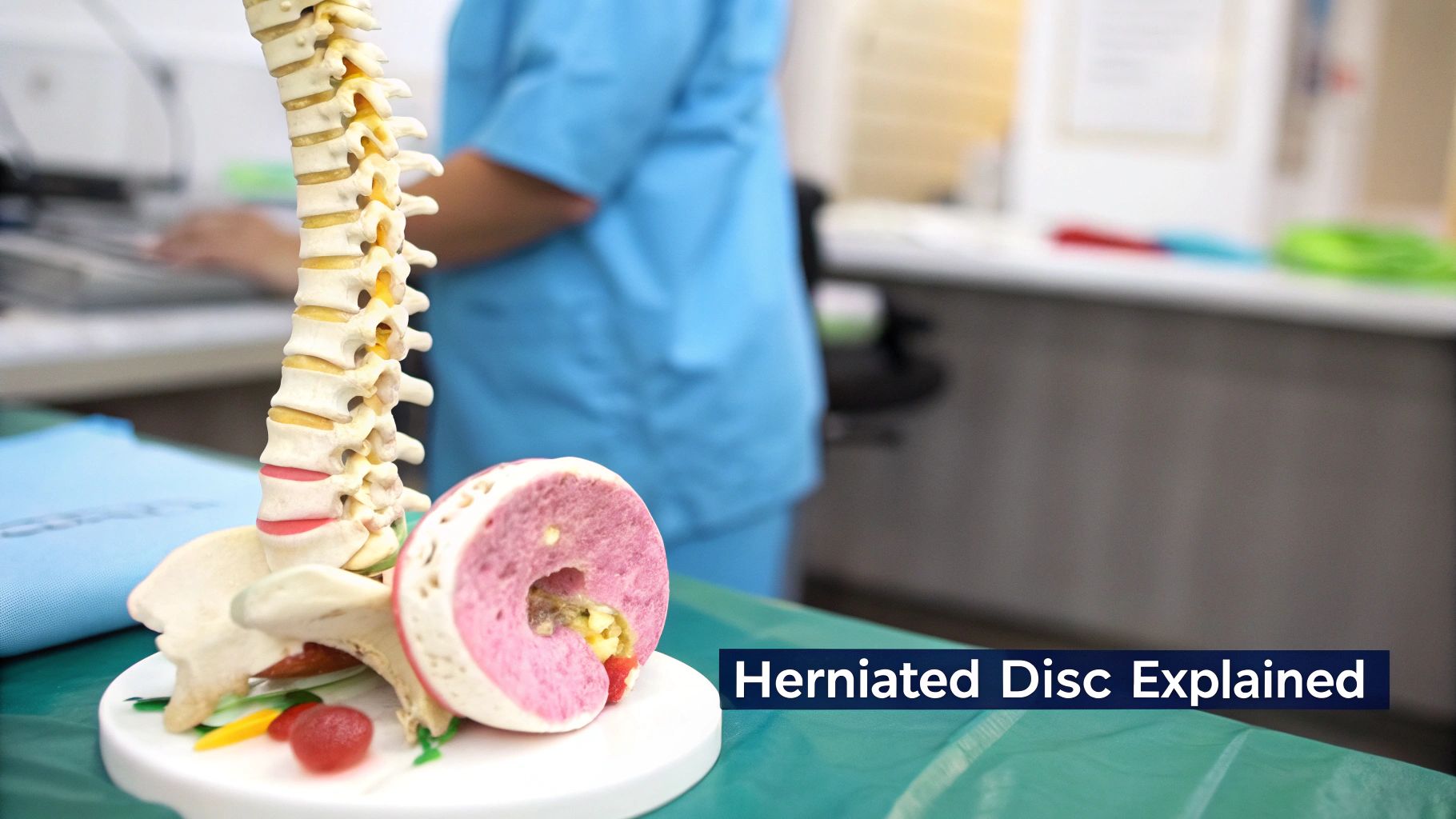
While the diagnosis sounds serious, it’s really a mechanical problem at its core. And the good news is, mechanical problems often respond incredibly well to the right kind of non-surgical disc herniation treatment.
To really get it, let's look at the disc's two main parts:
When these two parts work in harmony, your spine can bend, twist, and absorb the impacts of everyday life without a problem. The issue starts when that outer wall begins to fail.
People often use these terms interchangeably, but they describe two very different stages of disc injury. Understanding the distinction is key.
Imagine lightly stepping on a water balloon. The whole thing flattens and bulges out, but the balloon itself doesn't break. That’s a bulging disc. The disc is out of its normal boundary, but the tough outer wall is still intact.
Now, imagine stepping on that balloon hard enough for it to pop. That's a herniated disc. The outer wall has torn, and the inner gel has leaked out into the spinal canal. This is also what people mean when they say "ruptured disc" or "slipped disc." Because that inner material is now an intruder in a space where it doesn't belong, it’s far more likely to cause severe nerve compression and more intense symptoms.
A herniated disc isn't just a physical problem—it's also a biochemical one. The gel-like nucleus material is highly inflammatory. When it leaks out and touches a nerve root, it triggers a strong chemical irritation on top of the physical pressure.
A disc rarely fails out of the blue. It’s almost always the result of either one big, bad event or the slow accumulation of wear and tear over years.
Knowing this empowers you. Your pain isn't some random mystery; it's rooted in a specific mechanical and chemical problem. And that's a problem we can solve by taking pressure off the nerve, calming the inflammation, and restoring stability to the spine. This is the foundation of an effective non-surgical disc herniation treatment plan—one that addresses the root cause without resorting to invasive procedures.
When you're hit with the searing pain of a herniated disc, it's natural to want the quickest fix possible, and surgery might sound like that magic bullet. But before you even go down that road, it's crucial to understand one thing: your body has an incredible capacity to heal itself. For the vast majority of people, starting with non surgical disc herniation treatment isn't just a waiting game—it's the most powerful and effective strategy you can employ.
Think about it this way: your immune system is a brilliant cleanup crew. It sees that bit of leaked disc material as something that doesn't belong and launches a response to break it down and carry it away, just like it would with a bad bruise. Over time, this natural process can actually shrink the herniation, relieving the pressure on your nerve without a single scalpel in sight.
The whole point of conservative care is to give your body the best possible environment to do its job. These treatments are all about calming down the inflammation, getting your spine moving correctly again, and taking the physical stress off that injured disc. You're not just waiting for the pain to go away; you're actively helping your body's built-in repair team work its magic.
And this isn't just wishful thinking—the data is overwhelmingly on our side. A massive review looking at over 277,000 patients with lumbar disc herniations found something incredible. Within just one year, 97% of them got better without ever needing surgery. That’s a huge number, and it drives home the point that conservative care isn't an alternative, it's the gold standard for most people. You can read the full research on the effectiveness of conservative care.
Let that sink in. For nearly everyone diagnosed with a herniated disc, the body can win this fight with the right non-surgical support. Choosing this path first simply means you're working with your biology, not against it.
Look, surgery absolutely has its place for a small handful of cases, but it's a major undertaking. It's an invasive procedure with real risks and often comes with a long, tough recovery. By trying a non surgical disc herniation treatment plan first, you give yourself a chance to avoid all of that.
Here’s why starting with conservative care is the smartest approach:
It’s so important to shift your mindset here. Choosing a non-surgical route isn't about gritting your teeth and "toughing it out." It's an active, evidence-based, and strategic plan for getting your life back.
Working with a specialist, you get a personalized roadmap that pulls together the right therapies to soothe inflammation, create space in your spine, and restore healthy function. It’s a proactive approach that puts you in the driver's seat of your own recovery. The goal isn't just to get rid of a piece of a disc; it's to build a healthier, more resilient spine for the long haul.
Think of recovering from a herniated disc less like a single magic bullet and more like building a custom toolkit. Each non-surgical disc herniation treatment is a specific tool, each with a unique job—one might calm down inflammation, while another restores healthy movement. The real magic happens when you and your doctor combine the right tools to create a powerful, personalized strategy for healing.

This isn't just about chasing pain relief. It's about actively creating an environment where your body can do what it does best: heal itself. The plan is always to reduce nerve pressure, fix the underlying spinal mechanics, and strengthen the muscles that support your spine to keep this from happening again.
Physical therapy (PT) is the foundation of nearly every successful conservative treatment plan. This isn't just about being handed a sheet of generic exercises. It’s a guided program, tailored to correct the specific movement problems and weaknesses contributing to your pain. A skilled physical therapist acts as your personal coach, teaching you how to move safely and build resilience.
One of the most trusted techniques in the PT world is the McKenzie Method. This brilliant approach uses specific, repeated movements to "centralize" your pain. Think about a jelly donut: if some of the jelly squishes out, the goal is to gently push it back toward the center. That’s what centralization does for your pain—it moves it out of your leg or arm and back to its source in the spine, which is a fantastic sign that you're on the right track.
A great physical therapist doesn’t just treat your symptoms. They empower you with the knowledge and tools to manage your condition independently, making you an active participant in your recovery.
Chiropractic care zeroes in on restoring proper motion and alignment to the spine. When a disc herniates, the nearby spinal joints often lock up as your body instinctively tries to guard the injured area. While well-intentioned, this stiffness can actually slow down healing and cause even more pain.
Gentle, specific chiropractic adjustments can help get these "stuck" joints moving again. This not only eases that feeling of stiffness but, more importantly, takes mechanical stress off the injured disc itself. For many people, especially those with sciatica, the relief can be dramatic. Better joint function also helps you perform your physical therapy exercises correctly, making your entire recovery plan more effective. If nerve pain is your main battle, check out our guide on how to relieve sciatica pain naturally for more strategies.
Sometimes, the inflammation around the nerve root is so intense that it creates a vicious cycle of pain. This can make it nearly impossible to even think about doing exercises. This is where an Epidural Steroid Injection (ESI) can be a game-changer.
Let's be clear: an ESI doesn't "fix" the herniated disc. Its job is to deliver a powerful anti-inflammatory medication directly to the source of the fire.
Think of an ESI as calling in the fire department. They put out the blaze so the construction crew (your physical therapist) can get in and start the real repair work.
Medications are best seen as a supporting actor in your recovery, helping manage symptoms so you can stay active in your other therapies. They’re typically used for short-term relief while the more corrective treatments start to take effect.
The evidence for this layered, conservative approach is strong. A 2021 study that followed patients who were candidates for surgery found that non-surgical treatments produced results comparable to surgery over a two-year period, with everyone in the study showing significant improvement. The most effective plans almost always started by combining therapies like the McKenzie method, spinal mobilization, and patient education.
To make sense of these options, it helps to see them side-by-side. Each one has a different primary goal and is suited for slightly different situations.
| Treatment | Primary Goal | Best For | Typical Duration |
|---|---|---|---|
| Physical Therapy | Restore function, build strength, educate | Long-term stability & prevention | 6-12 weeks |
| Chiropractic Care | Improve joint mobility, reduce nerve irritation | Stiffness, localized pain, sciatica | 4-8 weeks |
| Epidural Injection | Rapidly reduce severe inflammation | Acute, severe radiating nerve pain | 1-3 injections over weeks/months |
| Medication | Manage symptoms (pain, inflammation) | Short-term pain control | Days to a few weeks |
Ultimately, the best approach isn't about picking just one treatment, but about layering them intelligently to address your specific needs at each stage of healing.
Sometimes, the standard approaches just don't cut it. When foundational care isn't enough to break the cycle of pain, we can bring in a powerful suite of modern tools designed to heal the problem from the inside out.
This isn't about replacing core treatments like physical therapy. It's about enhancing them. By integrating advanced protocols, we create a powerful synergistic effect that addresses both the mechanical and biological roots of disc pain at the same time. This strategy combines multiple evidence-based technologies into a potent, personalized non surgical disc herniation treatment plan. The goal is simple: create the ideal internal environment for your disc to finally heal.
For many, the cornerstone of this approach is Non-Surgical Spinal Decompression. Picture your disc being constantly squeezed under painful pressure. Decompression therapy acts like a gentle, sophisticated vacuum, working to reverse that force.
You'll lie comfortably on a specialized table as it applies a precisely controlled, gentle stretching force to your spine. This subtle action creates negative pressure—a vacuum effect—right inside the injured disc.
This negative pressure is the key. It helps gently draw the herniated material back toward the center of the disc, taking that intense pressure off the pinched nerve. At the same time, this process pulls in a rush of nutrient-rich fluid, oxygen, and blood, essentially force-feeding the damaged disc the building blocks it needs to repair itself.
While decompression fixes the mechanical problem, Class IV Laser Therapy tackles the biological one. This isn't a cutting laser; instead, it uses specific wavelengths of light that penetrate deep into the tissues around the herniated disc.
Your cells absorb this light energy, kicking off a process called photobiomodulation. Think of it as jump-starting the tiny energy factories (your mitochondria) within each cell. This cellular boost triggers several key healing benefits:
When we pair laser therapy with decompression, we're making sure the healing environment we’ve created is as healthy and robust as it can possibly be.
Lasting healing also depends on restoring proper movement to the spine. While traditional hands-on adjustments are effective, advanced tools like the PulStar system offer a new level of precision and comfort. This FDA-backed device uses computer guidance to analyze spinal joint motion and then deliver gentle, targeted impulses to restore mobility.
This approach is a huge help when acute pain makes manual adjustments feel too intense. It precisely targets stiff or "stuck" segments without any forceful twisting, which reduces mechanical stress on the injured disc and surrounding joints. By improving how each segment moves, these adjustments perfectly complement other therapies, like the rolling action of intersegmental traction tables, which also aim to restore normal spinal movement. You can learn more about how intersegmental traction helps mobilize the spine in our detailed guide.
The real magic here isn't in any single therapy, but in how we combine them. A single treatment might provide some relief, but a multi-faceted protocol attacks the problem from every angle.
A typical session might start with decompression to relieve pressure, followed by laser therapy to flood the area with healing energy and reduce inflammation. This is often supported by electrical stimulation to calm muscle spasms and nutritional counseling to make sure your body has the raw materials it needs for tissue regeneration.
It’s a comprehensive non surgical disc herniation treatment that is far more powerful than the sum of its parts—a strategy designed not just for temporary relief, but for lasting structural healing and a faster return to the life you love.
When you're dealing with a herniated disc, it's natural to wonder, "How long will this take?" The truth is, healing isn't a single event; it's a process with distinct stages. Knowing what's happening at each step helps you set realistic goals and see the progress you're making, even on tough days.
This isn't just about passively waiting for the pain to go away. It’s an active partnership between you and your body, focused on calming things down, rebuilding strength, and preventing future problems. Think of it as a roadmap from immediate relief to long-term spine health.
The first few weeks after a disc injury are all about putting out the fire. The main goal is to get the intense inflammation and pain under control, which is usually caused by the disc material pressing on a nerve. Your movement will probably be pretty limited, and the focus is squarely on finding comfortable positions and avoiding anything that sends those sharp, shooting pains down your leg.
Treatments during this phase are gentle, designed to soothe the irritated nerve root. Your at-home care is just as crucial. For example, learning to use ice packs correctly can be a game-changer for taming inflammation. For a deep dive, check out our guide on how gel ice packs can support your healing.
Once the worst of the pain has backed off, you move into the rehabilitation phase. This is where the real work begins. We shift from just managing pain to actively restoring function. The focus turns to specific exercises that strengthen the deep core muscles supporting your spine, improve your flexibility, and correct the movement habits that may have contributed to the injury in the first place.
You’ll start measuring progress by what you can do again, not just by how much it hurts. Maybe you can sit through a meeting without squirming, walk an extra block, or bend down to tie your shoes without thinking twice. This phase can last anywhere from several weeks to a few months, and being consistent is everything.
The timeline below shows how we layer in advanced therapies to support and speed up this rebuilding process.
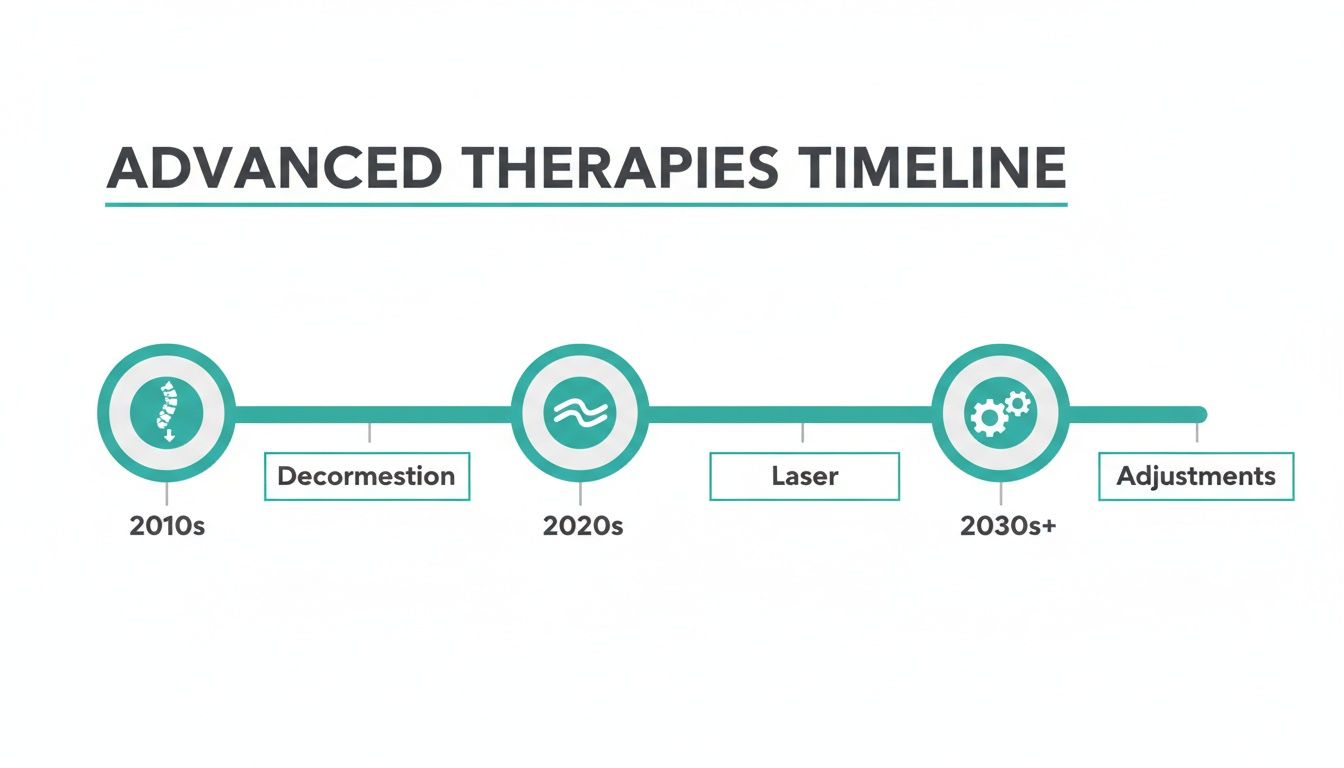
This visual gives you an idea of how treatments like decompression, laser therapy, and precise adjustments fit together over time to help your body heal itself more effectively.
Finally, you graduate to the maintenance phase. At this point, the goal is to weave the strength and healthy habits you’ve developed into your everyday life to keep this from happening again. This means sticking with your core exercises, being mindful of your posture at your desk, and using proper form when lifting anything—from groceries to grandkids.
This long-term commitment is what truly separates temporary relief from lasting wellness. And the research backs this up. The landmark Spine Patient Outcomes Research Trial (SPORT) followed people for eight years and found that those who chose non-surgical disc herniation treatment saw significant, durable improvements. In fact, 52% of them were still doing great without surgery years later, proving just how effective a structured, conservative approach can be.
Look, the vast majority of herniated discs get better with the kind of smart, conservative care we've been talking about. But in some very rare cases, a back problem can escalate into a true medical emergency.
It's absolutely critical to know what these "red flag" symptoms look like. They signal that a nerve is being compressed so severely that it could lead to permanent damage if not addressed immediately. This isn't about causing panic; it's about being informed and knowing when you need to act fast.
Think of these signs as your body's fire alarm. If you experience any of the following, it's not the time to "wait and see." You need to head to the nearest emergency room or urgent care facility right away.
These symptoms can point to a rare but very serious condition called Cauda Equina Syndrome. It happens when the entire bundle of nerves at the base of the spinal cord gets squeezed. This is a surgical emergency, and quick action is needed to release the pressure and prevent permanent paralysis.
I want to be clear: Cauda Equina Syndrome is extremely uncommon. The odds are overwhelmingly in your favor. But knowing what to watch for is a non-negotiable part of taking charge of your health. It ensures that if the worst-case scenario does happen, you can act decisively to protect yourself.
When you're dealing with a herniated disc, a lot of questions pop up about what you can and can't do. It's totally normal to feel a bit uncertain. Getting straight answers about daily life and what to expect can give you the confidence you need to heal. We've put together some of the most common questions we hear from patients to give you some clarity.
This is probably the number one question, and the honest answer is: it depends. Everyone's body is on its own unique timeline. That said, most people start to feel a real drop in their pain within the first 4 to 6 weeks of starting a dedicated non surgical disc herniation treatment plan. The focus during this initial stage is all about calming things down—reducing inflammation and getting you moving comfortably again.
But full recovery is a longer game. We're talking about rebuilding the deep core strength needed to protect your spine for the long haul, and that can take several months. The two most important things you can bring to the table are patience and consistency. Sticking with your program is the single biggest key to getting back to your life without pain.
Yes, it is—as long as it’s the right kind of exercise. High-impact stuff like running, jumping, or heavy, back-straining lifts are off the table for now. Anything that jars your spine or causes sharp pain is a clear signal to stop. But gentle, purposeful movement is not just safe; it’s crucial for healing.
I like to tell my patients that motion is lotion for the joints and discs.
The trick is to listen to your body and the guidance of your healthcare provider. They'll help you find that "sweet spot" where movement is healing, not hurting.
"The biggest mistake people make is thinking that complete rest is the answer. In reality, avoiding all movement can lead to more stiffness and a slower recovery. The key is smart, guided movement that supports the healing process."
Absolutely. The way you sleep can either help or hinder your recovery in a big way. Your posture over those 7-8 hours directly affects spinal alignment and the pressure on your discs. A few small tweaks can mean the difference between waking up stiff and sore or feeling noticeably better.
If you have a lower back herniation, give one of these positions a try:
Whatever you do, try to avoid sleeping on your stomach. It flattens the natural curve of your spine and forces your neck into a twisted position, putting a ton of strain on everything. It’s amazing how much of a difference these small adjustments can make.
At Bonesetters Critical Chiropractic, we don't just treat symptoms; we create personalized, non-surgical plans to fix the root cause of your disc pain. If you're ready to stop chasing temporary relief and start building a stronger, more resilient spine, we're here to help. Learn more about our approach and schedule your consultation at https://bonesetters.org.