

Neck decompression exercises are specific movements that gently stretch your neck, creating a bit of space between the vertebrae. This simple action can take a surprising amount of pressure off your spinal discs and nerves, often leading to a noticeable reduction in stiffness, pain, and those annoying radiating symptoms like tingling or numbness down your arms.
Before we jump into the actual exercises, it's really helpful to visualize what’s going on inside your neck. Picture your cervical spine as a stack of bony blocks—your vertebrae—with soft, squishy shock absorbers—your discs—sandwiched in between.
Things like poor posture (think "text neck"), a past injury, or just the wear and tear that comes with age can cause these blocks to press down, compressing those disc cushions.
This constant pressure is the culprit behind so many common neck issues. It squishes the discs, which can cause them to bulge or even herniate. When a disc gets pushed out of place, it can easily irritate or pinch a nearby nerve, triggering pain that shoots down your shoulders and into your arms. This compression also chokes off blood flow, slowing down the delivery of oxygen and nutrients your tissues desperately need to heal.
Neck decompression exercises essentially work to reverse this process. By creating a gentle, sustained pull on your cervical spine (a concept known as traction), you’re accomplishing a few key things:
The point of neck decompression isn't to get a big "crack" or a forceful adjustment. It's all about a gentle, steady stretch that gives the delicate structures in your neck the room they need to breathe, heal, and function properly.
Grasping this concept is a game-changer. It turns the exercises from a list of instructions into a set of intentional, purposeful actions. When you’re doing a towel-assisted stretch, you can actually picture the vertebrae separating and the pressure easing off those nerves. This mindset helps you perform the movements with more focus and precision.
You can dive deeper into the clinical side of this process and see what happens during the decompression of the cervical spine in our more detailed guide.
Knowing the "why" also helps you listen to your body more effectively. A gentle pulling or stretching sensation is exactly what you're looking for—that's the sign it's working. On the other hand, any sharp or shooting pain is your body’s signal to stop immediately. This foundational knowledge empowers you to approach these exercises safely and with confidence, greatly improving your odds of finding lasting relief.
Now that you have a solid grasp of how neck compression happens, let's get into the practical side of things—finding relief. Here are some effective and safe neck decompression exercises you can do right at home. I'm not just going to give you a list; I'll walk you through the proper technique, point out common mistakes, and give you the "why" behind each movement.
The whole point is to give you a routine you can feel confident starting today. The golden rule? You're looking for a gentle, relieving stretch. If you feel any sharp, shooting, or electric pain, that’s your body’s signal to stop. Listening to those signals is the most important skill you can develop.
This diagram shows exactly what we're trying to accomplish: moving from a compressed, painful state to a decompressed, healthy one.
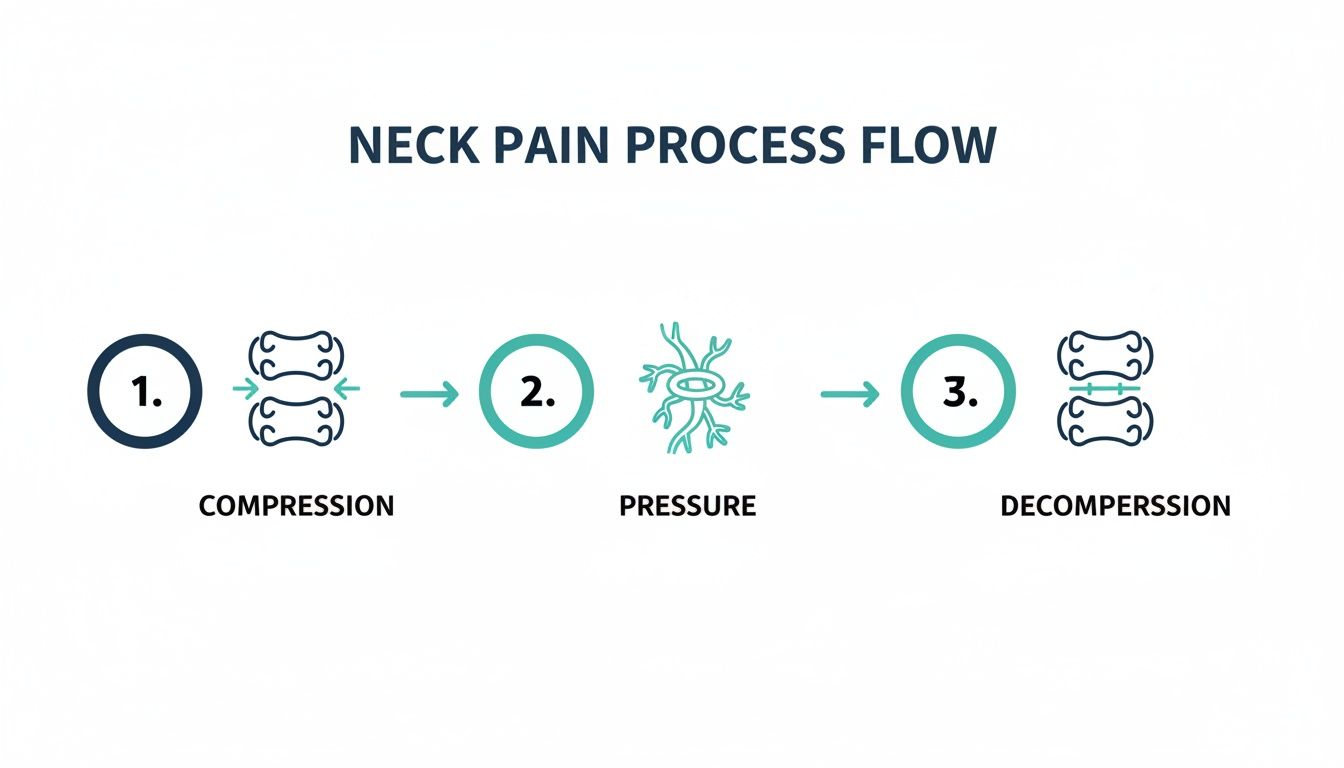
As you can see, we're essentially reversing the cycle of pain. By creating a little bit of space, we take the pressure off those sensitive nerves and discs.
This is probably one of the most accessible ways to decompress your neck at home. All you need is a bath towel. It lets you create a gentle, upward pull that mimics clinical traction but in a much milder, controlled way. The towel cradles the base of your skull, putting you in complete control of the intensity.
First, roll up a bath towel lengthwise so it's about three or four inches thick. Lie on your back on a firm surface—the floor or a yoga mat works great—with your knees bent and feet flat on the ground.
Slide the rolled towel behind your neck, getting it right up against the occipital ridge. That's the bony shelf you feel at the very base of your skull. Now, grab each end of the towel with your hands, palms facing up, and let your elbows rest comfortably on the floor.
From there, gently pull the towel forward and slightly upward, as if you're aiming for your forehead at a 45-degree angle. This should lift your head just a tiny bit off the floor, creating a subtle stretch all through the back of your neck.
My Pro-Tip: The magic word here is gentle. No sudden yanks or jerky movements. The pull should be slow, steady, and sustained. Hold this light traction for 20-30 seconds, breathing deeply the whole time to let your neck muscles fully relax into the stretch. Slowly release, rest for a breath, and repeat this 3-5 times.
You should feel a pleasant lengthening sensation. If you feel any pinching, you're likely pulling too hard or at the wrong angle. Just ease up on the force or adjust your pull until it feels like a comfortable release.
So many of us are stuck looking down at screens all day, which leads to that all-too-common forward head posture. This habit flattens the natural, healthy curve (the lordosis) in our cervical spine. This passive exercise is designed to gently push back against that flattening and help restore that crucial curve.
You'll need a standard foam roller for this one. Lay it on the floor, and then lie down on your back so the roller is positioned right in the curve of your neck. Your shoulders should be on the floor, not propped up on the roller.
Now, just relax and let your head gently drop back over the roller. Gravity will do all the work here. If it feels a little too intense at first, you can put a small pillow under your head to lessen the angle.
Try to stay in this position for 1-2 minutes, focusing on slow, deep belly breaths. You’ll probably feel tension releasing from the muscles in the front of your neck. As you get more comfortable, you can gradually work your way up to holding the position for as long as 5 minutes.
What makes this exercise so great is that it's completely passive. You're not actively tensing any muscles; you’re just allowing your spine to settle back into a more natural alignment. It’s perfect for the end of the day to undo all the postural stress from sitting. If this sounds like an issue you deal with, you might want to check out our detailed guide on forward head posture correction.
Sometimes you just need a quick reset during a long workday. This standing technique is perfect for that—no equipment needed, and you can do it anywhere. It simply uses your own hands to create that gentle decompressive force.
Start by sitting or standing tall with a neutral spine. Lace your fingers together and place your hands behind your head, so your palms are cradling the base of your skull. Your thumbs can rest along the sides of your neck.
Take a big breath in. As you breathe out, use your hands to gently lift your head straight up toward the ceiling. The feeling you're going for is making your neck longer. Keep your chin slightly tucked in so your head doesn't tilt back.
The lift should come entirely from your arms, not from you straining your neck muscles. Think of it as gently un-stacking the bones in your neck one by one.
Hold this upward lift for 10-15 seconds while you continue to breathe, then slowly release the pressure. You can repeat this 3-5 times whenever you feel that familiar stiffness or compression setting in. It's a fantastic little trick for fighting gravity and poor posture throughout the day.
Weaving these movements into your daily routine can truly make a world of difference. To give you a clear, at-a-glance reference, I've put together a simple guide summarizing these at-home exercises.
| Exercise | Technique Focus | Recommended Frequency | Primary Benefit |
|---|---|---|---|
| Towel-Assisted Traction | Gentle, upward pull at a 45-degree angle. | 3-5 reps, 30-sec hold, 1-2x daily. | Controlled decompression of the cervical spine. |
| Neck Extension | Passive extension over a foam roller. | 1-5 minutes, 1x daily (especially evening). | Helps restore the natural cervical curve. |
| Standing Self-Traction | Manual upward lift with interlaced hands. | 3-5 reps, 15-sec hold, as needed. | Quick relief from compression during the day. |
Think of this table as your starting point. You can complement these specific decompression techniques by exploring other helpful routines, like these 10 tech neck exercises, which can improve flexibility and manage discomfort. A well-rounded approach that combines decompression with gentle strengthening is usually the winning strategy for long-term neck health. Just remember to start slow and always focus on good form to make sure you're getting relief, not causing more strain.
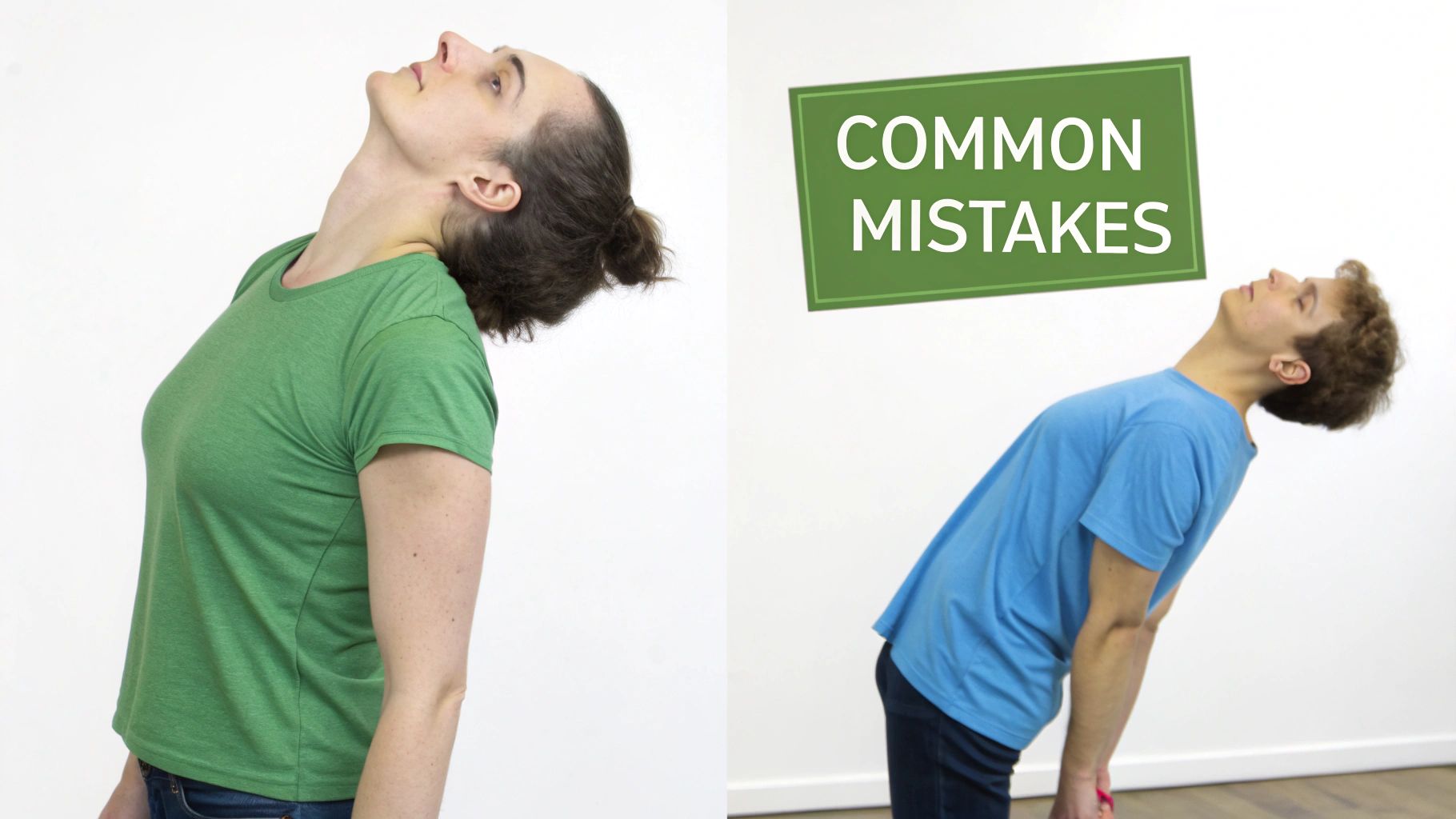
Getting these exercises right comes down to precision and paying attention to your body. The entire goal is gentle relief, but a few common missteps can easily cancel out your hard work or, even worse, make things feel worse. Knowing what not to do is just as important as knowing the proper technique.
One of the biggest mistakes I see is people simply pulling too hard, too soon. It’s a natural instinct—you want relief, so you think more force equals more relief. But the delicate structures of your neck just don't work that way. They respond best to slow, steady, gentle tension.
Think about trying to untangle a delicate necklace chain. If you just yank on it, you’ll only make the knot tighter. Your neck is similar; an aggressive stretch can make your muscles tense up to protect themselves, which is the exact opposite of what you want.
When it comes to neck decompression, speed is not your friend. Any kind of bouncing or jerky movement can send a jarring force through the small joints in your neck, potentially straining the very muscles and ligaments you're trying to help. Every single movement needs to be slow and deliberate.
If you're using a towel for traction, for instance, the pull should feel like a slow, gradual increase in tension, never a sudden jerk. This gives your muscles a chance to actually relax and let go, which allows the vertebrae to gently separate. Rushing the movement completely bypasses that process.
A good stretch should feel like a gentle lengthening, a subtle release of pressure. If you feel any sharp, shooting, or electric-like pain, that’s your body’s alarm bell. Stop immediately.
You can do the most textbook-perfect exercise, but if the rest of your body is slumped over, you’re just spinning your wheels. Your overall posture is the foundation for everything else.
A lot of people forget about the rest of their body and let their shoulders hunch forward or their low back round while they're focused on their neck. That poor alignment creates tension that travels straight up your spine, completely undermining the relief you’re trying to create.
Here's what to keep in mind:
Trying to decompress your neck while slouching is like trying to straighten out a kink in a garden hose while someone else is standing on it further down the line. You have to fix the foundational problem—your posture—to let the exercises do their job.
Lots of people can get relief from a stiff neck with these exercises, but they're a game-changer for a few specific conditions. It helps to know if you fit the profile, so you can go into it with the right expectations and feel good about where you're putting your effort.
These movements aren't just for a temporary crick in your neck from sleeping funny. They're designed to tackle deeper, structural issues where creating a little extra space in your spine can make all the difference.
If any of the following descriptions sound a little too familiar, you're probably in the right place. The common denominator here is some sort of compression—either a disc pushing on a nerve or the bones themselves getting too close for comfort. That’s exactly what these gentle traction exercises are meant to fix.
You're likely to feel the most significant improvement if you're dealing with:
Think of these exercises as a specific tool for compression-related symptoms. If your pain is coming from a simple muscle strain, you might still feel some relief, but the real magic happens when you're targeting disc and nerve issues.
In my world, we don't just guess who will respond to a treatment. We use something called a clinical prediction rule (CPR), which is basically an evidence-backed checklist of signs that point to a high chance of success.
And for neck traction, the research is pretty clear. One landmark study gave us a CPR that helps us spot patients who will almost certainly get better with a combination of neck decompression and strengthening exercises. When someone ticks four or more boxes on this list, the probability of a successful outcome skyrockets to 94.8%. You can dig into the details of this groundbreaking research on neck pain predictors yourself to see how we make these calls in the clinic.
Of course, a professional evaluation is always the best route. But knowing your symptoms line up with what the evidence says works can give you a lot of confidence to get started at home. For example, if you have radiating arm pain that actually feels better when you gently lift your head up (a little self-distraction), you're definitely on the right track.

While doing consistent, gentle neck decompression exercises at home is a great starting point, you have to know when it's time to call in a professional. Self-care is incredibly important, but it's not a magic bullet for every situation.
Ignoring certain red flags can not only prolong your misery but could make the underlying problem worse. Think of these exercises as step one; if they aren't getting you where you need to be, it's time for a specialist to take a closer look.
Sometimes, your body sends unmistakable signals that it's time for a professional evaluation. Pushing through these symptoms is never the answer. If any of the following sound familiar, put the at-home exercises on hold and make an appointment.
These are the "red flags" I always tell my patients to watch for. They often mean the issue is more than just tight muscles or a little bit of compression.
If at-home exercises aren't cutting it, that doesn't mean you've failed. It just means your neck needs a more powerful and targeted approach. This is exactly where clinical treatments, like non-surgical spinal decompression, enter the picture.
I often use this analogy: at-home towel traction is like gently wiggling a stuck zipper. Clinical decompression is like a specialist using a precise tool to methodically work that zipper free with a specific, computer-guided force you just can't duplicate yourself.
Professional decompression therapy involves sophisticated equipment that applies a controlled, highly targeted pulling force to your cervical spine. It creates a much stronger negative pressure inside the discs than any manual exercise can. This fosters a powerful healing environment for things like herniated discs or significant degenerative changes.
A chiropractor can pinpoint the exact angle and force your body needs, creating a safe, effective treatment that gets to the root cause of your pain and provides lasting relief.
Jumping into a new routine for your neck is bound to bring up some questions. That’s a good thing—it means you're being thoughtful about your health. Let's tackle some of the most common ones I hear from people so you can move forward safely and with confidence.
Think of this as the practical advice you'd get from a seasoned pro. Getting these details right helps you know what to expect and, more importantly, how to stay out of trouble.
This is always the first question, and the honest-to-goodness answer is: it really depends. Some people do a single, gentle towel traction and feel an immediate “ahhh” moment—a sense of release and space they haven't felt in years.
For others, especially if you're dealing with stubborn, long-term compression, it might take a couple of weeks of consistent effort to notice a real difference.
A few things really dictate your timeline:
If your pain gets worse, or if you feel zero improvement after about a week of gentle, daily practice, that's your body's signal to stop and get a professional opinion.
When you do them correctly, these exercises are incredibly safe. The golden rule is to be gentle and listen to what your body is telling you. That said, you can absolutely aggravate an issue if you get too aggressive or if the exercise simply isn't the right one for your specific problem.
Burn this rule into your memory: stop immediately if you feel any sharp, shooting, or radiating pain. Increased numbness or a sudden wave of dizziness are also non-negotiable red flags. If you have a history of severe osteoporosis, known spinal instability, or any recent trauma, you absolutely need to get a doctor's clearance before trying any of this.
That occasional pop or crack, which we call crepitus, is usually nothing to worry about. It’s a lot like cracking your knuckles—often just a harmless release of gas from a joint. As long as the sound doesn't come with a side of pain, it's generally fine.
Now, if you hear a loud pop that's immediately followed by a sharp spike in pain, that's a different story. The same goes for any cracking that is consistently painful every time you move a certain way. That kind of feedback could point to an underlying issue that needs a proper evaluation.
A painless crack is typically just noise. A painful crack is a message from your body that you need to pay attention to.
Many people also look for natural ways to complement their exercise routine. To help ease that lingering tension that often contributes to neck discomfort, some find that topical applications can really help. You can learn more about using peppermint oil for head and neck tension relief as a soothing addition to your self-care plan.
At Bonesetters Critical Chiropractic, we believe expert guidance is the key to lasting relief. If at-home exercises aren't cutting it, our team is here to provide a more targeted, evidence-based approach. We use advanced, non-surgical techniques to get to the root cause of your neck pain. Schedule a consultation today and take the next step toward reclaiming your comfort and mobility by visiting us at https://bonesetters.org.