
The good news is that your spinal health is largely in your hands. When it comes to preventing a herniated disc, the most effective strategies are surprisingly straightforward but incredibly powerful. It all comes down to strengthening your core, mastering proper posture, lifting smarter, managing your weight, and dropping bad habits like smoking.
Think of these as daily investments that work together to take unnecessary stress off your spinal discs.
Let's cut through the noise and get right to the practical steps you can start today. Protecting your back isn't about some massive, intimidating life overhaul. It's about making small, consistent tweaks to the things you already do every day.
Your spine is the central pillar supporting your entire body. Giving it the right kind of support is fundamental to your long-term health and ability to stay active.
The goal here is to provide a clear, actionable roadmap, grounded in the same evidence-based, non-surgical philosophy we apply at Bonesetters Critical Chiropractic. This plan is designed to empower you, helping you feel confident and prepared to protect your back for years to come.
I've found that the most successful prevention strategies are built on five foundational pillars. Each pillar targets a different kind of stress on your spine—from the internal support your muscles provide to the external forces you encounter in your daily life. When you get these right, you build a resilient back that is far less vulnerable to injury.
It's a sobering statistic, but up to 85% of adults will grapple with significant back pain at some point. By focusing on these five pillars, you can dramatically shift the odds in your favor, moving from a position of reacting to pain to proactively protecting your spine.
This table breaks down these core strategies into simple, actionable daily habits.
A summary of the core strategies for protecting your spine, breaking down each pillar into actionable daily habits.
| Prevention Pillar | Why It Matters | Simple Daily Action |
|---|---|---|
| Strengthen Your Core | Your core muscles are a natural corset for your spine. They stabilize it and absorb shock during movement. | Spend 10 minutes doing core exercises like planks or bird-dogs three times a week. |
| Master Your Posture | Slouching or poor posture places uneven, constant strain on your discs, accelerating wear and tear. | Set a recurring alarm to check your posture every 30 minutes. Make sure your shoulders are back and your head is aligned over your spine. |
| Lift Smarter | Lifting improperly is one of the most common ways to cause an acute disc herniation by creating sudden, intense pressure. | Always bend at your knees, not your waist, and keep the object you're lifting close to your body. |
| Manage Your Weight | Every extra pound, especially around your abdomen, increases the daily load your lower back has to support. | Swap just one sugary drink for a glass of water each day. This helps manage weight and keeps your discs hydrated. |
| Quit Smoking | Nicotine constricts blood vessels, choking off the vital blood flow that keeps your discs nourished and able to heal. | Find resources to help you create a plan to quit. This is one of the single best things you can do for your spine. |
By incorporating these small changes, you create a powerful defense system for your back, protecting it from the cumulative damage that can lead to a herniated disc.
Before we dive into prevention, it helps to know exactly what we’re trying to protect. Forget the complicated medical jargon; let's break down your spine's design with a simple analogy. Grasping this will make it crystal clear why some movements are risky and others are your spine's best friends.
Picture your spine as a stack of building blocks—these are your vertebrae. Tucked between each of these bony blocks is a small, squishy shock absorber called an intervertebral disc. These little cushions are absolute workhorses, giving your spine flexibility and soaking up the impact from every step you take.
Now, imagine each disc is a jelly donut. It has a tough, fibrous outer layer (the donut part), which is called the annulus fibrosus. Inside is a soft, gel-like center (the jelly), known as the nucleus pulposus. When this system is in good shape, it’s a brilliant piece of natural engineering.
A herniated disc—often called a "slipped" or "ruptured" disc—happens when a crack forms in that tough outer layer, allowing some of the inner gel to ooze out. Just like jelly squeezing from a donut, this material can bulge and press on the highly sensitive nerves that run along your spine. The result? Pain, numbness, or weakness that can travel down your arms or legs.
This isn't usually a one-and-done injury. More often than not, it’s the final straw after a long period of gradual wear and tear, made worse by daily habits that put uneven stress on your spine. Understanding what puts you at risk is the first real step toward building a bulletproof back.
While you can't control everything, many of the biggest culprits behind disc herniation are well within your power to change. This is where your efforts will pay off the most.
A herniated disc often points to a bigger issue: the spine's delicate mechanics are off-kilter. Misalignments, sometimes called subluxations, can create hotspots of abnormal stress, leaving certain discs far more vulnerable. If you're curious about how spinal alignment affects your overall health, you might find our guide on what spine subluxation is insightful.
It's also realistic to acknowledge the factors you can't change. These don’t seal your fate, but they do mean you might need to be extra diligent with your prevention plan.
The real-world impact of these risks is huge. Lumbar disc herniation (LDH), for instance, can affect a shocking 22.77% of people in some regions, a number that dwarfs the global average. Research shows it most often strikes adults between 30 and 50, with men being twice as likely to be affected. You can read more about the research on LDH prevalence and risk factors to see the data for yourself.
By understanding these risks—both the ones you can change and the ones you can’t—you can build a smarter, more effective plan to protect your spine for life.
Alright, let's move from theory to action. Think of your core muscles as a natural, built-in brace for your spine. A strong, stable core isn't just about having six-pack abs; it's about the deep web of muscles in your back, abdomen, hips, and pelvis all working together to create stability and absorb daily shocks.
When these muscles are weak or inactive, your spine and discs are forced to pick up the slack, taking on forces they simply weren't designed to handle alone. This section is your playbook for building that protective muscular corset, shifting your body from a state of vulnerability to one of resilience.
This simple graphic shows exactly how a healthy disc can degrade into a herniated one, eventually pinching a nerve.
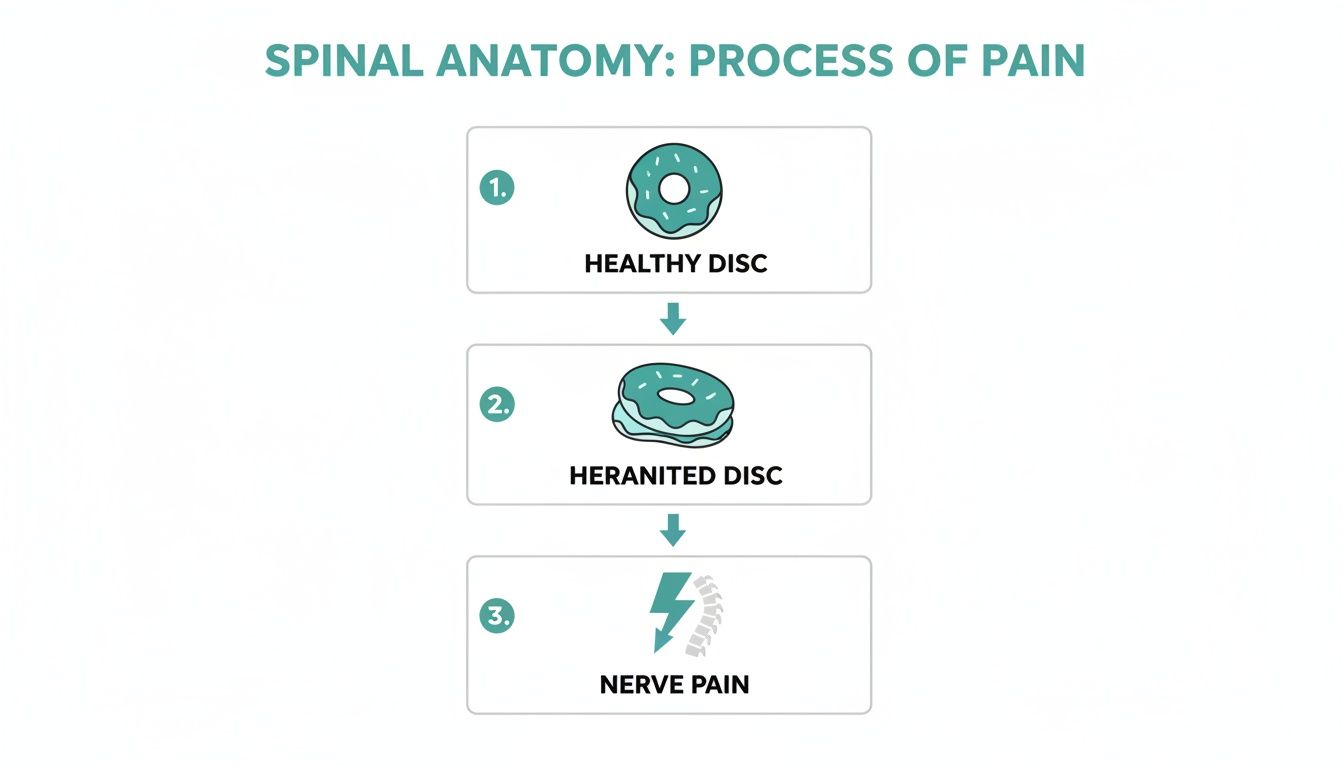
As you can see, protecting the disc's integrity from the start is the key to preventing that painful final stage. A strong core is your absolute first line of defense in keeping that disc healthy.
Many people think "core workout" and immediately jump to sit-ups and crunches. Here's the problem: those traditional exercises can actually put a ton of strain on your lumbar discs, potentially doing more harm than good if you're trying to prevent a herniated disc.
True core strength for spinal health is all about waking up and engaging the deep stabilizing muscles. We're going to focus on movements that teach your muscles to fire correctly, creating a solid platform for your spine as you move through your day. The goal here is consistency over intensity—a short, focused routine done regularly is far more powerful than an occasional, grueling workout.
Start with these simple but incredibly effective exercises. They’re designed to activate those deep core muscles without putting any unnecessary stress on your back. The key is to focus on slow, controlled movements and perfect form.
These foundational movements are the perfect place to start, but building a well-rounded routine is what really counts. After all, a strong core is your best defense against a herniated disc. You can learn more about the best core workouts for a stronger midsection to find exercises that provide that vital support.
Expert Tip: When you're doing any core exercise, imagine someone is about to gently push you from the side. That natural bracing action you'd take? That's the feeling of true core engagement you're aiming for. It’s about creating stiffness and stability, not just sucking in your stomach.
Once you feel solid and stable with the foundational movements, it’s time to add a bit more of a challenge. Always remember, form is everything. If you feel your back arching or straining, it’s a signal to scale back.
The Plank
The plank is a cornerstone of core strength for a reason. It engages multiple muscle groups at once, building the endurance your spinal support muscles need.
The Glute Bridge
This move strengthens your glutes and hamstrings, which are crucial partners to your core muscles in supporting the lower back.
Even the best exercises can be useless—or even harmful—if done incorrectly. Keep an eye out for these common pitfalls to make sure you're protecting your spine, not putting it at risk.
| Common Mistake | Why It's Harmful | How to Correct It |
|---|---|---|
| Holding Your Breath | This increases internal pressure and can spike your blood pressure. | Breathe steadily and evenly through the entire movement. Exhale during the hardest part of the exercise. |
| Arching the Lower Back | It places direct compressive force on your lumbar discs, completely defeating the purpose of the exercise. | Keep your core tight to maintain a neutral (flat) spine. If you can't, make the exercise easier. |
| Moving Too Quickly | This uses momentum instead of muscle control, which reduces the exercise's effectiveness and raises your risk of injury. | Perform every repetition slowly and with deliberate control. Really focus on the muscle contraction. |
By building a strong and stable core, you're doing more than just preventing injury—you're creating a more resilient body that can handle the demands of daily life with confidence. If you're already dealing with some back discomfort, these exercises can often still help, but getting a proper evaluation first is always the smartest move. Many people find that pairing a solid core routine with other targeted movements provides significant relief. In fact, you might want to explore the best exercises for lower back pain relief to complement your prevention efforts.

While targeted exercise builds a strong foundation for your spine, the real battle is won or lost in the small, repetitive movements you make every single day. It's the thousands of times you sit, bend, lift, and twist that either protect your discs or slowly grind them down.
The goal isn't to wrap yourself in bubble wrap and fear movement. It’s about moving smarter. By transforming unconscious, potentially risky habits into conscious, spine-safe actions, you can drastically reduce the daily wear and tear on your back.
Let's be honest, for many of us, our desk is where our back problems begin. Spending eight hours a day slumped in a bad chair or hunched over a laptop puts a constant, damaging load on your lumbar discs. Nailing your ergonomic setup is one of the most powerful preventative moves you can make.
And this isn't just for people in a traditional office. The same principles apply whether you’re driving for a living, working from a home office, or even just surfing the web at your kitchen table. The key is to arrange your environment to support your spine's natural curves, not force it into painful, unnatural positions.
A few simple tweaks can make a monumental difference. Your chair needs to support your low back's natural curve, your feet should be flat on the floor, and your monitor must be at eye level to stop your head from drifting forward and straining your neck.
I’ve seen countless patients invest in an expensive "ergonomic" chair but fail to actually adjust it to fit their body. A $1,000 chair is useless if your hips are below your knees and you're still craning your neck to see the screen. The setup is everything.
I put together this simple checklist to help you audit your own workspace. It breaks down the most important elements for proper spinal alignment and points out the common mistakes I see every day.
| Ergonomic Element | Optimal Setup | Common Mistake to Avoid |
|---|---|---|
| Chair Height | Your feet should rest flat on the floor with your knees at a 90-degree angle, level with or just a bit lower than your hips. | Sitting so low your knees are pushed up, which rounds your low back. Sitting too high puts a ton of pressure on your hamstrings. |
| Lumbar Support | The chair's backrest should have a curve that fits perfectly into the small of your back. If it doesn't, a small pillow or rolled-up towel works wonders. | Leaving a gap between your lower back and the chair. This forces your muscles to work overtime and leaves your lumbar discs totally unsupported. |
| Monitor Position | The top of your screen should be at or just below eye level, about an arm's length away. | Placing the monitor too low or too far away. This is a one-way ticket to "text neck" and upper back pain. |
| Keyboard & Mouse | Keep them close enough that your elbows stay relaxed by your sides, bent at a comfortable 90-degree angle. | Reaching forward for your keyboard or mouse. This rounds your shoulders and puts a huge strain on your neck and upper back. |
"Bend with your knees" is decent advice, but it's only half the story. Proper lifting is a full-body, coordinated movement that protects your back from the sudden, intense pressure that can blow out a disc. It’s about bracing your core, using your powerful leg muscles, and avoiding those dangerous twisting motions at all costs.
Let's walk through a couple of real-world examples.
This is a classic high-risk move because it combines bending, reaching, and lifting all at once.
This is another tricky one because it’s usually a quick, reactive movement.
The core principles never change: keep the load close to your center of gravity, maintain a straight spine, and always, always let your legs do the heavy work. This mindful approach turns everyday chores into an opportunity to reinforce good habits and protect your back for years to come.
What you do outside the gym or away from your desk matters just as much as your exercise routine. Your daily lifestyle choices can either build up your spinal resilience or slowly break it down.
Let's dig into three game-changers for disc health: managing your weight, eating to fight inflammation, and understanding the serious damage smoking does to your spine.
Think of your lower back as a hinge that bears a massive amount of weight. Every extra pound you carry, especially around your midsection, multiplies the compressive force on your lumbar discs.
This isn't a small thing. It’s a constant, day-in, day-out strain that speeds up wear and tear, making the tough outer wall of your discs brittle and vulnerable. Getting your weight into a healthy range is one of the most direct and effective ways to give your spine a break.
Even a modest weight loss of just 5-10% can dramatically reduce the daily load on your spine. This isn't about aesthetics; it’s about physics.
Your discs are living tissues. Just like muscles need protein to repair, your discs need specific nutrients to stay strong, hydrated, and flexible. It all starts with what you eat.
An anti-inflammatory diet is key. Loading up on fruits, vegetables, lean proteins, and healthy fats helps calm the low-grade inflammation that accelerates disc degeneration. On the flip side, processed foods, sugar, and unhealthy fats pour fuel on that fire.
A few things to add to your grocery list:
Hydration is equally critical. Your discs are mostly water—it’s what gives them that spongy, shock-absorbing quality. When you're dehydrated, they can literally shrink and lose their resilience, putting you at a much higher risk for injury. Aim for at least eight glasses of water a day to keep them plump and healthy. For more ideas, our guide on foods that help nerve pain is a great resource.
Sleep is when your spine finally gets to decompress and heal. If you wake up sore, your mattress might be the culprit. Looking into the best mattress toppers for bad backs can be a simple fix that makes a huge difference.
If you do one thing for your spine, quit smoking. The nicotine in cigarettes and vape products is a vasoconstrictor, which means it aggressively squeezes your blood vessels shut.
This process starves your spinal discs of the oxygen and nutrients they need to survive. Without a healthy blood supply, they can't repair themselves from daily micro-trauma. They slowly start to dry out, becoming brittle and far more likely to tear or herniate. The link is so direct that smoking is considered a primary risk factor for degenerative disc disease.
Here’s a startling fact: A 2018 study involving nearly 1,400 lumbar surgery patients found that smoking was the #1 predictor for re-herniating a disc. With 5 to 20 cases of herniated discs per 1,000 adults occurring annually, prevention is everything.
Quitting is tough, no question. But it's also the single most impactful step you can take for long-term spine health. The benefits start almost immediately as blood flow improves, kick-starting your body's natural ability to heal.
Even when you're committed to a plan, some questions always pop up. Let's tackle some of the most common ones I hear from people who are serious about protecting their backs. Getting these details right can make all the difference.
There’s no magic bullet to guarantee you'll never have a disc issue, especially since we can't control aging or our genetic makeup. But can you dramatically stack the odds in your favor? Absolutely.
Think of it this way: you can't guarantee you'll never get a cavity, but brushing your teeth and avoiding sugar makes it highly unlikely. The same logic applies here. By consistently strengthening your core, lifting smart, maintaining a healthy weight, and staying active, you build a spine that can handle life’s demands. You’re taking control of every controllable risk factor, which is a powerful thing.
Disc problems rarely happen overnight. They usually whisper before they shout. The earliest signs are often subtle and easy to brush off as just a "tweak" or a "stiff back."
Keep an eye out for these early signals:
Catching these signs early and getting them checked out is the key to stopping a minor annoyance from turning into a full-blown herniation.
This is where people often overcomplicate things. You don't need to spend an hour in the gym every day. When it comes to building a protective corset of muscle around your spine, consistency beats intensity every time.
A good goal for most people is 10-15 minutes of focused core work, 3 to 5 days a week. That’s it. A simple routine of planks, bird-dogs, and glute bridges—done with perfect form—is far more effective than hours of random ab exercises. This kind of routine builds deep muscular endurance, so your spine is supported automatically as you move through your day.
"I see so many people who think they need an intense, 'hardcore' workout to protect their back. The reality is that a few minutes of slow, controlled movements done consistently builds a much stronger and more resilient spine than an occasional, punishing gym session."
Yes, without a doubt. For most people with chronic or recurring back pain, these very strategies are the foundation of their recovery. When you strengthen the core muscles, you’re essentially building a natural brace to support the injured area. When you improve your posture, you stop adding unnecessary strain.
The crucial first step, however, is to get a proper diagnosis. You have to know exactly what you’re dealing with. Performing the wrong exercises on an already angry disc can make things much worse. A professional evaluation will pinpoint the cause of your pain and guide you toward movements that are safe and effective for your specific condition.
At Bonesetters Critical Chiropractic, our goal is to give you the tools and knowledge to protect your spine for the long haul. Whether you're dealing with existing pain or want to build a rock-solid prevention plan, our evidence-based, non-surgical approach can give you the clarity and support you need. Schedule your consultation today at https://bonesetters.org and take the first step toward lasting spinal health.