
The good news is that a bulging disc can often be managed—and even improved—with the right approach. It's not about one magic fix, but a combination of targeted exercises, posture adjustments, and smart lifestyle changes that work together to strengthen the muscles supporting your spine.
The real key is to get pressure off that irritated nerve. We do this through gentle movement, strategies to calm inflammation, and consistent, proactive care. True, lasting relief comes from fixing the root cause of the problem, not just chasing the pain.
Hearing the words "bulging disc" can be pretty unnerving. But it's a far more common and manageable issue than most people think. The first step toward feeling better is to shift your mindset from fear to empowerment by understanding what’s actually happening inside your back.
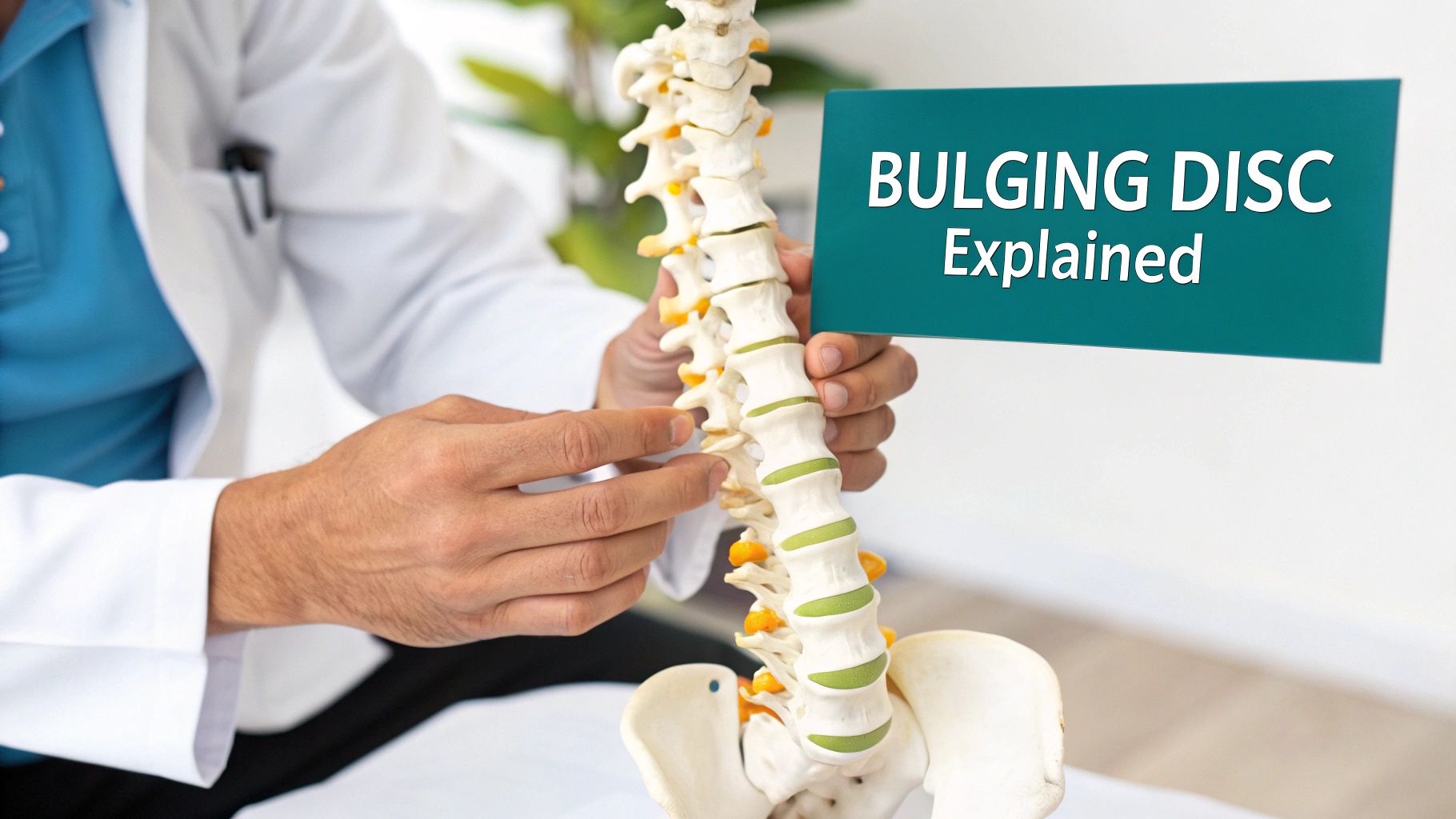
I often tell my patients to think of their spinal discs as little jelly-filled donuts tucked between each of their vertebrae. They're your body's natural shock absorbers, letting your spine bend and twist without bone grinding on bone.
A bulging disc happens when the tough outer layer of that "donut" weakens and starts to swell outward. Imagine a car tire that's a bit low on air and bulges out on the sides—it's a very similar idea.
Now, the bulge itself isn't always the problem. Plenty of people walk around with bulging discs and have no idea. The pain starts when that bulge pushes on a nearby spinal nerve. That's what can trigger that sharp, localized pain or the numbness and tingling that travels down an arm or leg. This is a classic sign of nerve irritation, which you can learn more about in our detailed guide on what is radiating pain.
It's so important to remember that a bulging disc is not a life sentence of pain. This is an incredibly common condition, affecting an estimated 266 million people worldwide every year.
What's really fascinating is how many cases show no symptoms at all. A landmark 2015 study found disc bulges in 30% of healthy 20-year-olds and a staggering 84% of 80-year-olds, most of whom never felt a thing.
For those of us who do have symptoms, the goal is simple: create an environment where the body can heal itself. This means getting the inflammation down, decompressing the spine to give the disc space, and building up a stronger support system with your core muscles.
You'll often hear people use "bulging" and "herniated" as if they're the same thing, but they actually describe two different stages of a disc injury. Knowing the difference helps you understand your diagnosis and set the right expectations for recovery.
In short, a bulge is a generalized swelling. A herniation is more like a specific blowout.
To make it crystal clear, here’s a quick breakdown of how they compare.
| Characteristic | Bulging Disc | Herniated Disc (Prolapsed) |
|---|---|---|
| Disc Shape | The disc swells and protrudes evenly around its edge, kind of like an underinflated tire. | The gel-like inner core breaks through a tear in the tough outer wall, creating a distinct protrusion. |
| Nerve Impact | May or may not press on a nerve root, depending on how big and where the bulge is. | Much more likely to directly hit a nerve, often causing more intense symptoms. |
| Common Cause | Usually develops gradually from age-related wear and tear, chronic poor posture, or repetitive strain. | Typically caused by a sudden injury, lifting something improperly, or an untreated bulge that got worse. |
Ultimately, seeing a bulging disc on a report is a clear signal from your body. It's telling you that your spine needs better support. By focusing on the root causes—like a weak core or poor daily movement habits—you can not only find relief but also build a much more resilient back for the long haul.
When that sharp, debilitating pain from a bulging disc hits, your world can shrink in an instant. The first 24 to 48 hours are absolutely critical. Your immediate reaction can either set you on the path to a faster recovery or make things significantly worse.
This isn't the time for complex rehab exercises. Right now, it's all about crisis management. The goal is simple: calm the inflammation, get pressure off the nerve, and give your body a chance to start healing.
The most powerful thing you can do when the pain is screaming is to let gravity help you, not hurt you. Lying down takes the load off your spine, but how you lie down makes all the difference. You're looking for a position that lets your back muscles completely let go.
Here are the two positions I've seen bring the most immediate relief to my patients:
On Your Back, Knees Up: Lie on the floor (not a soft bed) and slide two or three firm pillows under your knees. This simple trick tilts your pelvis just enough to flatten the curve in your lower back, instantly taking pressure off those lumbar discs. For many, it's a huge "ahhh" moment.
On Your Side, Pillow Between Knees: If lying on your back doesn't feel right, try curling up on your side. Tuck a pillow between your knees to keep your hips and spine perfectly aligned. This prevents the subtle twisting that can keep a nerve irritated.
Give both a try. One will likely feel much better than the other. Settle into that position and just focus on your breathing.
I know a warm heating pad sounds comforting, but in the first 48 hours of a flare-up, it's the last thing you want. Heat draws more blood and fluid to the area, which can actually crank up the inflammation around an already angry nerve.
Instead, ice is your best friend. Cold constricts the blood vessels, which helps numb the area and, more importantly, reduces the swelling that's causing the nerve compression.
How to Do It Right: Grab an ice pack or even a bag of frozen vegetables and wrap it in a thin towel—never put ice directly on your skin. Place it right over the most painful spot for 15-20 minutes. You can do this every hour or two to keep the pain and swelling under control.
The old advice of complete bed rest is out. We now know that staying completely still for days on end leads to stiffness and actually slows down your recovery. The trick is finding gentle movement that doesn't provoke pain but creates space in the spine.
The single best movement for this is the prone press-up.
Think of this as gently nudging the disc material away from the nerve. It’s a form of self-treatment that can provide incredible relief.
What you don't do right now is just as important as what you do. Steer clear of these common pitfalls that can set you back:
When you're dealing with a bulging disc, short-term fixes just don't cut it. Real, lasting relief comes from building a stronger, more supportive core that acts like a natural brace for your spine. This is the crucial next step after you’ve calmed the initial, acute pain—it's how we build long-term resilience.
A strong core essentially takes the load off your vulnerable discs. Picture your spine as a tall mast on a ship. Your core muscles—the abs, obliques, and deep spinal muscles—are the rigging holding it steady. When that rigging is strong and active, the mast stays stable through any storm. When it's weak, the mast is vulnerable, and in your case, that vulnerability is felt in your disc.
The exercises that follow are a starting point. We're not trying to build a six-pack here; we're focused on stabilization and control. Perfect form is everything. It's far more important than how many reps you can do. The principle is simple: movement is medicine, but only when it's the right movement, done correctly.
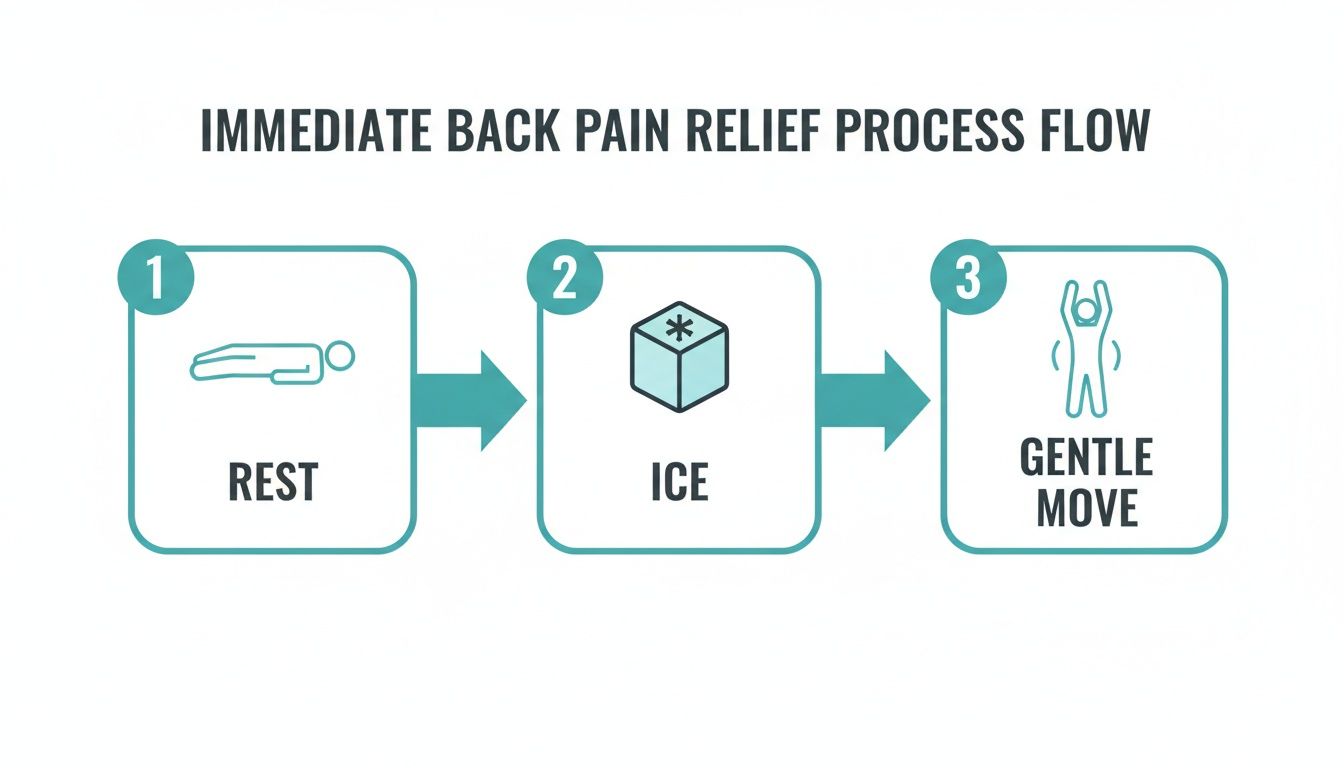
This simple flow from rest to ice to gentle movement is the foundation. It’s what calms a flare-up and gets your body ready for the real work of rehabilitation.
First, we need to re-engage the deep core muscles without putting any strain on your lower back. Think of these less as exercises and more as re-establishing a conversation between your brain and your body's innate support system.
Pelvic Tilts: Lie on your back, knees bent, feet flat on the floor. Without lifting your hips, gently flatten your lower back against the floor by tightening your stomach muscles. Hold that subtle engagement for 5-10 seconds, then relax. This simple move teaches you to control your pelvis, which is the foundation of your entire spine.
Glute Bridges: Starting in the same position, gently squeeze your glutes and lift your hips off the floor until your body forms a straight line from your shoulders to your knees. Don't over-arch your back. Pause for a moment at the top, then slowly lower yourself back down. This fires up the glutes, which are major supporters of the lower back.
Remember the pain-free rule. If any exercise causes sharp, shooting, or radiating pain, stop immediately. A mild feeling of muscle fatigue is okay, but pain is your body's signal to back off.
Once you’ve mastered those foundational moves and can do them without pain, it's time to challenge your stability. The goal now is to train your core to prevent unwanted twisting or arching of the spine while you move—exactly what it's supposed to do in your daily life.
The Bird-Dog exercise is perfect for this.
This movement is a game-changer because it teaches your body to maintain a stable spine while your limbs are in motion. Beyond direct core work, you also need to strengthen the muscles that support your spine, like your hip stabilizers. You can find some excellent gluteus medius and gluteus minimus exercises for strength and stability to build a more robust support system around your pelvis.
While bending forward often aggravates a bulging disc, gentle backward bending (extension) can feel incredibly therapeutic. It can help gently encourage the disc material to move forward, away from sensitive spinal nerves. The prone press-up we talked about for immediate relief is the classic example.
As you get stronger, you can explore other gentle extension exercises. For anyone looking for more detailed guidance on the safest and most effective movements, our clinic has put together a comprehensive resource. Feel free to explore our guide on the best exercises for lower back pain relief to safely expand your routine.
The key to all of this is consistency. A short routine of these stabilization exercises performed daily is far more effective than one long, intense workout once a week. You're not just exercising; you're retraining your body to support itself properly, building a strong, resilient spine that can protect you from future pain.
The exercises and stretches you do are vital, but they're only one part of the equation. What about the other 23 hours of your day? How you sit, sleep, and go about your daily tasks can either speed up your healing or completely sabotage your efforts.
You have to think of your daily habits as the ecosystem your spine lives in. Making that environment supportive is an absolute must if you're serious about getting lasting relief from a bulging disc.
This goes way beyond your mom telling you to "sit up straight." We're talking about small, conscious adjustments to your environment that chip away at the constant stress on your discs. Over time, these little changes add up in a big way, transforming your home and office from places that trigger pain into spaces that actually promote recovery.
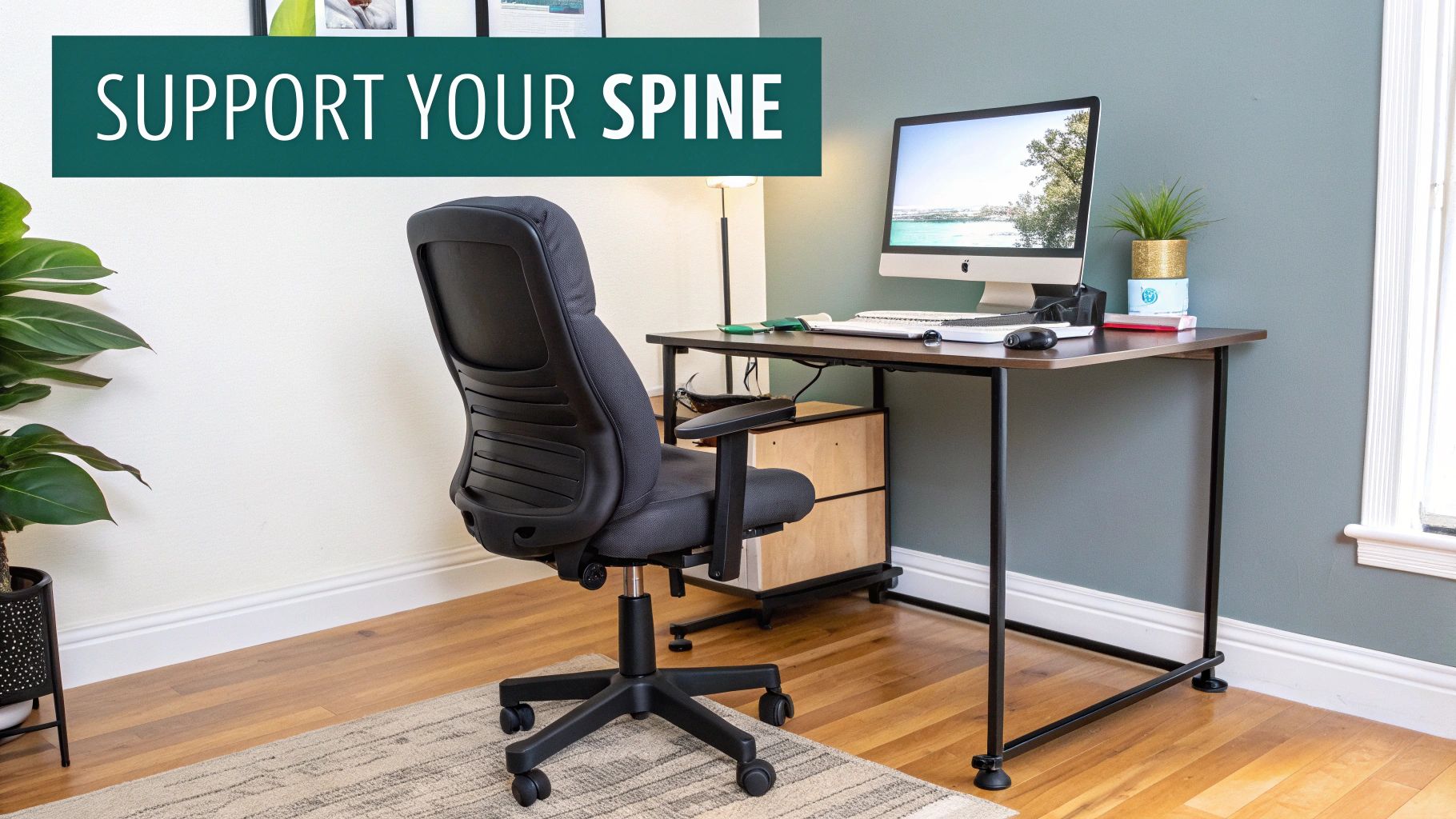
Let's be honest: for most of us, our desk is where a lot of the damage happens. Sitting for hours in a slumped position puts a relentless load on the discs in your lower back. But a few simple ergonomic fixes can turn your workstation from a pain point into a recovery station.
Start with your screen. Position your monitor so the top third is at eye level. This simple trick helps prevent that forward-head posture that pulls your entire spine out of alignment. If you're on a laptop all day, do your spine a favor and get an external monitor or at least a laptop stand.
Now, let's look down at your foundation. Your feet should be planted flat on the floor, with your knees bent at about a 90-degree angle. If your feet are dangling, grab a small footrest or even a stack of books. This keeps your pelvis in a neutral position, which is critical for maintaining your lower back's natural curve and taking pressure off those discs.
The goal here is to create a setup where your spine can hold its natural "S" curve without you having to constantly think about it. If you feel that familiar ache in your neck, shoulders, or low back after an hour at your desk, that's your body screaming that your setup is wrong.
Sleep is prime time for your body's repair crew to get to work. When you're dealing with a bulging disc, this is a non-negotiable healing window. But the wrong sleep posture can pile on hours of strain, making you wake up feeling even worse than when you went to bed.
From what I've seen with patients, two positions work best for taking the pressure off a sensitive spine:
A huge part of optimizing your environment is the surface you sleep on. It's worth digging into choosing the right mattress for back problems because the right support can be a game-changer.
Finally, you have to stay mindful of how you move throughout the day. Safe lifting techniques aren't just for the gym—they're for unloading the dishwasher, picking up the laundry basket, and grabbing that case of water from the car.
The one move to master is the hip hinge. Never, ever bend from your waist with a rounded back. Instead, always bend at your hips and knees, keeping your core engaged. Hold whatever you're lifting close to your body to reduce the strain on your spine.
Think about loading the dishwasher. Instead of bending over from a standing position, try kneeling on one knee. This small shift in technique keeps your spine protected and transforms a risky chore into a safe one.
So, you've done everything right at home. You've adjusted your daily activities, diligently performed your core exercises, and set up your workspace to be as ergonomic as possible—but the pain, numbness, or tingling just won't quit. This is a frustrating place to be, but it’s far from the end of the road. It certainly doesn't mean surgery is your only path forward.
When your best efforts with self-care aren't cutting it, it’s time to look at what's next. This is the perfect point to explore advanced, non-surgical treatments. These are powerful, evidence-based therapies designed to get to the root cause of the problem—the mechanical pressure and inflammation—without the risks and recovery time of an invasive procedure.
One of the most effective non-surgical options we have for a bulging disc is spinal decompression. The best way to think about it is creating a gentle, healing vacuum effect right where you need it most.
You lie comfortably on a highly specialized table as a computer-controlled system applies a precise, gentle pulling force to your spine. This process carefully separates the vertebrae, which accomplishes two critical things. First, it drops the pressure inside the disc, creating a negative pressure that helps draw the bulging material back toward the center. Second, it pulls in a fresh supply of oxygen, water, and nutrients that are absolutely essential for the disc to start healing itself.
Don't confuse this with old-school traction. Spinal decompression is a far more sophisticated therapy. It intelligently cycles between a gentle pull and a period of relaxation, which cleverly bypasses the body's natural tendency to tense up. It’s designed to be a comfortable, pain-free experience that directly addresses the underlying mechanical fault.
If you're curious about the technology behind this, our deep dive into the mechanics of a spinal decompression chair breaks down exactly how it works to foster healing.
More often than not, a bulging disc is connected to underlying spinal misalignments that have created uneven pressure on that disc for years. While traditional manual adjustments can be very effective, a more precise and gentle approach is often a game-changer for someone dealing with acute disc pain.
This is where computer-guided adjustment systems like PulStar come in. Instead of the traditional twisting or "popping," this FDA-cleared technology uses a gentle, targeted impulse to restore proper alignment.
Here’s a quick look at the process:
This level of precision is a huge benefit when you have a painful disc bulge, as it avoids any sudden, forceful movements that could make things worse.
When you're dealing with a bulging disc, understanding your treatment options is key. Each of these advanced therapies targets a different aspect of the problem, and they often work best when used together. Here’s a simple breakdown of how they compare.
| Treatment | How It Works | Primary Benefit |
|---|---|---|
| Spinal Decompression | Creates negative pressure inside the disc by gently separating the vertebrae. | Helps retract the disc bulge and pulls in healing nutrients. |
| Computer-Guided Adjustments | Uses precise, gentle impulses to correct spinal misalignments. | Restores proper joint mechanics to remove uneven stress on the disc. |
| Class IV Cold Laser | Delivers light energy to cells to stimulate metabolic activity. | Reduces inflammation, speeds up tissue repair, and alleviates pain. |
Ultimately, a comprehensive plan that combines these approaches gives you the best shot at a full recovery by addressing the mechanical, structural, and chemical aspects of your disc injury all at once.
Inflammation is public enemy number one when you have a bulging disc. The pressure on the nerve triggers a chemical firestorm, leading to pain, swelling, and constant irritation. Class IV Cold Laser Therapy is a fantastic non-invasive tool that tackles this inflammation at a cellular level.
This therapy uses specific wavelengths of light that penetrate deep into the tissues around the disc. This light energy stimulates the mitochondria—the "powerhouses" inside your cells—which kicks off a powerful healing response:
The treatment itself is completely painless; most people just feel a gentle, soothing warmth. It’s a perfect partner to decompression and adjustments because it calms the irritated nerve while the other therapies fix the mechanical problems.
The results can be truly remarkable. Clinical data shows treatments like Class IV cold laser can reduce inflammation by 30-50% in just a handful of sessions. And remember, non-surgical approaches have an excellent track record. Studies show that conservative care works for the vast majority of people—in fact, up to 97% of disc prolapse cases have been shown to resolve without surgery.
When you're dealing with a bulging disc, a million questions probably run through your mind. It’s completely normal. Knowing what to expect and how to handle the day-to-day realities can give you a sense of control over your own healing. Let's tackle some of the most common questions I hear from patients every day.
Remember, recovery is almost never a straight line. You'll have good days and not-so-good days. The key is understanding the process so you can stay the course without getting discouraged.
This is the big one, and the honest-to-goodness answer is: it depends. For most folks with a mild or moderate bulge, we often see a big improvement in symptoms within four to six weeks of sticking to a consistent care plan. That means doing your gentle exercises, fixing your posture, and taking steps to calm the inflammation.
But that's just the initial phase. The actual healing of the tough outer fibers of the disc can take several months. A few things really influence that timeline:
The best advice I can give is to stop watching the calendar and start paying attention to your progress. Are you moving a little easier this week than last? Is the pain showing up less often? Those are the real signs you're heading in the right direction.
The goal here isn't to just sit around and wait for the pain to vanish. It's about actively creating the right environment—through specific movements, better ergonomics, and smart daily choices—that lets the disc heal properly and build resilience against future problems.
Sometimes, yes. The body has an amazing capacity to clean up inflammation and even reabsorb some of the disc material, especially with minor bulges. Plenty of people have back pain that just sort of fades away on its own after a few weeks.
However, "healing on its own" shouldn't mean "do nothing." Just resting and waiting it out can backfire. Your supporting muscles get weak and your joints get stiff, which can leave you even more vulnerable to another flare-up down the road.
Being proactive is always the smarter play. When you do the gentle exercises, use the pain-relieving positions we've talked about, and make those ergonomic tweaks, you're giving your body a massive helping hand. You're speeding up its natural healing process. That's the difference between passively waiting and actively recovering.
Getting back to the gym, the trail, or the court is a huge goal, but jumping back in too soon is one of the biggest mistakes I see. The secret is a slow, gradual return where pain is your guide. If you feel that sharp, familiar pain, that's your body screaming "stop!"—it's a sign you're re-injuring the area, not making it stronger.
Here’s a simple framework to follow:
Your body will tell you what it can handle, you just have to listen. A bit of general muscle soreness is fine, but if any of that sharp, shooting, or nerve-like pain comes back, you have to pull back immediately. This journey is a marathon, not a sprint. A little patience now will save you from a major setback later.
At Bonesetters Critical Chiropractic, we know that no two recovery paths are the same. If you're feeling stuck with persistent pain or just have questions about your situation, our team, led by Dr. Leonard Hayes, is here to help. We focus on evidence-based, non-surgical solutions that get to the root cause of your pain. By combining advanced therapies like spinal decompression and computer-guided adjustments, we build a personalized plan to help you heal for good and get your life back.
Ready to move beyond the pain? Explore our patient-focused approach and schedule your consultation today.