

Finding the right chiropractor is about so much more than a quick search for "chiropractor near me." You're looking for a healthcare partner, someone who digs deep to find the root cause of your pain using evidence-based methods, not just mask the symptoms.
This choice is a major fork in the road for your health. One path leads to temporary fixes, while the other leads to genuine, long-term healing.

Let's be honest, navigating the world of chiropractic care can be confusing. When you're in pain from something like a disc injury, sciatica, or peripheral neuropathy, the last thing you want is more uncertainty. The field is surprisingly diverse—you’ll find a wide range of philosophies, techniques, and technologies from one office to the next.
Some clinics stick to traditional manual adjustments, which might give you a bit of temporary relief. But a modern, forward-thinking practice will go much further, investing in a comprehensive diagnostic process to pinpoint what’s actually causing your pain. This is the difference-maker for your long-term health.
A great chiropractor is a guide on your health journey, not just a practitioner you see for a few minutes. They build a personalized plan to restore your body’s function, not just turn down the volume on your pain.
This commitment to evidence-based protocols is crucial. It means their treatment methods are backed by solid scientific research and clinical results. They don't just "crack your back" and send you on your way; they use a thoughtful, multi-faceted approach that encourages real healing.
Think about someone dealing with debilitating knee pain. A symptom-focused approach might just offer a few adjustments around the area. An evidence-based specialist, on the other hand, might use advanced diagnostics followed by a treatment like non-surgical knee decompression to address the joint itself. That’s a path toward measurable, lasting improvement.
Think of this process as an interview. You are hiring a professional to manage a critical aspect of your health. Settling for the first option you find could be the difference between a temporary patch and true recovery.
Ultimately, knowing how to choose a good chiropractor puts you in the driver's seat. When you know what to look for—from specific credentials to the use of modern technology—you can confidently find a provider who truly gets your goals.
The right professional won’t just help you feel better in the short term. They’ll educate you, giving you the knowledge and tools to maintain your progress for years to come. This guide will give you the roadmap to tell the difference between average care and exceptional, life-changing results.
Finding a top-notch chiropractor means looking beyond the basic "D.C." (Doctor of Chiropractic) after their name. While that license is the absolute minimum—it confirms they graduated from an accredited college and passed national boards—it’s just the starting line. The real difference between a good chiropractor and a great one often lies in their postgraduate education and specialized certifications.
Think of it this way: your family doctor is perfect for annual check-ups, but you’d want a cardiologist for a serious heart condition. The same idea applies here. A general chiropractor is often great for common aches and pains, but if you're dealing with stubborn sciatica, a severe disc injury, or peripheral neuropathy, you really want someone with advanced, specialized training.
Postgraduate credentials are a huge tell. They show a deep commitment to a specific area of care and involve hundreds of extra hours of intense study, hands-on training, and tough exams. This is the kind of specialized knowledge that allows a doctor to build a sophisticated treatment plan for conditions that just don't respond to standard adjustments.
Here are a few key certifications to keep an eye out for and what they mean for your care:
These aren't just fancy letters. They’re your assurance that the provider has proven, in-depth expertise to handle challenging cases.
Before you even think about booking a consultation, do a little homework. It’s easy and can save you a world of frustration. Every state has a licensing board where you can check that a chiropractor's license is active and in good standing. Just search online for "[Your State] Chiropractic Licensing Board," and you should find their verification portal quickly.
This step is non-negotiable. It confirms the practitioner meets the basic legal and ethical standards to practice.
Your goal is to match the chiropractor's specific expertise to your health needs. Don't settle for a generalist if your condition is complex. A specialist will understand the nuances of your pain and know precisely how chiropractors know where to adjust for maximum effectiveness.
Choosing a provider who focuses on evidence-based practices can make a world of difference in your outcome, especially if you're dealing with chronic pain. The research backs this up. A massive study involving over 8 million patients found that an incredible 96% were satisfied with their treatment. More recently, data shows that chiropractic patients with chronic conditions achieve 86.4% satisfaction rates, which is significantly higher than the 71% satisfaction rate for traditional medical care. These numbers really highlight the value of finding a skilled practitioner who's aligned with your health goals.
As you evaluate potential chiropractors, run through this quick mental checklist to see if they’re a true specialist:
By taking the time to decode these credentials, you're moving past the guesswork. You’re setting yourself up to find a nationally recognized expert who can offer a real solution, not just another temporary fix.
When you're trying to figure out how to choose a chiropractor, one of the first things you'll notice is that not all practices are the same. Broadly speaking, you'll run into two main camps: the more traditional, subluxation-focused model and a modern, evidence-based approach. Knowing the difference is a game-changer for finding care that actually works for the long haul.
A traditional chiropractor often zeroes in on the idea of "subluxations," or spinal misalignments, as the source of nearly all health problems. While your spine's alignment is definitely important, an evidence-based practitioner takes a wider, more comprehensive view. They'll use a full diagnostic process to find the real root of your pain—whether that's a disc injury, a pinched nerve, or a soft tissue problem—and build a treatment plan based on solid, current scientific research.
This is why looking at credentials is so important. You want someone who goes beyond the basics.
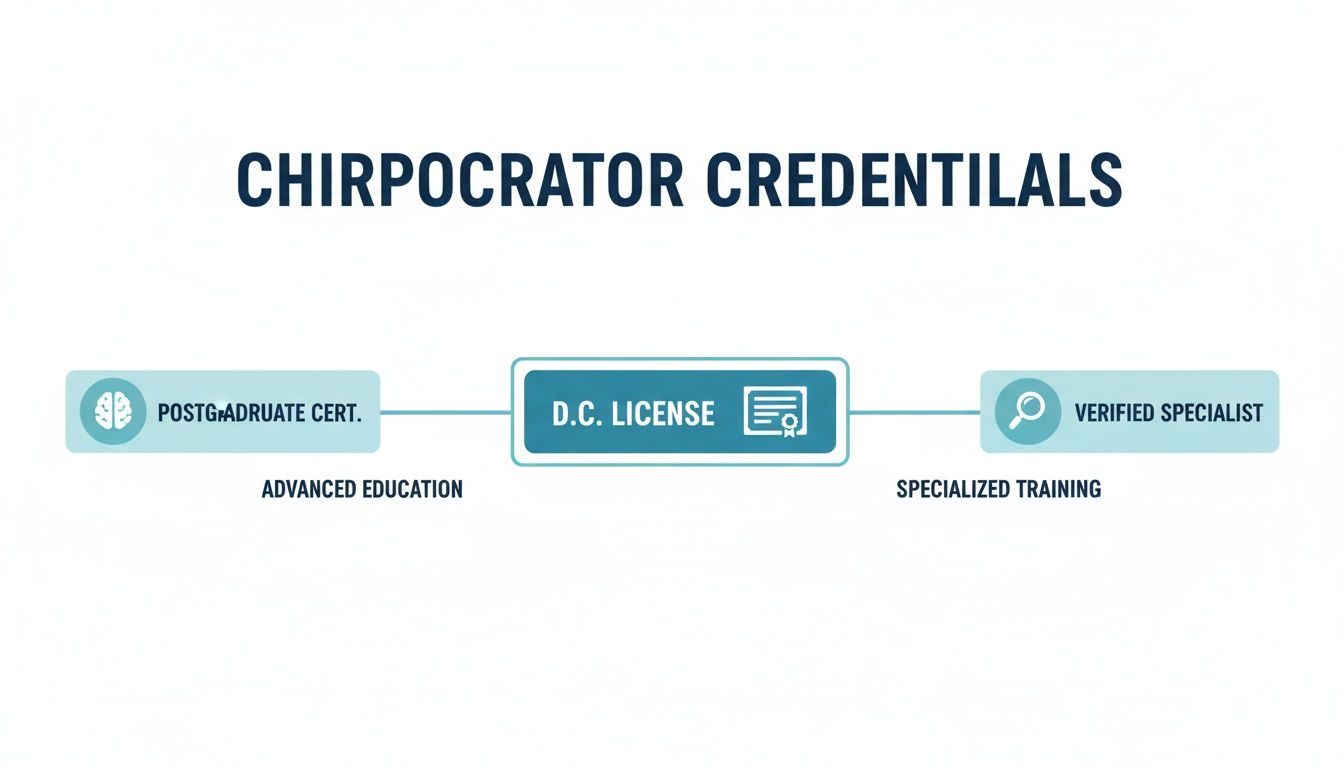
These qualifications show a commitment to specialized, advanced care that can make all the difference in your recovery.
So, what should you expect from a modern, evidence-based clinic? It's less about philosophy and more about tangible methods and results. They use objective data to guide your care, often referencing protocols from respected institutions like Harvard Medical. Your progress isn't just measured by asking, "Feeling any better?" Instead, they use concrete metrics to track your improvement.
This patient-first mindset means the chiropractor is always on the lookout for the most effective and safest techniques available. It also means they're willing to invest in advanced, FDA-backed technology to provide gentle, precise, and measurable treatments.
A key sign you're in a modern, evidence-based clinic is their investment in technology. These tools aren't just fancy gadgets; they're designed to deliver targeted, effective care that goes far beyond what a manual adjustment alone can accomplish, especially for complex or severe pain.
Seeing modern equipment in a clinic is a great sign that they are serious about getting to the root of the problem. Many of these tools are designed specifically for people with severe pain, disc injuries, or even a fear of the traditional "cracking" and "popping" of manual adjustments.
Here are a few game-changing technologies to keep an eye out for:
To help you distinguish between these approaches, here’s a quick comparison of what you might encounter.
This table breaks down the key differences between a modern clinic focused on evidence and outcomes versus a more traditional practice.
| Feature | Modern Evidence-Based Care | Traditional Symptomatic Care |
|---|---|---|
| Diagnostic Process | Uses objective data (MRI, X-rays, functional tests) to pinpoint the root cause of pain. | Often relies primarily on manual palpation and the concept of "subluxations." |
| Treatment Tools | Integrates advanced technology like spinal decompression, Class IV laser, and computer-guided adjustments. | Focuses almost exclusively on manual spinal adjustments (the "cracking" and "popping"). |
| Care Plans | Creates personalized, goal-oriented plans with a clear timeline and measurable outcomes. | May recommend indefinite, long-term "maintenance" adjustments for general wellness. |
| Patient Focus | Aims to resolve the underlying condition, restore function, and empower the patient with self-care. | Focuses on providing temporary symptom relief through repeated adjustments. |
| Collaboration | Often works alongside other medical specialists (orthopedists, physical therapists) for comprehensive care. | May operate in isolation, viewing chiropractic as a standalone solution for most ailments. |
Ultimately, a modern approach gives you a clearer path to recovery, with a plan tailored specifically to your diagnosis.
While a classic manual adjustment certainly has its place, it can sometimes be a one-size-fits-all solution. For someone with a severe disc herniation, advanced osteoporosis, or intense nerve pain, a forceful manual thrust could be uncomfortable at best and counterproductive at worst.
This is where technology really shines. It provides a level of precision and gentleness that’s nearly impossible to replicate by hand. Computer-guided systems ensure the exact right amount of force hits the exact right spot, every single time. Spinal decompression can target a specific disc level with a controlled, consistent pull that no human hands could achieve.
By choosing a chiropractor who uses these modern tools, you’re choosing a practice that tailors your care to your specific injury and comfort level. This thoughtful, tech-forward approach dramatically boosts the odds of a successful outcome, helping you finally get back to living without pain. It's a clear signal you've found a doctor who is truly invested in your long-term health.
Your first visit with a potential chiropractor is more than just a physical exam—it's an interview, and you're the one in charge. The quality of the questions you ask will directly shape the quality of care you get.
Moving past a simple, "Can you help my back pain?" is the key. Your goal is to get a real sense of the chiropractor's philosophy, how they diagnose problems, and whether they're truly invested in being a partner in your health. This conversation is your best shot at figuring out if you've found someone who offers lasting solutions or just temporary fixes.
Before a single adjustment happens, you need to understand how the chiropractor thinks. Their diagnostic process is the bedrock of your entire care plan. If that foundation is shaky, the results will be, too.
Start by digging into their methodology. You’re listening for specifics and a clear, logical process. Vague answers are a definite red flag.
Here are a few essential questions to get the ball rolling:
Good chiropractic care isn't aimless; it's goal-oriented. You need a clear picture of what success looks like and the roadmap to get there. Vague promises of just "feeling better" don't cut it—ask for measurable milestones.
This part of the conversation is all about making sure you and your doctor are on the same page about the destination. It sets clear, realistic expectations for your recovery journey.
The single most important factor in choosing a chiropractor is their ability to build trust through clear communication. Study after study shows this connection leads to higher patient satisfaction and better health outcomes. In a massive review of 43 separate studies, chiropractic patients reported higher satisfaction than those seeing other professionals, with an incredible 95% of them saying trust was a key reason. One study of 797 patients even showed chiropractors outperforming family doctors in nearly all satisfaction metrics, a success often tied to longer, more detailed consultations. You can learn more about the impact of patient-doctor relationships in chiropractic care.
At the end of the day, your gut feeling matters. Do you feel like this person is truly listening? Do you feel respected and empowered? A chiropractor can have the most impressive credentials on the wall, but if they don't make you feel like a partner, the relationship just won't work.
Use these questions to see what kind of partnership you can expect:
By asking these smart, targeted questions, you shift from being a passive patient to an active, informed participant in your own health. You’ll walk away feeling confident that you've chosen a chiropractor who is not only skilled but is also the right long-term partner for your health journey.
Let's talk about the financial side of things. It’s a topic that can feel awkward, but knowing how to choose a chiropractor also means understanding how the bills get paid. A practice that's upfront and transparent about costs is a practice that respects you as a patient.
Before you even book a consultation, it’s smart to make a quick phone call. Grab your insurance card, dial their number, and ask the front desk to do a benefits check. They should be able to give you a rough idea of what your policy covers.
Keep in mind, though, that insurance plans often don’t cover the full cost of a really thorough treatment plan, especially one that goes beyond basic adjustments to address the root cause of your problem.
To avoid any surprises down the road, you need to ask the right questions from the get-go. Don’t hesitate to be direct—a professional and well-run office will appreciate your thoroughness.
Honestly, this first phone call is a great litmus test. It gives you a feel for how organized and patient-focused the clinic really is.
When the chiropractor presents you with a recommended treatment plan, it’s natural to look at the total cost first. But I urge you to look a little deeper and consider the value you’re getting.
A seemingly cheap plan that just keeps you coming back for endless adjustments might only offer temporary relief. Over the long haul, that can end up costing you far more in time, money, and frustration than a plan that addresses the underlying issue once and for all.
For instance, a plan for a herniated disc that includes non-surgical spinal decompression might seem more expensive initially. But if it prevents years of chronic pain and helps you avoid surgery, its long-term value is massive.
Think of it as an investment in your future. Paying to actually fix the problem is always a better deal than just paying to manage the symptoms forever.
What if you find the perfect chiropractor, but they're out-of-network or your coverage just isn't great? Don't write them off just yet. Most good clinics are willing to work with you.
At the end of the day, a great chiropractor and their team will help you navigate the financial piece so you can put your energy where it belongs: on your health and recovery.

Knowing what to look for in a great chiropractor is half the battle. The other half is recognizing when to walk away. Your health is the top priority, so it’s crucial to spot the warning signs of a practice that might not have your best interests at heart. Above all, trust your instincts—if something feels off, it probably is.
One of the biggest red flags is any kind of high-pressure sales pitch. Be very cautious if you feel pushed into signing a long-term, prepaid contract for a year or more of care, especially before a clear diagnosis has even been made. Ethical, patient-first care is adaptable and should be based on your actual progress, not a rigid payment plan.
A professional treatment plan should have a clear destination and a map to get there. If a chiropractor offers a plan with no specific goals, milestones, or timelines, that's a major warning sign. A good practitioner will define how they'll measure your improvement beyond just asking, "So, you feelin' better?"
You should also be wary of anyone claiming chiropractic care can cure unrelated conditions like asthma, digestive issues, or infections. While chiropractic is fantastic for addressing musculoskeletal and nervous system problems, it's not a silver bullet for everything. Claims like that are unprofessional and simply not backed by science.
When it comes to choosing a chiropractor, your safety and their track record are non-negotiable. With an estimated 280 million chiropractic visits happening in the U.S. each year, the safety data is overwhelmingly positive. Serious complications from adjustments are incredibly rare—less than 1 in 2 million. While some temporary soreness can happen, it typically fades quickly. The real risk lies in poor provider selection. Choosing a specialist with a strong reputation who uses modern tools, like the PulStar system, helps ensure you get precise, effective care. You can find more details on chiropractic safety and patient outcomes.
Take a close look at how the chiropractor approaches treatment. If their solution for every single patient and every condition is the exact same adjustment, it signals a one-size-fits-all mentality, not personalized care. Your treatment for a complex disc injury should look completely different from someone else's treatment for a minor muscle strain.
Finally, a lack of transparency about costs is an absolute deal-breaker. You have every right to know exactly what each service costs and what you're paying for. If the office staff is cagey about fees or can't give you a straight answer on billing, it points to a lack of professionalism that you don't want to deal with. A great chiropractor builds trust by being open and honest from the start.
Even when you've found a chiropractor who seems like a great fit, it’s completely normal to have some practical questions buzzing around in your head. Getting these last few details ironed out can give you the confidence to finally book that first appointment.
Let’s tackle some of the most common things people wonder about before starting care.
This is probably the number one question on everyone's mind, and the honest-to-goodness answer is: it depends entirely on you. Your timeline is shaped by your specific condition, how long you've been dealing with it, and what your personal health goals are.
A good chiropractor will map out a treatment plan with distinct phases. You might start with intensive care to get you out of pain, then move to a corrective phase to fix the root cause, and finally transition to periodic wellness visits to keep you feeling great.
A huge red flag is any clinic that pushes a vague, year-long treatment plan from day one. Your care should have a clear beginning, middle, and end goal. If a chiropractor can't give you a reasonable estimate of what to expect, you should be wary.
Yes, absolutely—with a big caveat. It has to be performed by a chiropractor with specific training in pediatrics or perinatal care. The techniques used for children and expectant mothers are a world away from a standard adult adjustment. They are incredibly gentle and precise.
For an infant, the pressure used is often no more than what you’d use to check a tomato for ripeness. For pregnant women, chiropractors use special tables and pillows to ensure comfort and safety while they work to relieve back pain and help align the pelvis for an easier birth.
If you're looking for family care, seek out a chiropractor who is certified by an organization like the International Chiropractic Pediatric Association (ICPA). This is a solid sign that they have the advanced skills needed to treat these special populations safely and effectively.
For the most part, no. Chiropractors are considered primary contact healthcare providers, which means you can walk in and make an appointment directly, just like you would with a dentist. It's one of the things that makes accessing care so convenient.
That said, it's always a good idea to check your insurance policy. Some HMO plans are sticklers for referrals and might require a note from your primary care physician before they'll cover your visits. A quick phone call to your insurance company can clear this up in minutes.
Ultimately, the best results often come from an integrated approach where your chiropractor and medical doctor are on the same page, working as a team for your health.
At Bonesetters Critical Chiropractic, we believe in providing clear answers and evidence-based care tailored to your unique needs. If you're ready to find a real solution to your pain, we invite you to learn more about our approach. Visit us at https://bonesetters.org.