

It's a common question we hear: "How do you know exactly where to adjust?" The answer isn't guesswork or intuition. It's a systematic diagnostic process, much like a detective solving a case. We gather clues from your health history, a hands-on physical exam, and sometimes imaging to build a complete picture of your body's needs before a single adjustment is made.
Think of your first visit as the start of an investigation. A skilled chiropractor doesn't just start "cracking" your back. Instead, they carefully piece together information from multiple sources to understand the root cause of your issue, ensuring every adjustment is specific, targeted, and safe.
This multi-step approach is what allows us to create a care plan that goes beyond just masking symptoms. It’s a process designed to build confidence by showing you that your treatment is based on solid diagnostic evidence.
The entire process starts with one simple thing: listening to you. Your story—how the pain started, what makes it better or worse, your daily activities, and past injuries—forms the foundation. This initial conversation helps us form a working hypothesis that guides the rest of the physical examination.
From there, we combine your story with objective physical findings to create a clear roadmap for your care.
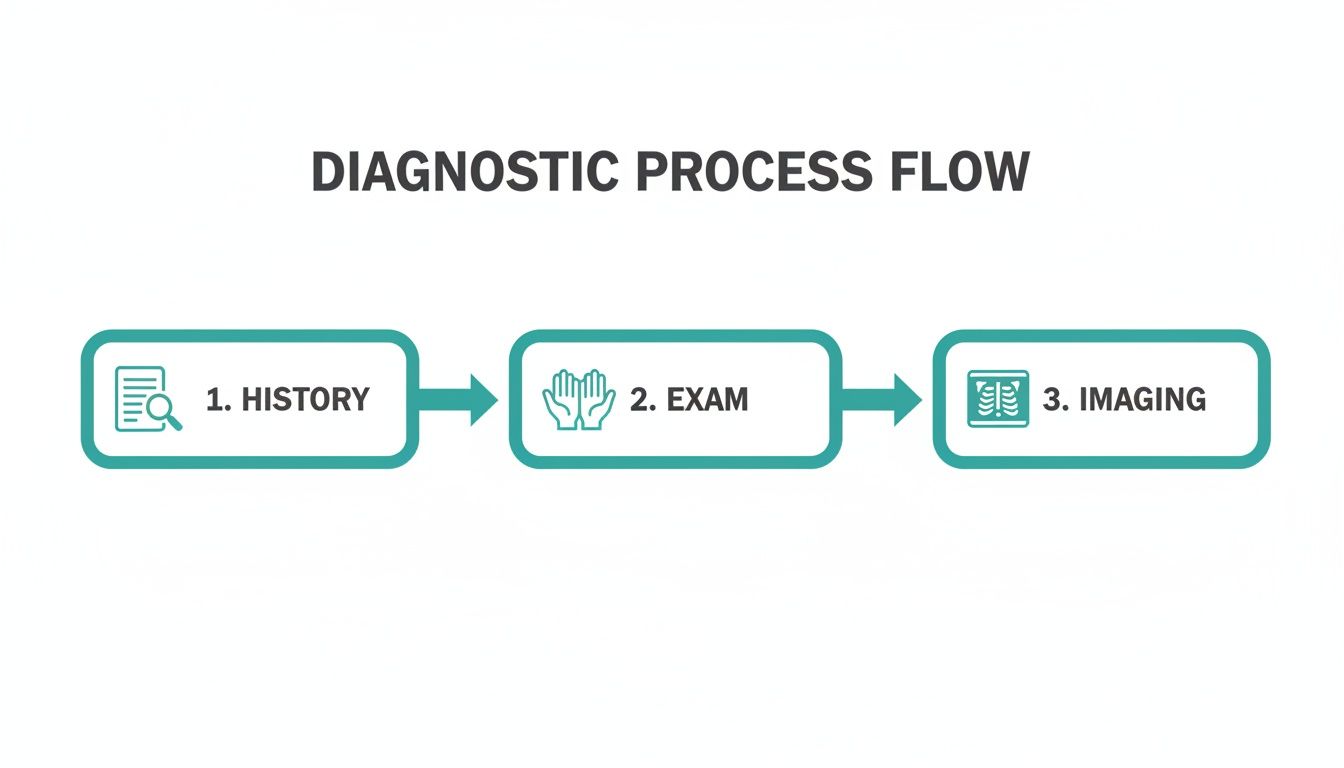
As you can see, each step builds on the last. This creates a comprehensive map of your spinal health and helps us identify the underlying joint restrictions, sometimes called vertebral subluxations.
A targeted chiropractic adjustment is the final step in a thorough diagnostic process. It is the solution that comes after the investigation is complete, never before.
Here's a quick look at the methods we use to get a clear picture of what's going on.
This table breaks down the primary techniques a chiropractor uses to identify areas needing adjustment. It shows how each piece of the puzzle contributes to the final treatment plan.
| Diagnostic Method | What It Reveals |
|---|---|
| Patient History | The "story" behind your symptoms—past injuries, lifestyle factors, and pain patterns. |
| Visual Assessment | Clues from your posture, how you walk (gait), and overall body symmetry. |
| Range of Motion Tests | How well your joints move and where they are restricted or causing pain. |
| Palpation (Static & Motion) | The "hands-on" feel for joint position, muscle tension, and how segments move together. |
| Muscle & Nerve Tests | The strength of key muscles and the health of nerve pathways. |
| Imaging (X-ray, MRI) | A look inside at bone structure, joint alignment, and soft tissue health. |
By combining what you tell us, what our hands feel, and what advanced diagnostics might show, we can confidently determine exactly where and how to adjust. This integrated approach is what makes modern chiropractic care a blend of art and science, leading to effective and lasting relief.

The entire diagnostic process starts the moment we sit down and talk. Long before we even begin a physical exam, your chiropractor’s first job is to be a detective, carefully piecing together the story of your health and your pain. Think of your comprehensive health history as the foundational map we'll use to navigate your treatment.
This conversation is so much more than filling out forms. We're trained to listen for specific clues in the words you use. Is the pain sharp and shooting, or is it a dull, nagging ache? Does it travel down your arm, or does it stay put? These little details are the first breadcrumbs on the trail to figuring out what’s really going on.
Your daily life—from your job and hobbies to old injuries you’d nearly forgotten about—provides crucial context. An IT professional with chronic neck pain paints a very different clinical picture than a weekend warrior who tweaked their back lifting something heavy. Every piece of your story helps us form an initial idea, a working hypothesis, that will guide the hands-on part of the exam.
This deep dive into your history is what allows us to create a care plan that gets to the root cause of your problem, rather than just chasing symptoms. It’s the difference between putting a bandage on the issue and developing a strategy for genuine, long-term relief.
Your story is the single most important diagnostic tool. The details you share about your pain, activities, and history create the framework for an accurate diagnosis and an effective, targeted treatment plan.
This patient-first approach isn't just a philosophy; it’s backed by decades of evidence. Research has consistently shown the value of specific, targeted spinal adjustments, especially for common issues like low back pain. In fact, studies show a high percentage of patients report significant pain relief, highlighting why this careful, data-driven process—which always starts with listening—is so important. You can explore some of the foundational research supporting chiropractic care on jamanetwork.com.
As we talk, we're actively searching for patterns and connections. Here are some of the key puzzle pieces we're looking for:
By carefully documenting and analyzing your story, we can walk into the physical examination with a much clearer sense of direction, ready to test our hypothesis and pinpoint the problem.
Once I’ve heard your story, it’s time for me to get a feel for what’s actually happening with my own hands. This is where a chiropractor’s highly developed sense of touch really comes into play. Think of it like a skilled mechanic listening to and feeling an engine—you can detect subtle vibrations and misfires that a simple visual check would never catch.
This hands-on evaluation is fundamental to figuring out precisely where to adjust. We use two main approaches to build a detailed, three-dimensional map of your spinal function: static palpation and motion palpation.
First, I'll have you sit or lie still while I gently but firmly press along your spine and the muscles surrounding it. This isn't just random prodding; it's a methodical search for specific clues that point to what's going on under the surface.
I'm looking for a few key things:
This initial, static assessment gives me a baseline snapshot of your spinal health, highlighting the "hot spots" before we even look at how things are moving.
Next up is motion palpation, and this is where we get dynamic. I’ll gently guide your neck, mid-back, or low back through its natural movements while keeping my fingers on the specific spinal joints. This lets me feel exactly how each individual segment is moving... or not moving.
Motion palpation is all about the quality of movement, not just the quantity. It’s not about how far you can bend, but how well each joint contributes to that motion. A stuck or restricted joint has a very distinct feel to a trained hand.
This technique is crucial for finding what we call joint restrictions or fixations. A healthy joint glides smoothly through its range of motion. A restricted one feels stiff, blocked, or even a little "gritty." It’s this lack of proper movement that so often leads to pain, stiffness, and nerve irritation. This hands-on skill, honed since the first chiropractic schools opened in the late 1800s, is just as critical today as it was then.
It’s a targeted approach that works. Millions of Americans see chiropractors every year, and you can explore more chiropractic facts and statistics on northeastspineandsports.com to see the impact.
By combining what I feel with my hands with what you told me about your history, I can pinpoint exactly what needs to be done. Sometimes, the muscles are so involved that we'll also use techniques like instrument-assisted soft tissue mobilization to help them release, making the adjustment even more effective.

While a chiropractor’s hands are their most valuable tool, sometimes we need to look under the hood. Modern technology gives us a way to do just that, confirming what our hands-on exam suggests and providing concrete, objective data. This blend of traditional skill and diagnostic tech is central to pinpointing exactly where to adjust with such high precision.
Think of it like an experienced mechanic listening to an engine. They can often tell what’s wrong just by the sound, but they'll still plug in a diagnostic computer to get the exact error codes. It confirms their intuition and ensures they're fixing the right problem. In chiropractic, these tools remove the guesswork and help us validate our findings.
There are times when the story you tell us, combined with the physical exam, points to something that needs a closer look. That’s when imaging studies like X-rays or an MRI can be incredibly helpful.
We don't order these for everyone. Instead, we use them strategically in specific situations:
Using imaging this way is all about ensuring your safety and tailoring the most effective treatment plan for you.
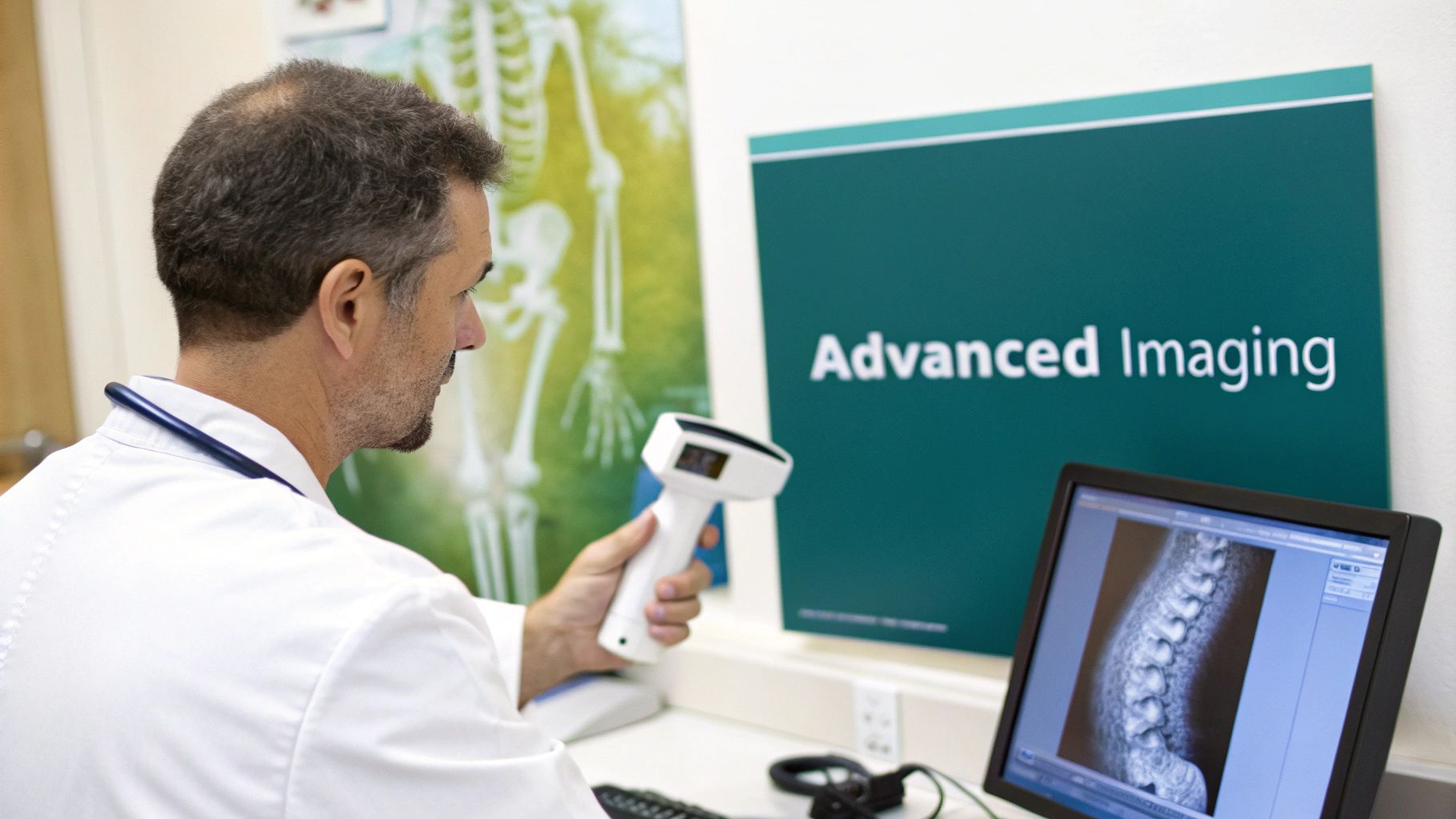
Beyond standard imaging, many modern chiropractic offices use advanced tools right in the treatment room to get real-time data on how your spine is functioning. A great example of this is the PulStar system, a handheld device that uses sophisticated sensors to analyze how each joint is moving—or not moving.
As the chiropractor glides the instrument down your spine, it sends tiny, gentle impulses into each joint. The system then measures the joint’s response and resistance, creating a clear, objective map of every restriction. This data takes all the subjectivity out of the equation and shows both of us exactly which segments are stuck.
This level of detail represents a huge leap forward in evidence-based care. Since the very first chiropractic adjustment back in 1895, the profession has evolved by integrating new understandings of biomechanics and proven technologies. With 35 million Americans visiting a chiropractor each year, tools like these help ensure every single adjustment is perfectly targeted for the best possible result. You can dive deeper into the evolution and evidence behind chiropractic care at PMC.
By combining skilled hands with advanced diagnostics, we can build a truly comprehensive picture of your spinal health.
After gathering all the clues from your history, hands-on exam, and any imaging, the final step is to put it all together. A chiropractic adjustment isn’t just a random “crack”; it’s the logical conclusion of a thorough investigation into your body's unique mechanics. This synthesis of information is how we pinpoint exactly where to adjust, turning our diagnostic findings into a precise, effective action plan.
Think of it like being a detective solving a case. Each piece of information—your story, the results of palpation, your posture, and any imaging—is a vital clue. We have to fit them all together to see the whole picture and identify the true culprit behind your pain or dysfunction. This ensures every single adjustment is delivered to the right spot, at the right time, and with the right technique.
This process is all about looking for patterns and correlations. We cross-reference what you tell us with what our physical examination reveals, building a case for why you’re feeling the way you do. This cross-check is what gives us the confidence that we’re targeting the actual source of the problem, not just chasing symptoms.
Here’s what that looks like in a real-world scenario:
With these three pieces aligned, the path forward is crystal clear. The adjustment will be precisely targeted at restoring motion to the L5 vertebra to help take pressure off that irritated nerve. This logical progression is fundamental to good chiropractic care.
If you’re dealing with persistent issues, understanding the treatment process is key. You can dive deeper by exploring our guide on how to relieve chronic back pain.
A successful adjustment isn't just about the technique used; it's about the accuracy of the diagnosis that comes first. By linking your symptoms to specific biomechanical dysfunctions, we make sure your care is focused and purposeful.
Most importantly, your treatment plan isn't set in stone. It’s a dynamic roadmap that we adjust as your body responds to care. At the start of each visit, we’ll do a quick reassessment—often using palpation and re-checking motion—to see how your spine and nervous system are adapting.
This allows us to fine-tune our approach in real time. Maybe a segment is moving better and needs less attention, or perhaps a new area of stiffness has appeared that now needs to be addressed. This collaborative journey ensures your care remains perfectly aligned with your body’s changing needs, guiding you toward lasting results.
Even after learning about the diagnostic process, it's natural to have a few more questions. Let's tackle some of the most common ones we hear from patients.
Not typically. Your very first visit is the deep dive—that’s when we do the most comprehensive evaluation to get a crystal-clear picture of your health and map out your initial treatment plan. Think of it as creating the master blueprint for your recovery.
Follow-up visits are different. They involve a more focused re-assessment. Before each adjustment, your chiropractor will use key techniques like motion palpation and muscle testing to see how you’re progressing and how your body has responded to the last treatment. This ongoing check-in allows us to fine-tune our approach, making sure every adjustment is perfectly suited to how you're feeling that day.
Posture gives us valuable clues, but it's only one piece of a much larger puzzle. A quick visual check is never enough to form a complete diagnosis on its own.
For instance, seeing forward-slumped shoulders might suggest tight chest muscles and weak upper back muscles, which are often linked to neck pain. But that's just a starting point.
Posture is a symptom, not a diagnosis. It shows us where the body might be under stress, but a skilled chiropractor will always follow up those visual cues with a hands-on exam, motion tests, and other diagnostics to pinpoint the root cause before ever performing an adjustment.
This is why our thorough process is so important. A postural assessment guides the hands-on investigation; it never replaces it.
Your safety is, and always will be, our number one priority. Chiropractors are trained as primary contact healthcare providers, which means we are skilled at recognizing "red flags"—symptoms that point to serious conditions outside the scope of chiropractic care.
These could be things like fractures, infections, tumors, or other medical issues that need immediate attention. If we suspect anything like this at any point during your examination, we will stop and refer you to the right medical specialist, whether that's your primary care doctor, an orthopedic surgeon, or another provider.
This commitment to collaborative care ensures you always get the right treatment from the right expert. Our job is not just about knowing where and when to adjust—it's also about knowing when not to.
At Bonesetters Critical Chiropractic, we blend decades of hands-on diagnostic experience with modern, evidence-based technology to find the true source of your pain. If you're ready for a care plan built on precision and tailored to you, visit us at https://bonesetters.org to get started.