

When you get a diagnosis like degenerative disc disease (DDD), it’s easy to feel a bit lost. But here’s the good news: managing it effectively is absolutely within reach. The path forward involves a range of degenerative disc disease treatment options, starting with simple, foundational care and moving toward more advanced procedures only if necessary. Think of it as a progressive journey, not a one-shot fix.
Imagine your spinal discs are like the shock absorbers in a car. With time and use, they naturally show some wear and tear. While we can't turn back the clock on that process, we can absolutely manage the painful symptoms that come with it. The real goal of treatment is to dial down the pain, get you back to doing the things you love, and slow down any further degeneration. This approach puts you back in the driver's seat of your own spinal health.
And you're not alone in this. Each year, about 266 million people—that’s 3.63% of the global population—are diagnosed with lumbar DDD. This widespread issue has pushed the global market for treatments to an estimated USD 30.5 billion in 2024, a number that's only expected to grow.
The journey to managing DDD usually follows a clear, step-by-step path. Most people get fantastic results with the foundational methods and never have to even think about more invasive options. It’s best to view treatment as a pyramid, starting with the safest and least invasive approaches at the base.
This chart lays out the typical progression, from conservative care all the way to surgical intervention.
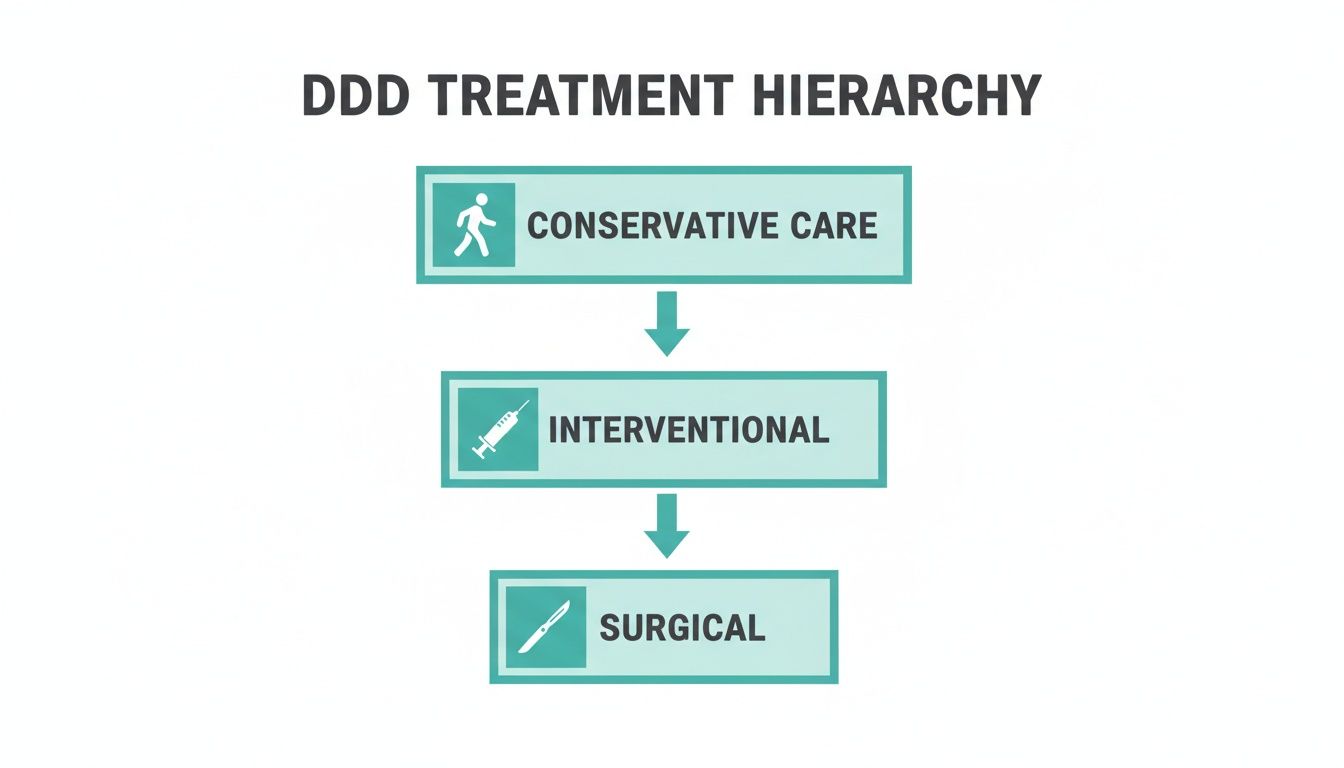
As you can see, the vast majority of care starts—and often ends—at that foundational level with conservative strategies. They're often incredibly effective on their own.
To help you get a clear picture of the road ahead, here’s a quick overview of the main treatment categories. A structured approach is critical, and our specialized Disc Care Protocol details how these steps fit together for the best possible outcome.
To make this even clearer, the table below breaks down the primary treatment pathways.
| Treatment Category | Primary Goal | Common Examples |
|---|---|---|
| Conservative Care | Reduce pain and improve function with self-managed strategies. | Physical therapy, exercise, posture correction, weight loss. |
| Manual & Advanced Therapies | Provide targeted, non-invasive relief for stubborn symptoms. | Spinal decompression, computer-guided adjustments, cold laser therapy. |
| Interventional Procedures | Reduce severe inflammation and block pain signals directly. | Epidural steroid injections, nerve blocks, facet joint injections. |
| Surgical Options | Correct severe structural issues causing instability or nerve compression. | Discectomy, spinal fusion, artificial disc replacement. |
This tiered approach ensures you always start with the safest, most effective options first, giving your body the best chance to heal without unnecessary interventions.
The most successful treatment plans are not one-size-fits-all. They are personalized roadmaps that start with the simplest, most effective strategies and progress only as needed, putting you in control of your recovery.
When you're dealing with degenerative disc disease, it's easy to think you need complex procedures to find relief. But in my experience, the most powerful and effective treatments are often the simplest and least invasive. This first-line approach is what we call conservative care, and it's all about putting you back in the driver's seat.
Think of your spine like the foundation of a house. If that foundation isn't strong and stable, everything built on top of it is at risk. Conservative care is how we build that solid foundation, piece by piece. These aren't passive fixes; they are active, empowering steps that get to the root of the problem by improving your body's mechanics and reducing the daily stress on your discs.
For the vast majority of people I see, this is all it takes to find real, lasting relief.
I know it sounds backward—moving more when you're in pain—but for DDD, it’s an absolute cornerstone of recovery. When you stop moving, your muscles get weak, your joints get stiff, and that just puts even more strain on your already vulnerable discs. The right kind of movement, however, does the exact opposite.
This is where targeted physical therapy shines. A good therapist won't just give you a sheet of exercises; they'll design a program specifically for you that will:
Simple, low-impact activities like walking, swimming, or using a stationary bike are fantastic for supporting your spine without jarring it.
The little things you do every day add up. How you sit at your desk, stand in the grocery line, or lift a bag of dog food places constant stress on your spine. Over years, poor posture puts uneven, excessive loads on your discs, which can absolutely speed up the degenerative process.
Fixing your posture is a surprisingly potent tool. It's about retraining your body to find its natural alignment, so your weight is distributed evenly and your muscles are doing the work, not your discs.
Key Takeaway: Good posture isn’t about standing ramrod straight. It's about finding that relaxed, neutral spine position where your body is balanced and supported.
Here are a few practical ways to make this happen:
These might seem like small adjustments, but when you do them consistently, you dramatically reduce the daily wear and tear on your spine.
Your spine is an incredible structure, but it has its limits. Every extra pound you carry significantly increases the mechanical load it has to bear. In fact, that pressure is magnified, especially when you bend or lift.
Think about it like this: carrying excess weight is like wearing a heavy backpack 24/7. That constant compression squeezes the life—and the water—out of your discs, flattening them and accelerating degeneration. It also fuels inflammation, which is a major source of pain in DDD.
The good news is that losing even a small amount of weight can bring huge relief. Research consistently shows that a 5-10% reduction in body weight can lead to dramatic improvements in back pain and mobility. It’s one of the most effective things you can do for yourself.
This becomes even more critical if you have pain radiating down your leg (sciatica). We cover this in-depth in our guide on how to relieve sciatica pain naturally. When you combine weight management with the right exercises, you build a powerful defense against DDD.
The goal isn't a crash diet; it's a sustainable lifestyle. A balanced diet filled with anti-inflammatory foods (fruits, vegetables, healthy fats) plus regular, low-impact exercise is the winning formula. This foundational work makes every other treatment more effective and helps you build long-term resilience.
When foundational care like exercise and posture work isn't quite cutting it, we often turn to a combination of hands-on and technology-assisted therapies. These treatments are the next logical step, designed to get to the heart of the mechanical problems causing your pain. Think of them as non-invasive tools that help improve your spine's alignment, create much-needed space between vertebrae, and even kickstart healing deep within your cells.
If conservative care is about building a strong foundation for your spine, these advanced therapies are like bringing in skilled specialists to fix the specific structural issues. They're a powerful part of a comprehensive treatment plan because they directly target the source of your pain without relying on medications or injections.

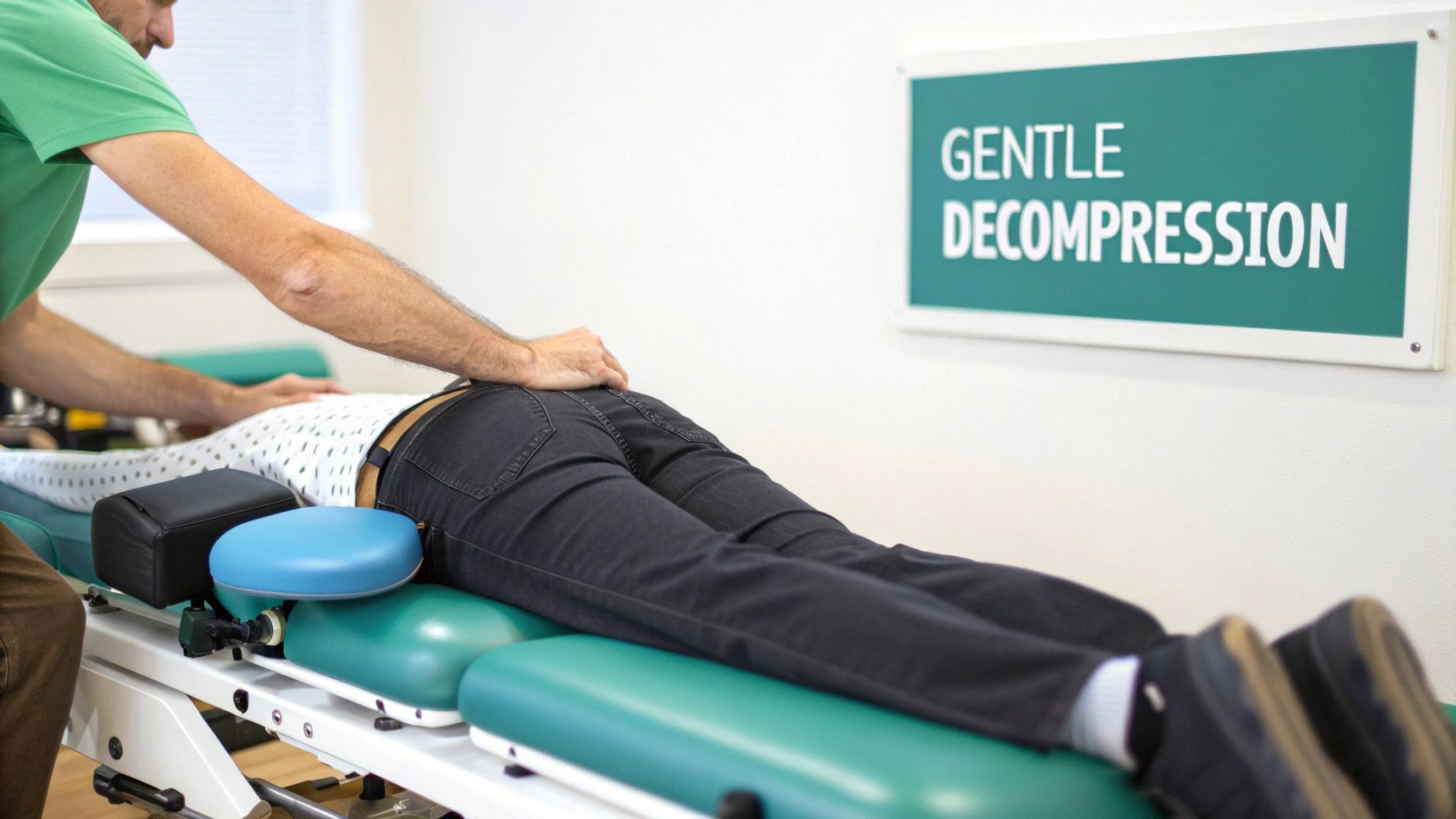
A core problem with degenerative disc disease is the loss of space between your vertebrae as the discs get thinner. This compression is what squeezes and irritates nerves, leading to that all-too-familiar pain. Spinal decompression therapy tackles this problem head-on by gently stretching the spine.
Picture an accordion that’s been squeezed shut. Decompression therapy carefully and slowly pulls it apart, letting it expand. This gentle, controlled stretch creates a negative pressure inside the disc, which acts like a vacuum to help pull in water, oxygen, and nutrients essential for healing.
The Goal of Decompression: This therapy aims to relieve pressure on pinched nerves, reduce bulging or herniated disc material, and improve the overall health of the disc by enhancing hydration and nutrient flow.
The process is surprisingly relaxing for most people. You lie comfortably on a specialized table as a computer-controlled system applies a precise and gentle pulling force, ensuring the treatment is both safe and tailored to your specific needs.
There's a good reason chiropractic care has been a staple for back pain for so long. As discs degenerate, the surrounding spinal joints can become stiff, fall out of alignment, and lose their normal range of motion. This not only creates painful friction but also adds more stress to an already compromised disc.
Gentle chiropractic adjustments are focused on restoring proper movement to these "stuck" joints. Modern approaches, like the FDA-backed PulStar system, use technology to deliver precise, computer-guided impulses to the affected vertebrae. This technique gently nudges them back into a healthier alignment without any of the forceful twisting or popping you might imagine.
Restoring proper spinal mechanics provides several key benefits:
This kind of targeted adjustment works beautifully alongside decompression. While decompression creates space, adjustments make sure the joints within that newfound space are moving as they should. You can learn about a similar concept in our guide explaining what is intersegmental traction, which also focuses on improving spinal mobility.
Beyond the mechanical fixes, we can use advanced therapeutic technologies to stimulate healing from the inside out. These "modalities" work at a cellular level to calm inflammation and speed up tissue repair, making them fantastic partners for decompression and adjustments.
Two of the most effective tools in this category are Class IV cold laser therapy and horizontal stimulation.
Don't let the word "laser" fool you—this isn't for surgery. A therapeutic laser uses specific wavelengths of light that penetrate deep into your body's tissues. This light energy gives a jolt to the mitochondria, which are the tiny powerhouses inside your cells, prompting them to produce more energy.
This cellular energy boost triggers several powerful effects:
A typical session is completely painless and lasts just a few minutes.
This therapy uses targeted electrical frequencies to get deep into the body and address pain and inflammation. It's far more advanced than a simple TENS unit, which mostly just blocks pain signals at the surface. Instead, horizontal stimulation is designed to create real biochemical changes in the tissues. It can help reduce swelling, soothe irritated nerves, and provide significant pain relief that lasts long after the treatment is over.
By skillfully combining these manual and advanced therapies, we can create a powerful, multi-pronged attack on degenerative disc disease that goes far beyond simply masking your symptoms.
When the usual conservative treatments aren't cutting it, and your pain from degenerative disc disease just won't quit, interventional procedures can be a game-changer. These aren't just general pain pills; they're highly targeted treatments designed to go right to the source of your discomfort. Think of it as calling in a specialist to handle a specific problem, rather than a general approach.
This is often the critical step between initial therapies and the much bigger consideration of surgery. For many people, these injections break the frustrating cycle of chronic pain, opening up a window where physical therapy and exercise can finally be effective.
Pharmacological treatments, from oral medications to these injectables, are still a huge part of managing DDD. In fact, in 2024, drugs made up 61.9% of the global DDD treatment market, with oral medications leading the way at a 66.7% market share. These often provide that crucial first-line relief, paving the way for more targeted injections if the pain persists. You can discover more insights about these market trends and what they mean for patient care.
One of the most common and effective procedures you'll hear about is the epidural steroid injection, or ESI. When a disc starts to degenerate, it can leak inflammatory chemicals that really irritate the sensitive nerve roots right next to it. That inflammation is what causes the sharp, shooting pain—like sciatica—that so many people with DDD experience.
An ESI works by delivering a powerful anti-inflammatory medication (a corticosteroid) directly into the epidural space, which is the area right around those irritated spinal nerves.
Imagine you have a small fire smoldering inside a wall. Instead of spraying down the whole room, a firefighter would pinpoint the source and douse it directly. That's exactly what an ESI does; it puts the medicine right where the inflammation is raging.
The goals of an epidural steroid injection are threefold:
While the relief from an ESI can be dramatic, it's important to know it's not a permanent fix for the disc itself. The effects can last anywhere from a few weeks to several months, giving you valuable time to work on long-term solutions.
Sometimes, the main issue is that the pain signals themselves have gone haywire. In these situations, the goal is to interrupt those signals or simply turn down their volume before they reach your brain. The two main ways we do this are with nerve blocks and radiofrequency ablation.
A nerve block is an injection of a local anesthetic (numbing medicine) near a specific nerve. This is often done for two reasons. First, it's a great diagnostic tool—if the pain goes away right after the injection, we've confirmed which nerve is causing the trouble. Second, it provides immediate, though temporary, pain relief.
For a longer-lasting solution, we often turn to radiofrequency ablation (RFA), also called a rhizotomy. This is particularly useful for chronic pain coming from the facet joints, which often become arthritic due to the changes from DDD.
The process is straightforward:
Think of it like disabling a faulty car alarm that keeps blaring for no reason. RFA doesn't fix the joint, but by silencing the alarm, it can provide pain relief that lasts anywhere from 6 to 18 months, and sometimes even longer.
Key Insight: Interventional procedures aren't about masking pain. They're strategic tools used to either pinpoint the exact cause of your symptoms or create a pain-free period that makes real, lasting rehabilitation possible.
To help clarify the differences, here's a side-by-side look at the most common injections used for pain stemming from degenerative disc disease.
| Procedure | Primary Target | Goal of Treatment | Typical Duration of Relief |
|---|---|---|---|
| Epidural Steroid Injection | Inflamed nerve roots in the epidural space | Reduce inflammation to relieve radiating nerve pain (sciatica) | Weeks to several months |
| Medial Branch Block | Medial branch nerves (from facet joints) | Diagnose facet joint pain and provide temporary relief | Hours to a few days |
| Radiofrequency Ablation | Medial branch nerves (after a positive block) | Interrupt pain signals for long-term facet joint relief | 6 to 18+ months |
| Sacroiliac (SI) Joint Injection | The sacroiliac joint | Reduce inflammation and pain originating from the SI joint | Weeks to several months |
Each of these procedures has a specific job. Your specialist will determine which one, if any, is the right fit for the unique source of your pain.
These injections are generally very safe and are done as simple outpatient procedures. But like any medical treatment, they do come with small risks, such as infection, bleeding, or temporary nerve irritation, which your doctor will review with you.
Most importantly, remember that these injections are a piece of a much larger puzzle. Their success is magnified when you pair them with an active rehabilitation program. The relief they provide is your opportunity to build core strength, improve flexibility, and create a more resilient spine for the future.
For the vast majority of people, managing degenerative disc disease is a journey that stays far away from the operating room. The good news is that conservative and interventional treatments are incredibly effective for most people, helping them control symptoms and get back to their lives.
But for a small group, there comes a point where surgery shifts from a last resort to the most logical next step.
This isn't a decision made lightly. Surgery only enters the conversation after you’ve diligently tried other less invasive degenerative disc disease treatment options without getting the relief you need. It’s reserved for very specific situations where the physical changes in your spine are causing severe problems that non-surgical therapies just can't fix. This isn't about failure; it's about choosing a more definitive path when others have led to a dead end.

So, what pushes the conversation toward surgery? It usually starts with the appearance of specific "red flag" symptoms. These are serious warning signs that nerve compression has become so critical it could lead to permanent damage, making quick action essential.
Your doctor will likely recommend a surgical consultation if you're experiencing any of these issues:
These aren't just pain signals; they are signs that your nervous system is in serious trouble. When these symptoms show up, the focus shifts from simply managing pain to preventing irreversible nerve damage and preserving your long-term mobility and function.
If you and your surgeon agree that an operation is the right move, it's important to understand the goal. Surgery for DDD isn't about making your spine "perfect" again. It’s about fixing the specific structural problem that is pinching nerves or causing severe instability.
Think of it this way: a surgeon is like a master plumber. They aren't there to remodel the whole house, but to fix the one crushed pipe that’s causing a massive leak and damaging everything around it.
The technical side of spine surgery is complex, but the goals of the most common procedures are pretty straightforward.
Ultimately, the choice to have surgery is a deeply personal one, made after thorough discussion with your doctor and surgeon. It becomes the right call only when the potential rewards of relieving severe nerve compression and restoring stability clearly outweigh the risks—and only after you've given conservative care a true, dedicated shot.
When you're trying to figure out the best path forward for degenerative disc disease, you're bound to have questions. It's only natural. Getting clear, straightforward answers is the first step toward feeling confident and in control of your health.
Let's walk through some of the most common concerns we hear from patients just like you every single day.
This is almost always the first question people ask, and it gets right to the heart of the matter. The honest answer is that the wear-and-tear process itself can't be reversed. But—and this is a big but—the pain and limitations it causes can be managed with incredible success.
The real goal of a good treatment plan isn't to make your discs look perfect on an MRI again. It's to get you out of pain, restore your ability to live your life, and slow down any further breakdown.
Think of it like managing a chronic condition like high blood pressure. You can't just "cure" it, but with the right strategies—diet, exercise, maybe medication—you can control it completely and live a full, active life. We approach DDD the same way.
Effective management is where the power lies.
Patience and consistency are your two best friends here. When you start with foundational treatments like physical therapy and specific exercises, most people start to feel a shift in their symptoms within just a few weeks.
However, building true, lasting strength in your spine is a marathon, not a sprint. It takes time to wake up and strengthen those deep core muscles that act as a natural brace for your discs and to unlearn years of postural habits.
For significant and stable relief, plan on committing to your program for 6 to 12 weeks. Every week you stick with it builds on the last, creating a powerful compounding effect that leads to long-term success.
Absolutely. And honestly, they often have a bigger impact than most people expect. Your daily habits create the environment inside your body, which can either help heal your spine or make things worse.
An anti-inflammatory diet, for instance, can be a game-changer. By focusing on whole foods packed with antioxidants and omega-3s, you can calm the systemic inflammation that fuels a lot of DDD pain.
A few other simple changes can make a world of difference:
These habits support all the other degenerative disc disease treatment options you're using, making everything work better.
While most pain from DDD isn't a medical emergency, there are a few critical warning signs that mean you need to seek help immediately. These "red flags" can point to serious nerve compression that could cause permanent damage if it's not addressed right away.
Head to an emergency room or call your doctor immediately if you experience any of these:
These symptoms are rare, but it's crucial to know what they are. Getting a prompt evaluation is essential for protecting your long-term nerve function.
At Bonesetters Critical Chiropractic, we specialize in creating personalized, evidence-based treatment plans that address the root cause of your pain without drugs or surgery. If you're ready to explore non-surgical solutions for your degenerative disc disease, we are here to help. Find out more about our unique approach by visiting us at https://bonesetters.org.