

Lower back pain can feel like a relentless cycle of discomfort and limitation, but the path to lasting relief is often more accessible than you think. It's not about masking symptoms; it's about addressing the root causes. Common culprits like weak core stabilizers, poor glute activation, and restricted spinal mobility often force your lower back to bear more strain than it's designed to handle.
This guide is not a list of random stretches. It is an evidence-based blueprint featuring the 8 best exercises for lower back pain relief, specifically curated to build foundational stability and restore healthy movement patterns. At Bonesetters Critical Chiropractic, we have seen firsthand how targeted, non-surgical approaches can achieve profound results. We believe in empowering you with the same principles our specialists use, grounded in research from leading institutions and tailored for real-world application.
Each exercise detailed here is a deliberate step toward reclaiming control over your body. You will learn not just what to do, but why it works, with clear instructions, recommended sets and reps, and crucial modifications for conditions like sciatica or disc issues. Our goal is to help you move beyond temporary fixes and build a resilient, pain-free back for the long term, reducing reliance on passive treatments and fostering true structural strength. This is your practical toolkit for sustainable spinal health.
A foundational movement in both yoga and physical therapy, the Cat-Cow stretch is a gentle, dynamic exercise that improves spinal mobility and provides effective, low-impact relief for lower back stiffness. It involves a fluid transition between two positions: spinal extension (Cow Pose) and spinal flexion (Cat Pose). This controlled movement helps to hydrate the intervertebral discs, awaken the muscles supporting the spine, and release accumulated tension in the lumbar region.
Because of its simplicity and safety, the Cat-Cow is often one of the first exercises prescribed for individuals seeking the best exercises for lower back pain relief. It acts as both a diagnostic tool for practitioners to assess spinal movement and a therapeutic exercise for patients to perform at home.
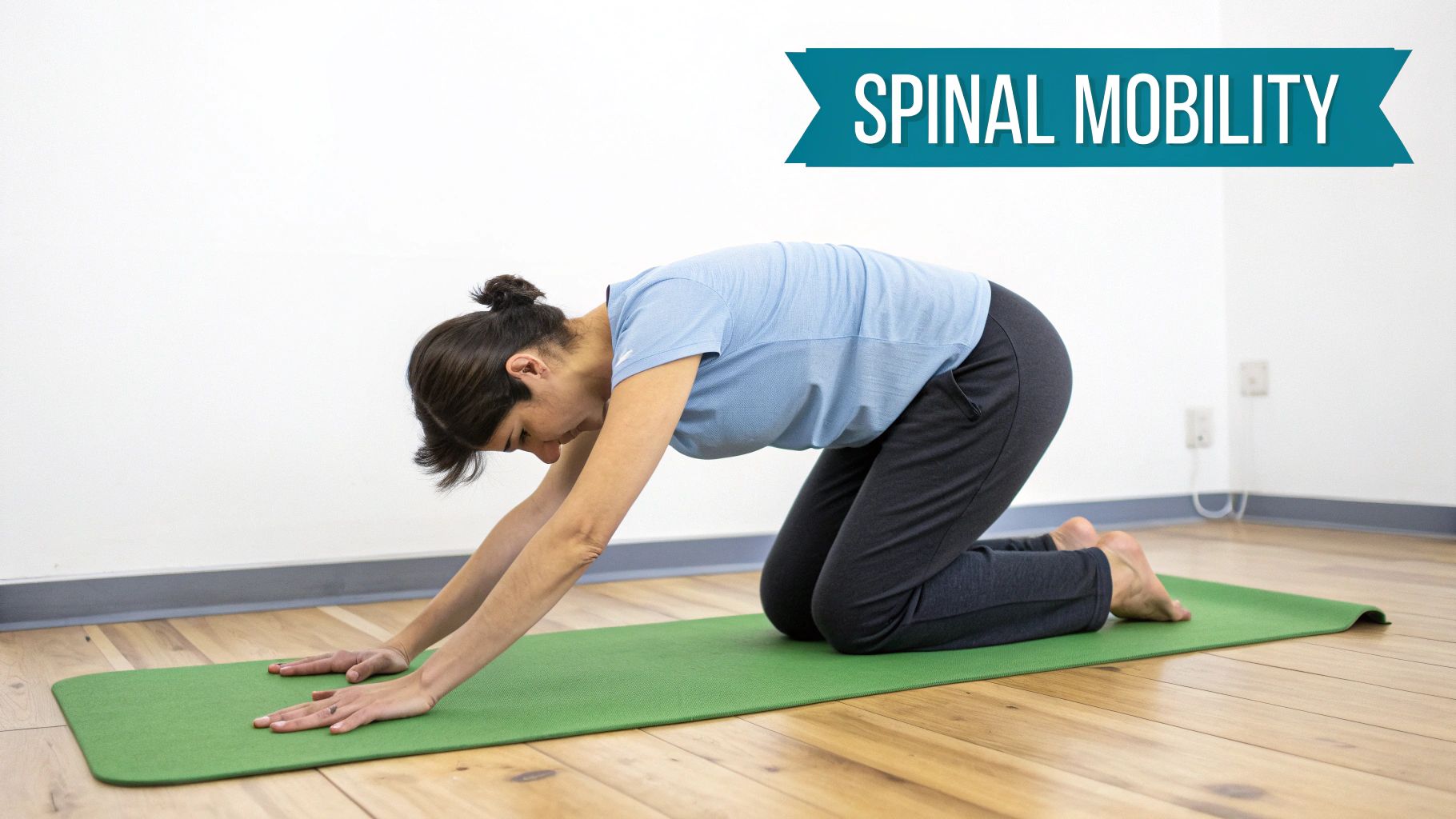
Follow these steps for proper form and maximum benefit:
Our Clinical Insight: At our clinic, we emphasize the Cat-Cow as a "spinal flossing" technique. The gentle flexion and extension helps to nourish the spinal discs by encouraging the exchange of fluid and nutrients, a key principle in our non-surgical approach to disc health.
A foundational strengthening exercise in both rehabilitation and performance training, the Glute Bridge targets the gluteus maximus, the largest muscle in the body. This exercise is critical for lower back pain relief because weak or underactive glutes often force smaller, less capable muscles in the lower back to compensate for hip extension, leading to strain and pain. By activating and strengthening the glutes, this movement helps stabilize the pelvis and support the lumbar spine.
Glute Bridges are a cornerstone exercise for correcting postural imbalances caused by prolonged sitting, a common aggravator of back pain. As one of the best exercises for lower back pain relief, they teach the body to use the powerful hip extensors for lifting and movement, offloading the vulnerable structures of the lower back. This re-education of movement patterns is fundamental to long-term spinal health.

Follow these steps to ensure proper form and glute activation:
Our Clinical Insight: We often call this the "anti-sitting" exercise. Chronic sitting deactivates the glutes, forcing the lower back into a cycle of overwork and pain. Glute Bridges effectively "wake up" these crucial muscles, restoring the proper kinetic chain and providing immediate support to the lumbar spine. This can sometimes be paired with techniques like myofascial release to address muscular imbalances.
The Dead Bug is a fundamental core stabilization exercise that trains you to move your limbs while keeping your spine and pelvis perfectly still. Performed lying on your back, it targets deep core muscles like the transverse abdominis and multifidus, which act as a natural corset to support and protect the lumbar spine. Its name comes from the starting position, which resembles an upside-down insect.
By teaching the core to engage properly before limb movement, the Dead Bug corrects compensatory patterns where the lower back overworks. This makes it one of the best exercises for lower back pain relief, especially for individuals whose pain is triggered by everyday activities like lifting or reaching. It is a cornerstone of post-surgical rehabilitation and foundational in core training methodologies like Pilates.
Follow these steps to build deep core stability without straining your back:
Our Clinical Insight: We refer to the Dead Bug as "spinal anti-extension training." It directly counteracts the excessive arching (lumbar extension) that is a common cause of facet joint irritation and disc stress. Mastering this controlled movement pattern is essential for patients to build a resilient core that protects them during daily life.
Child's Pose, or Balasana, is a universally recognized restorative posture in yoga and physical therapy. It is a gentle, passive stretch that lengthens the spine, opens the hips, and calms the nervous system. By folding the torso over the thighs, this position provides a mild traction effect on the lumbar spine, helping to decompress the vertebrae and stretch the powerful erector spinae muscles that run along the back.
This pose is highly recommended as one of the best exercises for lower back pain relief because it encourages relaxation and release. For individuals experiencing pain from muscle guarding or stress-related tension, the supportive nature of Child's Pose allows the back muscles to let go, promoting blood flow and reducing stiffness without active strain.
Follow these steps for proper alignment and a deep, restorative stretch:
Our Clinical Insight: We often recommend Child's Pose as a "neural reset" for the back. The combination of gentle spinal flexion and deep, diaphragmatic breathing helps to down-regulate the sympathetic nervous system (your "fight-or-flight" response), which is often overactive in chronic pain states. This calming effect is crucial for breaking the pain-tension cycle.
A cornerstone of core stabilization and functional movement training, the Quadruped Bird Dog is a dynamic exercise that enhances balance, proprioception, and control. Performed from a hands-and-knees position, it involves simultaneously extending an opposite arm and leg while maintaining a completely stable torso. This movement directly engages the deep core muscles, glutes, and erector spinae, which are critical for supporting and protecting the lumbar spine.
The Bird Dog is renowned in physical therapy as one of the best exercises for lower back pain relief because it teaches the body to resist rotational forces at the lumbar spine. This ability to prevent unwanted twisting is essential for performing daily activities like lifting, walking, and reaching without aggravating lower back pain. It builds functional strength in a safe, controlled manner.
Follow these steps for proper form and maximum benefit:
Our Clinical Insight: We refer to the Bird Dog as "anti-rotation training for the spine." The primary goal isn't lifting the limbs high, but keeping the torso perfectly still while the limbs move. This trains the deep stabilizing muscles to fire correctly, creating a natural corset of support around the lumbar spine, which is fundamental to our non-surgical disc treatment protocols.
Often overlooked in the direct treatment of back pain, releasing the posterior chain, specifically the hamstrings and calf muscles, is a critical component of a comprehensive care plan. The posterior chain is a group of muscles running along the back of the body, and when these muscles are tight, they can alter pelvic tilt and force the lumbar spine to compensate for limited hip movement. This compensation leads to increased mechanical stress and is a common underlying cause of chronic lower back pain.
Stretching the hamstrings and calves improves overall biomechanics, restores proper pelvic alignment, and reduces the strain on the lumbar vertebrae and discs. For this reason, targeting the posterior chain is a foundational strategy in physical therapy and one of the best exercises for lower back pain relief, as it addresses the source of the mechanical dysfunction rather than just the site of pain.
Follow these steps for a safe and effective hamstring stretch:
Our Clinical Insight: We often see patients whose lower back pain is directly linked to posterior chain tightness, especially in cases of sciatica. By releasing the hamstrings, we reduce tension on the sciatic nerve as it passes through the back of the leg, providing significant relief. We teach our patients to think of this as creating "slack" in the system to offload the spine.
The plank is a premier isometric exercise for building core endurance and stability without putting the spine through potentially aggravating movements. Unlike dynamic exercises like crunches, planks strengthen the deep stabilizing muscles of the abdomen, back, and hips by forcing them to work together to hold a rigid body position. This creates a functional "internal brace" that protects the lumbar spine during daily activities like lifting, standing, and walking.
By developing this foundational endurance, you train your core to automatically support your lower back, reducing micro-movements and strain that often lead to chronic pain. This focus on static strength makes the plank one of the safest and most effective core exercises for individuals seeking the best exercises for lower back pain relief, especially those with conditions sensitive to spinal flexion or extension.
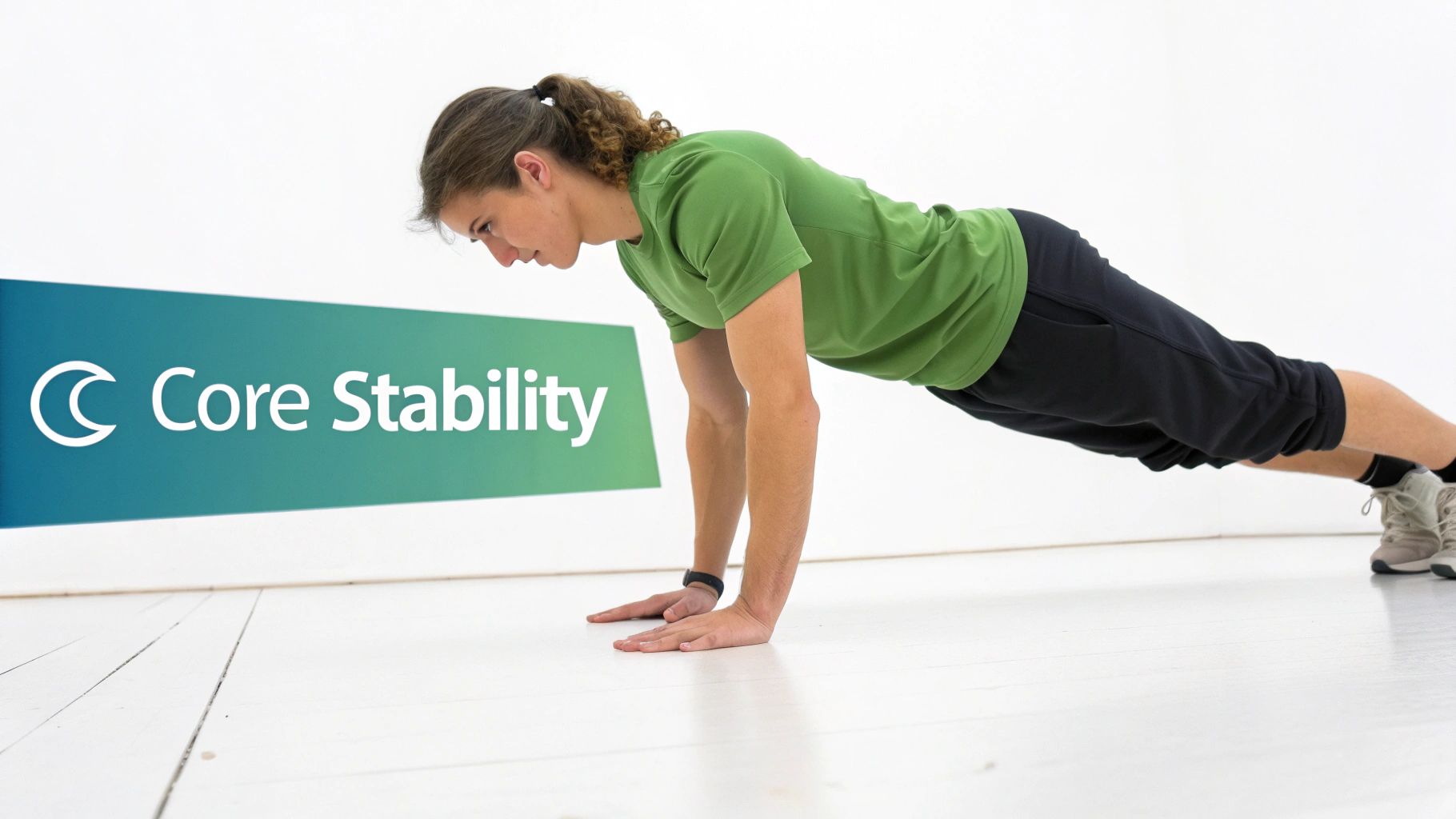
Follow these steps to ensure proper form and activate the correct muscles:
Our Clinical Insight: We often refer to the plank as "anti-extension" training. Its primary benefit is teaching the body to resist the tendency of the lower back to over-arch. Mastering this control is a cornerstone of our non-surgical approach, as it directly translates to better spinal protection during everyday movements.
Using a stability ball for lumbar stabilization is an advanced approach that introduces an unstable surface to challenge and strengthen the deep core muscles. This dynamic method forces greater activation of the tiny stabilizer muscles surrounding the spine, which are crucial for maintaining proper posture and absorbing daily stresses. Exercises like ball back extensions, bridges, and planks on the ball train the core to react and stabilize in real-time, improving neuromuscular control.
This technique moves beyond static floor exercises, making it one of the best exercises for lower back pain relief for those ready to progress their rehabilitation. It builds functional strength that translates directly into better support during everyday activities, from lifting groceries to sitting at a desk. The unstable surface increases the demand on the core, promoting a more resilient and responsive lumbar region.
The bridge is an excellent starting point for using a stability ball. Follow these steps for proper form:
Our Clinical Insight: We integrate stability ball exercises as a key progression in our non-surgical treatment plans. The ball’s instability mimics real-world scenarios where your body must constantly adjust. This helps re-educate the neuromuscular system to automatically fire the correct stabilizing muscles, which is a core component of our Disc Care Protocol.
| Exercise | Implementation complexity | Resource requirements | Expected outcomes | Ideal use cases | Key advantages |
|---|---|---|---|---|---|
| Cat-Cow Stretch (Marjaryasana-Bitilasana) | Very low — simple rhythmic movement | None (yoga mat/towel recommended) | Improved spinal mobility, reduced stiffness, better proprioception | Daily mobility, warm-up, workplace breaks, initial PT assessment | Low injury risk, breath-synced, easily modified |
| Glute Bridges (Hip Extension Strengthening) | Low–moderate — requires hip-hinge understanding | Minimal (mat; optional band/weight) | Increased glute strength, improved hip extension, reduced lumbar load | Rehabilitation for back pain, strength programs, gym/home training | Evidence-based for back pain reduction, progressive overload possible |
| Dead Bug Exercise (Core Stabilization) | Low–moderate — requires neutral spine control | Minimal (mat; optional light weights) | Deep core stability, improved neutral spine control, reduced compensatory patterns | Post-surgical rehab, core foundation work, safe for acute pain | Low spinal load, builds foundational stability, easily progressed |
| Child's Pose (Passive Spinal Flexion Stretch) | Very low — passive hold | None (optional pillow/blanket) | Spinal decompression, posterior chain stretch, autonomic relaxation | Rest in yoga, acute pain relief, stress reduction, office breaks | Promotes relaxation, accessible to most fitness levels |
| Quadruped Bird Dog (Dynamic Core Stability) | Moderate — balance and coordination required | Minimal (mat) | Dynamic spinal stability, improved balance and anti-rotation control | Progression from dead bug, athletic training, clinical stability programs | Functional carryover, engages multiple muscle groups |
| Hamstring & Calf Stretching (Posterior Chain Release) | Low — technique and consistency important | None (optional strap or wall) | Increased posterior chain flexibility, reduced lumbar strain | Runners, posture programs, preventive occupational health | Targets common contributors to back pain, simple and versatile |
| Planks & Variations (Isometric Core Strengthening) | Low–moderate — form critical to avoid compensation | Minimal (mat) | Improved core endurance and static stability, reduced chronic symptoms | Core conditioning, athletic prep, endurance training | Scalable progress (time/variations), effective for endurance |
| Lumbar Stabilization with Stability Ball (Dynamic Core Strengthening) | Moderate–high — higher learning curve and control needed | Stability ball, space; optional bands | Enhanced dynamic core activation, improved balance and proprioception | Rehab progression, Pilates, functional/core training (not acute flare-ups) | High neuromuscular demand, versatile exercise options |
You have now explored a curated list of some of the best exercises for lower back pain relief, from the gentle mobilization of the Cat-Cow to the core-bracing power of the Plank. By understanding and practicing these movements, you are taking a significant, proactive step toward managing discomfort, improving spinal stability, and reclaiming control over your physical well-being. The true power of these exercises lies not in performing them sporadically, but in building a consistent, mindful routine that becomes an integral part of your life.
Remember, the goal isn't just to alleviate pain in the moment; it's to build a resilient, functional foundation that prevents future flare-ups. Each exercise we’ve detailed, whether it's the Dead Bug for deep core stabilization or Glute Bridges for posterior chain strength, serves a specific purpose in creating a balanced and supportive structure around your lumbar spine. This isn't about pushing through pain; it's about listening to your body, respecting its limits, and progressing intelligently.
As you move forward, keep these core principles at the forefront of your practice. They are the difference between temporary relief and lasting change.
Consistently performing the best exercises for lower back pain relief is a powerful strategy, but it is often one piece of a larger puzzle. True, long-term healing requires addressing the root cause of your pain, which may involve underlying structural issues, disc pathology, or chronic inflammation that exercise alone cannot fully resolve.
At Bonesetters Critical Chiropractic in Chesterfield, we view targeted exercise as a crucial component that supports and enhances a comprehensive, evidence-based care plan. Our philosophy is built on integrating foundational movements like these with advanced, non-surgical treatments designed to correct the source of your pain. We utilize precise diagnostics to understand your unique condition, whether it's sciatica, a herniated disc, or degenerative changes. This allows us to create a personalized protocol that may include:
These clinical interventions create an environment where your body can heal more effectively. The exercises you perform at home then serve to stabilize the corrections made in our clinic, strengthen the supporting musculature, and empower you to maintain your progress for years to come. If you've been diligently exercising but your progress has stalled or your pain remains complex and persistent, it may be time for a professional evaluation to uncover the missing pieces of your recovery. A personalized, whole-body approach is often the key to unlocking measurable, lasting relief and helping you reclaim a life of comfort and mobility.
Ready to move beyond temporary solutions and address the root cause of your lower back pain? The team at Bonesetters Critical Chiropractic, led by Dr. Leonard Hayes, integrates targeted exercises with advanced non-surgical treatments to create a personalized path to lasting relief. Schedule your consultation today at Bonesetters Critical Chiropractic to discover how a comprehensive strategy can help you achieve your health goals.