

If you’ve been chasing a solution for nagging lower back pain with no luck, the problem might not be in your spine at all. A surprising amount of chronic low back pain—up to 25% of cases, in fact—originates from the sacroiliac joint. SI joint chiropractic care is all about getting to the root of this specific issue, correcting the mechanics of the joint to provide relief where other treatments have missed the mark.
Picture your sacroiliac (SI) joints as the body's primary shock absorbers, the crucial connection point between your spine and your pelvis. You have two of them, flanking your tailbone, and they are built to be incredibly strong. Their main job is to transfer the load from your upper body to your legs every time you move.
But what happens when one of these hardworking joints stops working correctly? If it moves too much (hypermobility) or gets stuck and barely moves at all (hypomobility), it can set off a chain reaction of pain. This is called sacroiliac joint dysfunction, and it's a very common, yet frequently missed, cause of persistent pain in the lower back, buttock, and even down the leg.
SI joint issues rarely just pop up overnight. They usually develop from specific stressors that throw the joint's stability out of whack. Knowing what causes them is the first step in getting things back on track.
Here are some of the most common culprits:
Here’s where it gets tricky. SI joint pain is a master of disguise, and its symptoms often look a lot like other back problems. It’s incredibly common for people to be told they have sciatica or a herniated disc when the SI joint is the real source of their misery.
The biggest hurdle in getting effective back pain treatment is often just getting the right diagnosis. SI joint pain can feel like a sharp, stabbing sensation in the buttock, a dull ache that radiates down the thigh, or pain that flares up when you're climbing stairs or just trying to roll over in bed.
Because the symptoms overlap so much, it's easy to get confused. This table breaks down the key differences to help you tell them apart.
| Symptom Area | SI Joint Dysfunction | Sciatica (Lumbar Disc Issue) |
|---|---|---|
| Primary Pain Location | Low back, buttock, groin; usually one-sided. | Starts in the low back, travels down the leg. |
| Pain Radiation | Typically stops above the knee. | Often radiates past the knee, into the foot. |
| Numbness/Tingling | Uncommon, but can cause some thigh numbness. | Common, often follows a specific nerve path. |
| Pain Triggers | Standing up, climbing stairs, rolling in bed. | Bending forward, sitting for long periods. |
| Muscle Weakness | Rare. | Can cause weakness in the leg or foot ("foot drop"). |
Distinguishing between these conditions is critical because the right treatment depends entirely on the right diagnosis.
This is why a targeted approach is so important. Research has shown just how effective specific chiropractic care can be. In one key study, women with confirmed SI joint dysfunction were split into two groups. The first group received only a chiropractic adjustment to the SI joint. The second received adjustments to both the SI joint and the lumbar spine. The results were telling: the group that got the combined treatment reported much better improvements in both pain and mobility, not just right away, but a full 30 days later. You can read more about these findings on SI joint treatment. It’s a perfect example of why zeroing in on the true source of the pain is the only way to achieve lasting relief.
Getting lasting relief from SI joint pain isn't a matter of luck. It all starts with a precise, hands-on diagnosis. A general back pain exam might just look at your lumbar spine, but a chiropractor experienced with SI issues knows how to isolate that specific joint and confirm it's the true culprit. This detective work is the single most important step toward getting the right treatment.
It always begins with a conversation—a deep dive into your health history and symptoms. We'll want to know exactly where it hurts, what brings on the pain, what (if anything) makes it feel better, and how it’s messing with your daily life. This isn't just friendly chat; it’s the beginning of our clinical investigation, helping us rule out other common suspects like a disc herniation or sciatica.
After we talk, the hands-on work begins with a thorough physical and biomechanical exam. This is where we see how your body is functioning as a whole system and uncover the specific issues contributing to your pain.
This evaluation is a multi-part process:
To really zero in on the SI joint, we use a series of well-established orthopedic tests. These are specific, gentle movements designed to put a little pressure on the joint. If a certain maneuver triggers that familiar pain you've been feeling, it's a very strong sign that the SI joint is the problem.
Think of it like finding a squeaky hinge on a door. You don't just stare at the door; you push and pull on specific spots until you make it squeak. These tests work the exact same way.
A correct diagnosis is more than half the cure. By using specific provocation tests, a chiropractor can move beyond guesswork and build a treatment plan based on clear, objective evidence of SI joint involvement.
Here are a few of the go-to tests you might experience:
This diagnostic flowchart gives you a good idea of how a professional thinks through the process, sorting through symptoms to distinguish between different sources of low back pain.
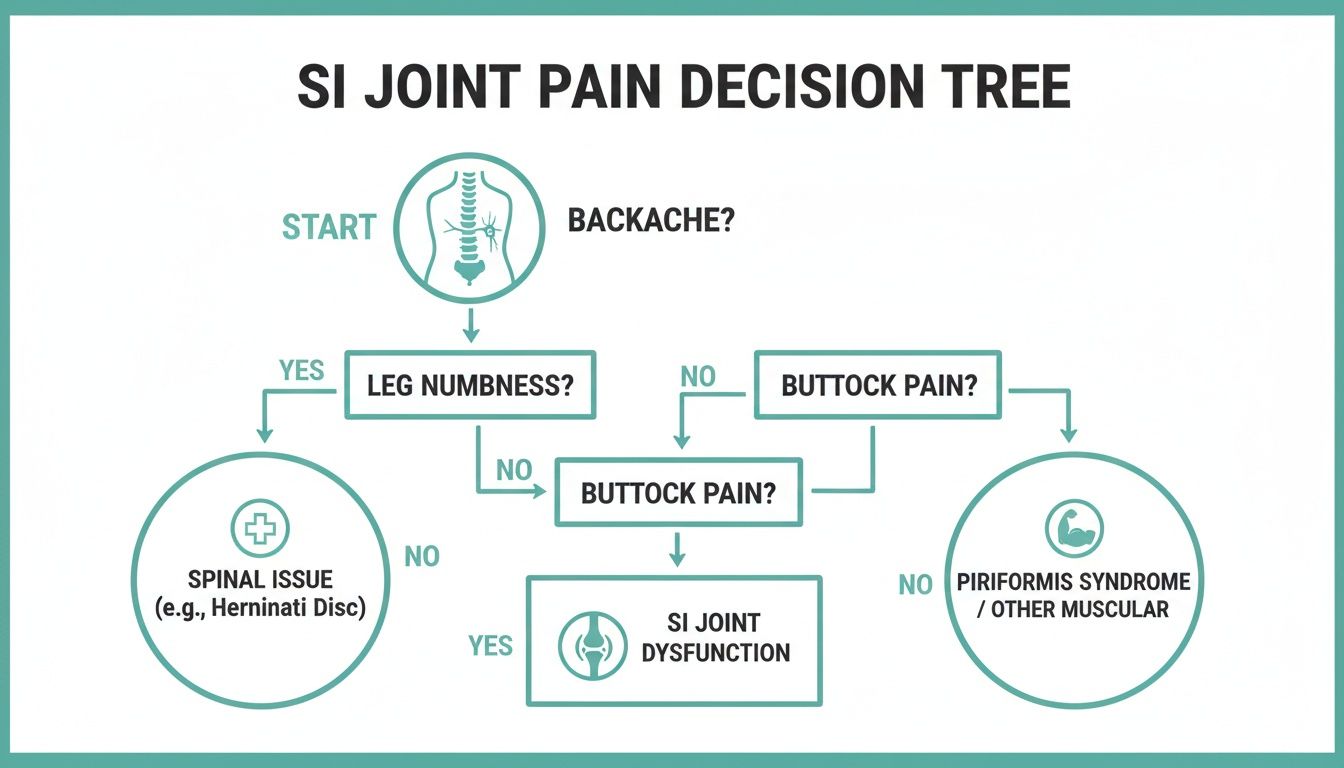
As the chart shows, a "backache" is just the starting point. The specific location of your pain and other symptoms, like leg numbness, are key clues. By combining this kind of systematic thinking with a hands-on exam, we get a crystal-clear picture of what’s going on. If you're curious about this process, you can learn more about how a chiropractor knows where to adjust in our detailed guide on the topic.
Once we've confirmed the SI joint is the root of your pain, we can get to work. The goal isn't just random "back cracking"; it's about applying a very specific force in just the right direction to fix what’s wrong with the joint's movement. We're aiming to restore that perfect balance—not too stiff, not too loose—which is the key to getting you out of pain and back to your life.
Modern chiropractic care gives us a whole toolbox of techniques, from the classic hands-on adjustments you might be familiar with to newer, incredibly precise instrument-assisted methods. This flexibility lets us choose the perfect approach for your body, your comfort, and the unique way your SI joint is acting up.

The cornerstone of si joint chiropractic care is the manual adjustment, where the chiropractor uses their hands to apply a controlled force to the joint that’s giving you trouble.
These hands-on methods aren't just based on tradition; they're backed by solid research. One landmark clinical trial looking at chiropractic for SI joint pain found that 78% of patients made a full recovery after only four weekly sessions. The study showed a major drop in pain after HVLA manipulation, which is exactly the kind of targeted, effective adjustment we aim for. You can read the full research on chiropractic for SI joint pain for yourself.
While manual adjustments have a long track record of success, technology has given us tools for an even greater level of precision. Here at Bonesetters, we often use advanced, computer-guided instruments like the PulStar system to deliver adjustments that are both incredibly accurate and comfortable.
Think of it as a "smart tool" for your spine. The process is simple:
The PulStar system takes the guesswork out of the equation. It lets us perform an adjustment that's not only incredibly precise but also exceptionally gentle, making it a great choice for patients who are nervous about traditional adjustments or have conditions that need a more delicate approach.
This technology allows us to provide a consistent, measurable treatment every time, ensuring the force we apply is exactly what your SI joint needs to heal. It’s a perfect example of how modern si joint chiropractic care combines time-tested principles with advanced tech to get better results.
Whether it’s with skilled hands or with the help of computer guidance, the objective is always the same: correct the joint's mechanics so you can get lasting relief from pain.
Wondering what’s happening on a deeper level during these corrections? Our guide explains in more detail how do chiropractic adjustments work to get your body functioning properly again.
Restoring proper motion to the SI joint with chiropractic adjustments is the heart of recovery, but it’s not the whole story. Think of it like fixing a crooked gate hinge. The adjustment straightens the hinge (the SI joint), allowing the gate to swing freely again. But what if the fence post is wobbly or the wood is inflamed and swollen? You have to address those issues, too.
That's where complementary therapies come in. They work hand-in-hand with your si joint chiropractic care to create the perfect healing environment. By tackling inflammation, easing nerve pressure, and strengthening the muscles that hold your pelvis together, these additional treatments can speed up your recovery and build real, lasting stability.
When an SI joint is locked up or out of place, it tends to squeeze everything around it—muscles tighten up, and nearby nerves get irritated. Spinal decompression is a fantastic, non-surgical therapy we use to gently and methodically relieve that pressure. You simply relax on a specialized table as it creates a subtle negative pressure right where you need it.
This process is a game-changer for two key reasons:
The whole process is incredibly gentle and controlled. It’s the perfect partner to a specific chiropractic adjustment because it calms down the entire area, making the adjustments more effective and your relief that much deeper.
Inflammation is a huge part of the pain equation with SI joint dysfunction. While adjustments fix the mechanical problem, we still have to put out the fire. Class IV cold laser therapy is one of our best tools for this. It uses specific wavelengths of light energy that penetrate deep into the tissues around the inflamed SI joint.
This isn't science fiction; it's cellular biology. The light energy kickstarts your mitochondria—the tiny powerhouses inside your cells. This process, called photobiomodulation, sets off a chain reaction of positive effects.
In simple terms, the laser gives your cells an energy boost to repair themselves faster. It dials down inflammation, improves blood flow to the damaged area, and accelerates tissue regeneration—all without any heat, sound, or sensation.
Patients often report much faster pain reduction when we combine laser therapy with their adjustments. If you want to dive deeper into the science, you can learn more about the benefits of cold laser therapy and how it helps with all kinds of joint pain.
While the adjustment is the primary intervention, these supporting therapies create an environment where the body can heal faster and more completely.
| Adjunct Therapies for SI Joint Recovery |
| :--- | :--- | :--- |
| Therapy | How It Helps SI Joint Pain | Primary Benefit |
| Spinal Decompression | Gently creates negative pressure in the lumbar spine and pelvis, relieving pressure on the sciatic nerve and facet joints. | Nerve Decompression |
| Class IV Cold Laser | Penetrates tissue to stimulate cellular repair (photobiomodulation), reducing swelling and pain signals. | Inflammation Reduction |
| Horizontal Stimulation | Uses electrical frequencies to re-activate and strengthen the deep stabilizing muscles around the pelvis (glutes, core). | Muscle Re-education |
| Nutritional Support | Provides the body with key anti-inflammatory compounds and building blocks for cartilage and connective tissue repair. | Tissue Healing |
By integrating these therapies, we build a comprehensive plan that doesn't just chase symptoms but fosters true, long-term healing from the inside out.
Once the SI joint is moving correctly, we need to make sure the muscles around it are strong enough to keep it that way. After dealing with chronic pain, it's common for these supportive muscles to get weak or forget how to fire properly. Horizontal stimulation therapy is all about re-educating that system.
This therapy uses targeted electrical frequencies to wake up and strengthen the key muscles that stabilize your pelvis, like your glutes and deep core muscles. It helps rebuild strength, improve coordination, and restore the correct firing patterns. It's like a hyper-focused workout for the exact muscles needed to protect your SI joint, helping to lock in the progress from your chiropractic care.
To give your body even more support, proper nutrition is key. Looking into a complete guide to supplements for joint health can provide valuable insights that complement our hands-on work. When we combine mechanical correction with therapies that reduce inflammation, decompress nerves, and retrain muscles, we’re truly tackling the problem from every angle.
While chiropractic adjustments are fantastic for correcting SI joint misalignments and getting you out of pain, the real secret to lasting relief is teamwork. Think of your chiropractor as the expert who realigns your spine and pelvis. Now it's your turn to strengthen the support system around it to make sure that alignment holds.
Lasting wellness is truly a partnership between you and your doctor. When you take an active role in your recovery, you're not just getting treatment—you're building a more resilient, pain-free foundation for the long haul.

Your SI joints don't work in isolation; they depend on a whole network of muscles to keep them stable. If those muscles, particularly your deep core and glutes, are weak, the ligaments around the joint take on too much of the load. That leads directly to strain, instability, and pain.
A specific exercise program is designed to rebuild this muscular "corset," giving your pelvis the internal support it craves. We often start with a few simple but incredibly effective exercises:
The goal isn't to become a powerlifter; it's to restore function. Consistency with these gentle exercises is far more important than intensity, as it retrains your body’s natural stabilization patterns.
This combined approach is backed by solid evidence. One study found that while chiropractic adjustments provided the quickest initial relief for SI joint pain, combining them with exercise therapy led to significant, lasting improvements in both pain and function. This really drives home the importance of pairing professional si joint chiropractic care with your own active recovery plan. You can explore the research on combined SI joint therapies yourself to see how this dual approach creates much better long-term results.
Even the strongest muscles can't protect you from bad habits. The way you sit, stand, and lift throughout the day can either support your SI joints or constantly put them under stress, undermining all your hard work.
Making a few small changes to your daily routine can make a world of difference. Here’s where to focus:
Walking into a new clinic can feel a bit intimidating, especially when you're in pain. We get it. That's why we make your first visit for si joint chiropractic care a straightforward, comfortable experience where you're in the driver's seat. This isn't about a quick adjustment and out the door; it's the beginning of a partnership aimed at finding the root cause of your pain and building a strategy for long-term relief.
The entire process starts with a simple conversation. We'll go over your health history, dig into the specifics of your SI joint pain, and talk about what has or hasn't worked for you in the past. More importantly, we want to know how this pain impacts your daily life—what activities it's keeping you from enjoying and what your ultimate goals are.

After we’ve talked, we move on to a thorough, hands-on examination. This is where the real detective work begins, as we gather the physical clues needed to confirm that the SI joint is, in fact, the culprit. Your chiropractor will lead you through a series of specific movements and tests designed to gently assess your pelvic mechanics without causing more pain.
This detailed evaluation usually involves:
Once the exam is done, we’ll sit down together and go over everything. We make it a priority to explain our findings in plain English, so you understand exactly what's going on in your body. We’ll connect the dots between what we found and the symptoms you're feeling, then lay out the best path forward.
This part is very much a team effort. We'll propose a personalized treatment plan outlining the specific therapies we recommend, an estimated timeline for visits, and the concrete goals we'll aim for together.
Our goal for your first visit is simple: you should leave with clarity and hope. That means having a clear diagnosis, a step-by-step recovery plan, and a full understanding of the gentle, effective techniques we’ll use to get you there.
There are no surprises. Your care plan is our roadmap, and we’ll be with you for every step of the journey, making sure you feel informed and in control from day one.
It's completely normal to have questions before starting a new kind of treatment. When it comes to something as specific as SI joint chiropractic care, getting clear answers helps you feel confident and ready to find relief. Let's walk through some of the most common questions we hear from patients just like you.
This is probably the most common question, and the honest answer is: it depends. There’s no magic number. How many visits you'll need is based on your unique situation—how long the problem has been there, your overall health, and how your body responds to care.
That said, most people start feeling a noticeable difference within the first few visits. A typical plan of care might involve somewhere between 4 to 12 sessions over a few weeks. We'll lay out a clear roadmap for you from the start. The goal isn't endless appointments; it's to restore function and empower you to stay stable for the long haul.
The short answer is no. Most people describe the feeling of an SI joint adjustment as a sense of relief or release. The techniques we use, especially the modern, computer-guided methods, are incredibly gentle and precise.
You might hear a “pop,” but that’s nothing to worry about. It’s just gas being released from the joint fluid, similar to cracking your knuckles, and it’s perfectly harmless. Your comfort is our top priority, and we’ll talk you through every step of the process so you always feel safe and in control.
The entire point of an adjustment is to get you out of pain, not put you in it. The force we use is carefully controlled and aimed directly at the stuck joint to gently get it moving again.
Yes, and this is something we see all the time. Cortisone injections are great for temporarily knocking down inflammation, which is why they can give you some relief. The problem is, they don't fix the mechanical issue that caused the inflammation in the first place.
This is where SI joint chiropractic care shines. We focus on the root cause. By restoring proper alignment and movement to the joint, we’re fixing the biomechanical problem that’s generating the pain. Many patients who felt let down by the short-term fix of injections find lasting relief with us because we address the actual source of the problem.
Figuring out if your pain is coming from the SI joint or somewhere else in your low back is the crucial first step. While you can look for clues, a professional examination is the only way to know for sure. A specialist chiropractor will take you through a series of specific orthopedic tests designed to pinpoint the exact source of your pain.
Some common signs that strongly suggest the SI joint is the culprit include:
A thorough, hands-on assessment gets rid of the guesswork. It confirms the diagnosis and makes sure you're getting the right treatment for the right problem.
At Bonesetters Critical Chiropractic, our expertise lies in diagnosing and treating the true source of your pain. If you’re ready for a clear diagnosis and a personalized plan for lasting relief, visit us online to schedule your consultation.