

A chiropractic adjustment is all about applying a specific, controlled force to a joint that’s stuck or not moving the way it should. Think of it like a traffic controller clearing a jam on your nervous system’s superhighway. This precise movement restores motion, takes pressure off irritated nerves, and helps your body get back to functioning and healing properly.

At its heart, a chiropractic adjustment is a highly skilled procedure that fixes problems in your body's structure to improve how it works. When a joint in your spine loses its normal alignment or gets "stuck," it can start to irritate the nerves and muscles around it. This is what often leads to pain, stiffness, and a host of other health problems.
The entire process is built on two key scientific principles:
By applying a quick, targeted thrust, a Doctor of Chiropractic can improve mobility, relieve the pressure on those sensitive nerves, and tell tight muscles to relax. It’s so much more than just "cracking your back." It’s a calculated, gentle intervention designed to reboot the connection between your brain and body.
The moment an adjustment is delivered, a few things happen almost instantly. The table below breaks down the immediate biomechanical and neurological changes that kickstart the healing process.
| Effect Type | What Happens to the Body | Benefit to the Patient |
|---|---|---|
| Biomechanical | Joint restriction is released, improving the range of motion. | Increased mobility and flexibility; less stiffness. |
| Neurological | Nerve pressure is relieved as the joint returns to a better position. | Reduced pain signals being sent to the brain. |
| Proprioceptive | Specialized nerve receptors in the joint are stimulated. | Better joint position sense and improved balance/coordination. |
| Muscular | Overactive, tight muscles receive a signal to relax. | Immediate reduction in muscle tension and spasms. |
These immediate effects work together, creating a window of opportunity for the body to start healing and for you to feel relief.
While most people first walk into a chiropractor’s office looking for pain relief, our ultimate goal is to restore long-term function. An adjustment doesn't just put a band-aid on your symptoms; it gets to the root cause of the problem.
When we correct those joint restrictions, we're giving your body a much better chance to heal itself and prevent the same issues from popping up again down the road. If you're curious about how we pinpoint these exact problem spots, check out our guide on how chiropractors know where to adjust.
An adjustment is essentially a conversation with the nervous system. By introducing a specific mechanical input (the thrust), we prompt a cascade of positive neurological responses that reduce pain, relax muscles, and restore balance to the body.
This focus on foundational health is what makes chiropractic care such a powerful tool for everything from managing chronic pain to boosting athletic performance. By making sure your body's structure is solid and its communication lines are clear, adjustments help you move better, feel better, and live a healthier, more active life.
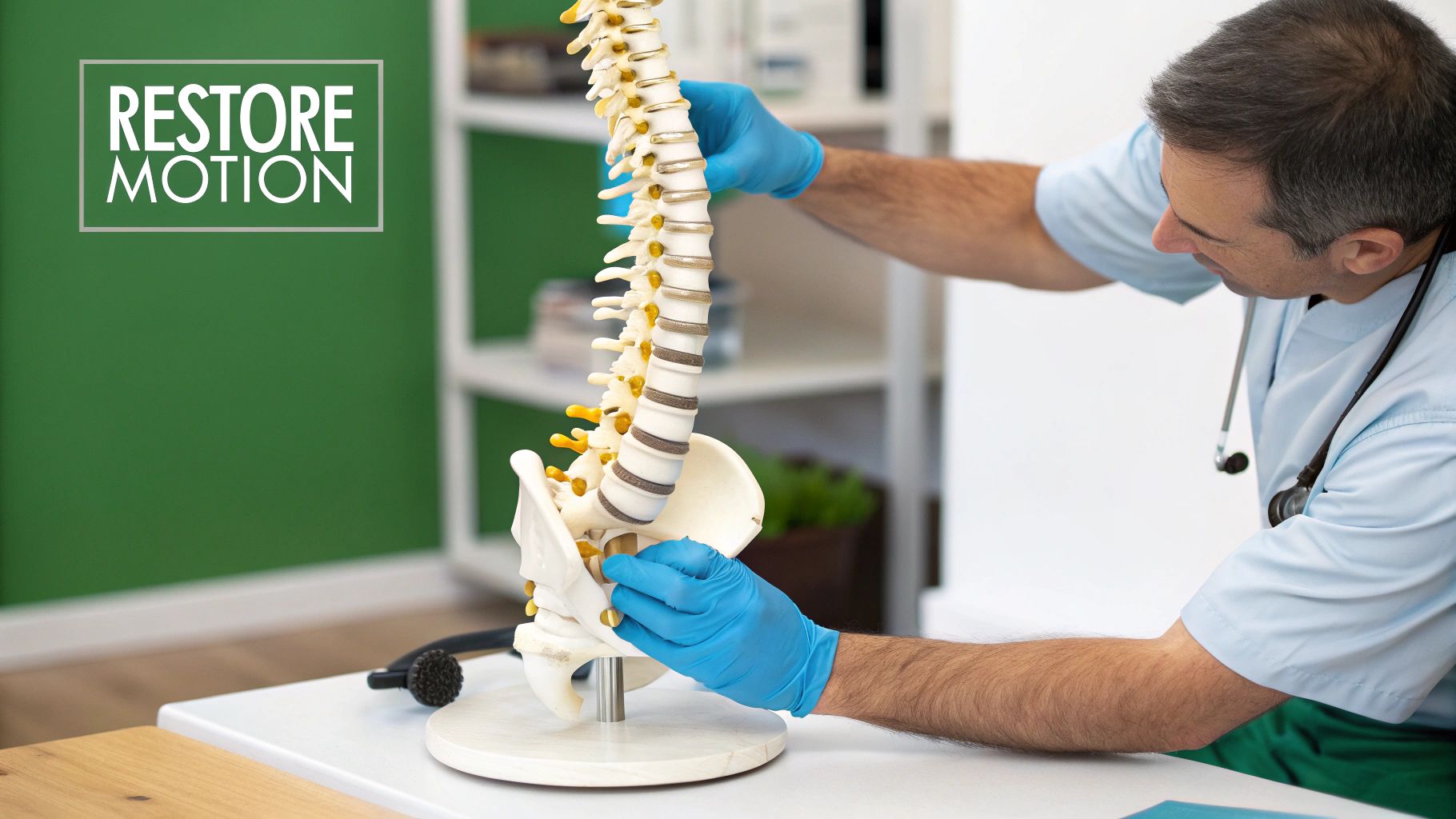
To really get to the heart of how a chiropractic adjustment works, we have to start with the most immediate physical effect: getting things moving again. Think of a perfectly good door that won't open all the way because its hinge is stiff and rusty. Your spinal joints can get stuck in a very similar way, often from injuries, years of poor posture, or just repetitive daily stress.
When a joint loses its natural, smooth range of motion, it kicks off a chain reaction. Other parts of your body have to pick up the slack and overcompensate. This leads to muscle strain, imbalances, and, eventually, pain. Your body is an incredible system of interconnected parts, and when one part isn't doing its job, others are forced to work overtime.
A chiropractic adjustment is a lot like applying a specific, quick push to that rusty door hinge. It’s a highly targeted force designed to break up the tiny adhesions and bits of scar tissue that have formed around the joint, essentially gluing it in place.
In our field, we call this a high-velocity, low-amplitude (HVLA) thrust. Let’s break that down.
This precise action restores the joint's ability to glide and pivot, effectively "unsticking" it. The result is often an immediate improvement in how you move, which is the foundational first step toward real healing.
Getting a joint moving again does a lot more than just make you feel less stiff. Inside every spinal joint is a substance called synovial fluid, which is basically the WD-40 for that hinge. This fluid is rich with nutrients that keep the joint cartilage healthy and lubricated.
When a joint is stuck, that fluid can become stagnant, starving the cartilage of what it needs to thrive. The adjustment creates a natural pumping action, circulating this vital fluid. It flushes out inflammatory waste products and pulls in fresh nutrients, giving the joint the resources it needs to repair itself.
The mechanical restoration of joint function is the essential starting point for healing. By addressing the root physical cause of the problem—the restricted joint—we create the conditions necessary for the body to reduce inflammation, relax tense muscles, and alleviate nerve irritation.
This is how we directly address the underlying cause of things like chronic back pain, nagging neck stiffness, or radiating sciatica. We aren't just chasing symptoms; we're restoring your body’s intended design.
Once a joint is moving correctly, the benefits start to ripple outward. Muscles that were constantly tight from overcompensating can finally let go and relax. Nerves that were pinched or irritated by the dysfunctional joint are no longer under pressure. This is a core principle of how chiropractic works: fix the structure to improve the function.
Think about what this means for different types of pain:
By focusing on restoring this natural, efficient motion, we empower your body to kickstart its own powerful healing process. It's really about removing the interference so your body can get back to doing what it does best: taking care of itself.
While getting joints moving again is the obvious first step, the real magic of a chiropractic adjustment happens deep within your nervous system. Think of your body as a high-performance computer. An adjustment acts like a system reboot, interrupting the dysfunctional loops that keep you stuck and resetting the lines of communication between your brain and body. This is where true healing begins.
When a joint is adjusted, that quick, gentle movement creates a flood of information from specialized nerve receptors tucked away in the surrounding muscles and tissues. These tiny sensors, called mechanoreceptors, are constantly telling your brain about movement and position. The adjustment sends a massive, positive wave of this sensory data rushing up the spinal cord.
This sudden burst of new information essentially overrides and turns down the volume on persistent pain signals. It's like being in a noisy room where everyone is shouting (your pain signals). Suddenly, a clear announcement comes over the loudspeaker (the adjustment). The shouting gets drowned out as your brain is forced to pay attention to the new, more important message.
There's a well-established scientific concept that explains this perfectly: the Gate Control Theory of Pain. It proposes that your spinal cord has a kind of neurological "gate" that either allows pain signals to pass through to the brain or blocks them. The intense stimulation from an adjustment helps "close the gate" on those pain messages.
This is why many people feel an immediate sense of relief right after a visit—the physical act is directly tied to this very real neurological response. If you're interested in the nitty-gritty of how your nervous system handles pain, you can understand the Gate Control Theory of Pain in more detail.
On top of that, this neurological reset also triggers the release of your body's own natural painkillers, known as endorphins. These powerful neurochemicals don't just dull pain; they create a sense of well-being, which is another reason adjustments can feel so good.
This isn't just a nice theory; it's a documented bio-neuro-mechanical cascade. Research has shown that in the incredibly brief 150 milliseconds it takes to perform an adjustment, a remarkable chain reaction is set off. This precise input has been proven to calm down overactive muscle spindles—the very things that keep muscles painfully tight.
What's even more impressive is that the effects aren't just local. An adjustment to one specific area of the spine can still produce 60% to 80% of that calming muscle response two segments away. It’s a clear demonstration of how the positive effects ripple through the nervous system.
This whole process stimulates the central nervous system right where it's needed, helping to break the negative cycle caused by chronic joint dysfunction. We explain how these dysfunctions, known as vertebral subluxations, create this neurological interference in our detailed guide.
By introducing a specific, controlled force, we are essentially sending a powerful, positive signal that interrupts the body's pain-spasm-pain cycle. This reboot allows the nervous system to recalibrate, reducing pain perception and restoring clearer communication pathways.
This neurological "reboot" does so much more than just mask pain. When your brain and body can talk to each other more clearly, a whole host of other functions naturally begin to improve.
Ultimately, this neurological reset is how a chiropractic adjustment creates lasting change. It gets to the root of the problem by restoring the body's master control system. The goal isn't just to make you feel better, but to help you function at a completely different level.
It's a common misconception that all chiropractic adjustments are the same. In reality, a modern chiropractor has a whole toolbox of techniques, and the key is knowing which tool is right for the job—and for the person on the table. Think of it like a master mechanic; they wouldn't use a sledgehammer when a precision screwdriver is needed.
The choice between a classic hands-on adjustment and a modern instrument-guided one comes down to your specific condition, your body's needs, and even your comfort level. Let's break down the two main approaches.
When most people picture a chiropractic adjustment, they’re thinking of this classic, hands-on method. It’s technically called a high-velocity, low-amplitude (HVLA) thrust, where the chiropractor uses their hands to apply a quick, controlled force to a specific joint.
This is the technique often associated with that familiar “popping” or “cracking” sound (which is just gas releasing from the joint fluid, nothing to worry about!). For decades, manual adjustments have been a fantastic way to restore movement, especially in larger, sturdier joints. A skilled chiropractor can get a lot of tactile feedback this way, feeling exactly how the joint is moving. The main drawback is that the force can vary slightly each time, and it isn't the best fit for every single patient.
No matter the technique, the goal is always to reboot the nervous system by restoring proper joint function, which helps to quiet down those disruptive pain signals.
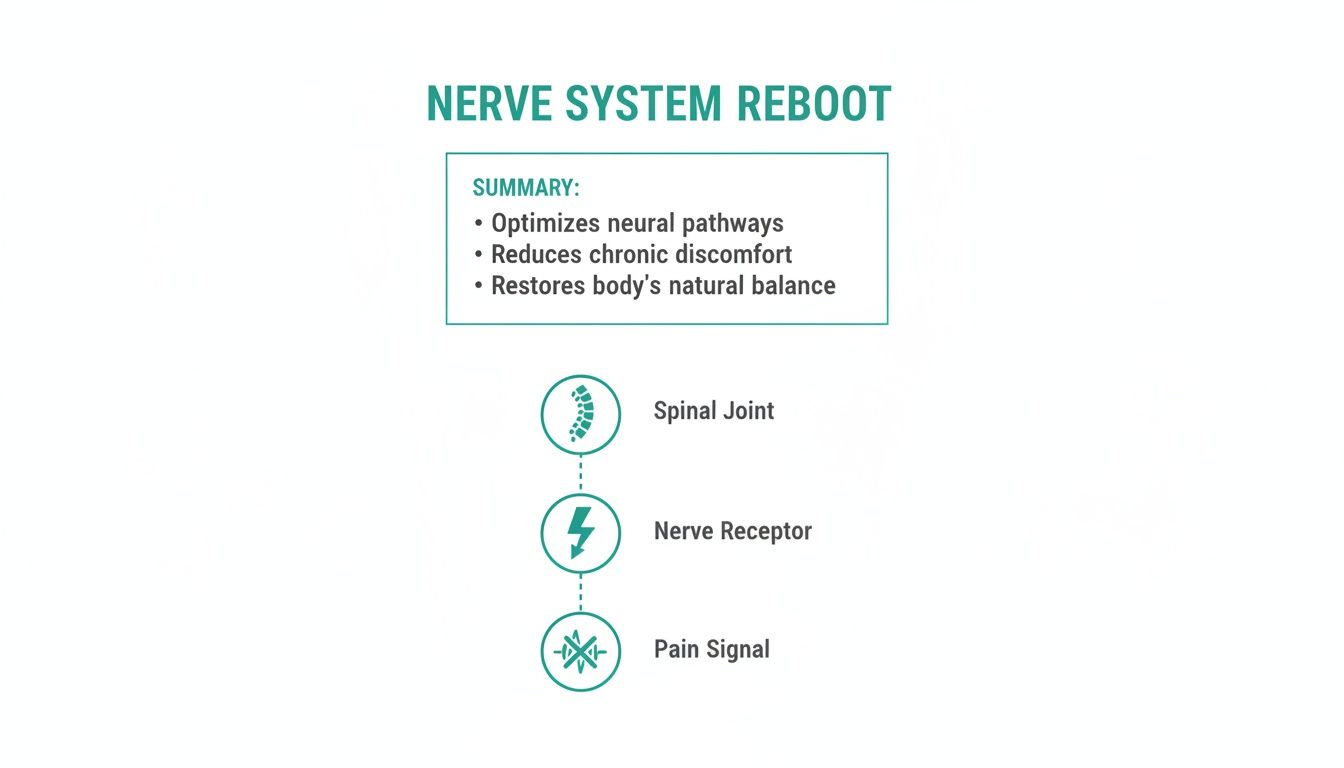
As you can see, fixing the joint's mechanics has a direct, calming effect on the nerve receptors, helping to interrupt the pain messages being sent to your brain.
For patients who prefer a gentler touch or situations that demand absolute precision, instrument-assisted techniques are a game-changer. Imagine the difference between a sculptor using a hand chisel versus a high-tech 3D printer. Both can create a masterpiece, but the printer offers a level of consistency and detail that's hard to match by hand.
At Bonesetters, we use the FDA-backed PulStar system, a computer-guided tool that’s a huge leap forward in chiropractic technology. The PulStar uses a small, handheld device to send very gentle impulses into the spine. As it does this, a sophisticated computer program analyzes how the joint responds, pinpointing exactly where things are stuck.
This data allows us to deliver a series of soft, targeted taps at the precise frequency needed to get the joint moving again. The best part? There’s no twisting, popping, or cracking involved, which makes it a fantastic option for a wide range of people.
Instrument-assisted adjustments deliver a measurable, reproducible, and incredibly gentle force. This allows us to provide effective care for patients with complex conditions, acute injuries, or apprehension about manual techniques, ensuring both safety and optimal results.
So, how do these two approaches stack up? Both are effective, but they shine in different situations. Here's a quick comparison to help you see the difference.
| Feature | Manual Adjustment (HVLA) | PulStar System (Instrument-Assisted) |
|---|---|---|
| Sensation | A controlled, quick thrust. Often produces a "popping" sound. | A series of gentle, tapping or percussive impulses. |
| Precision | Relies on the practitioner's hands-on skill and feel. | Computer-guided for pinpoint accuracy and targeted force. |
| Force | Higher velocity, but low amplitude. Can vary slightly with each adjustment. | Extremely low and controlled force, adjustable for each patient. |
| Patient Suitability | Excellent for most healthy adults with general joint restrictions. | Ideal for sensitive patients, seniors, children, and acute injuries. |
| Analysis | Based on palpation, motion tests, and practitioner experience. | Provides real-time, objective computer analysis of joint motion. |
| Comfort | Effective, but can cause anxiety for those who dislike the "cracking" sound. | Non-invasive and very comfortable; no twisting or popping. |
Ultimately, having both options available means we can provide a truly customized experience.
The decision between a manual or instrument-assisted adjustment is always a collaborative one, based on a thorough exam and your health history. Our job is to figure out the safest, most effective way to help you heal.
Here are a few common scenarios where the PulStar system is often the clear winner:
By having multiple tools in our arsenal, we can tailor your care to your exact needs. The goal never changes: restore motion, reset the nervous system, and get you back to doing what you love.
It's one thing to understand the mechanics of an adjustment—how it moves joints and affects nerves. But what really matters is how those changes translate into real-world results. This is where modern chiropractic care truly stands out, moving from theory into the realm of science-backed, clinical proof. For years, major medical journals have documented the effectiveness of spinal manipulation, establishing it as a go-to approach for many common pain conditions.
This isn't some fringe idea; it's a discipline grounded in high-level research. The conversation has shifted from if chiropractic works to how well it works, especially when stacked up against other standard treatments. The evidence consistently points toward great outcomes, particularly for some of the most stubborn and debilitating issues people face.
Low back pain is a massive problem, and it's also where the research on chiropractic is incredibly strong. Study after study has shown that chiropractic adjustments often deliver better results for both short-term and chronic low back pain than usual medical care, leading to real improvements in pain levels and the ability to get back to daily life.
One landmark study in the journal Spine put some hard numbers on it. Researchers found that a staggering 94% of patients who received manual-thrust adjustments saw their low back pain drop by more than 30%. For comparison, only 69% of patients who received standard medical care got the same level of relief. You can see the full details in this paper on chiropractic's edge over standard treatments. This isn't magic; it's the result of quieting pain signals in the spinal cord, reducing inflammation, and improving blood flow to the injured area.
A major 2017 study in the Journal of the American Medical Association (JAMA) drove this point home, confirming that chiropractic care offers superior outcomes for acute low back pain compared to what most people typically receive.
This growing body of evidence makes it clear: adjustments get to the root of the problem by addressing both the mechanical and neurological causes of back pain, offering a path to lasting relief, not just a temporary fix.
The proof doesn't stop at the lower back. The same principles that make adjustments so effective for lumbar issues apply all the way up the spine, bringing relief for a whole host of other common problems.
On top of all this, the Annals of Internal Medicine has repeatedly confirmed that spinal manipulation is safe, with a very low risk of serious side effects when performed by a qualified professional. When you combine high effectiveness with a strong safety profile, it’s easy to see why chiropractic has become such a powerful, evidence-based choice for people ready to reclaim their health and get back to living without pain.
Good chiropractic care goes way beyond just fixing a sore back or a stiff neck. When we restore the spine's natural alignment and reboot the nervous system, the positive effects ripple through the entire body. Think of it this way: a healthy spine is the foundation for a healthy life. When that main communication highway between your brain and your body is clear, every cell, tissue, and organ just works better. The benefits reach far beyond simple pain relief.
This happens because adjustments directly improve proprioception—your body's built-in GPS for knowing where it is in space. By stimulating the nerve receptors tucked inside your joints, we're basically giving your brain a clearer, high-definition picture of what every part of your body is doing. This mind-body connection is the real secret to unlocking a higher level of function and vitality.
One of the biggest payoffs from better proprioception is a noticeable improvement in physical performance and stability. When your brain gets accurate, real-time data from your joints, it can coordinate your muscles with much greater efficiency. This isn’t just theory; it shows up in real, tangible ways.
For an athlete, that could mean a more powerful golf swing or shaving a few seconds off their sprint time. For an older adult, better balance and body awareness can be life-changing, dramatically reducing the risk of a fall and helping them stay independent. The principle is the same across the board: a well-adjusted body simply moves with more precision and control.
And the research backs this up time and again. Clinical trials have shown significant gains in range of motion, faster reaction times, and better overall sensorimotor function after chiropractic care. One major study even found spinal manipulation worked better than standard medical care for improving function in people with acute low back pain. You can dig into some of these powerful research findings on chiropractic effectiveness yourself.
Restoring nervous system integrity is like upgrading your body’s operating system. When that communication is optimized, secondary benefits like deeper sleep, a stronger immune response, and a real sense of well-being often follow.
Beyond the purely physical gains, chiropractic adjustments can have a profound effect on how your body handles stress. When you're dealing with chronic pain or spinal problems, your nervous system can get stuck in a low-grade "fight-or-flight" mode. This constantly pumps stress hormones like cortisol through your system, which can wreck your sleep, weaken your immune defenses, and just drain your energy.
By calming that neurological irritation right at the source, adjustments help your body shift back into a "rest and digest" state. This neurological reset is crucial because it frees up your body's resources to focus on healing and recovery. It’s why so many of our patients tell us they don't just feel less pain—they're also sleeping better, feel more resilient, and have a much greater sense of overall well-being. It’s a powerful reminder that a healthy spine really is the foundation for taking back your health from the inside out.
Even with a good grasp of the science, it's completely normal to have a few questions before your first visit. The whole idea of an "adjustment" can feel a little mysterious if you've never experienced one, but the process is actually very straightforward and centered on one thing: helping your body heal. Let's walk through some of the most common questions to clear things up.
Feeling confident and informed is the first step in any successful healthcare journey. Our goal is to give you clear, honest answers so you know exactly what to expect.
Yes, absolutely. When performed by a licensed and skilled Doctor of Chiropractic, adjustments are widely recognized as one of the safest, drug-free therapies available. Major medical journals consistently report that the risk of a serious issue is incredibly low. A thorough initial exam, where we go over your health history and perform specific tests, is the first and most important step to ensure you're a good candidate for care.
Plus, with the evolution of gentle, precise techniques like instrument-assisted adjustments, care is safer and more comfortable than ever for people of all ages—from kids to seniors.
That sound you sometimes hear is called a cavitation, and it's nothing more than the release of a tiny gas bubble from the fluid inside the joint. Think of it like opening a can of soda—it's just a change in pressure releasing dissolved gas (mostly nitrogen). It is definitely not the sound of bones cracking or grinding!
While that "pop" can happen during a manual adjustment, it's not the goal. In fact, many of the most effective and gentle techniques we use restore perfect joint motion without making any sound at all.
The audible "pop" is a common but non-essential byproduct of some manual adjustments. The true measure of a successful adjustment is the restoration of joint motion and the positive neurological response that follows, not the sound it makes.
This is probably the most common question we get, and the honest answer is: it's unique to you. How many visits you'll need depends on several factors:
Some people feel a world of difference after just a few visits. For others with more chronic or complex conditions, it might take a bit more time to correct the underlying problem.
A well-designed treatment plan is all about creating lasting change as efficiently as possible, not just chasing temporary relief. This is where finding the right provider makes all the difference. If you're looking for guidance, our article on how to choose a chiropractor is a great resource for making an informed decision.
At Bonesetters, our evidence-based protocols are designed to address the root cause of your pain and restore your body’s natural ability to heal. If you're ready for lasting relief from chronic pain or disc conditions, visit us at https://bonesetters.org to discover a personalized care plan that delivers measurable results.