
Knee pain can feel inevitable, but it doesn't have to be. For many, the key to avoiding discomfort lies not in complex treatments but in proactive, targeted movement. The strength of your hips, the flexibility of your hamstrings, and the stability of your core all play a critical role in how your knees function. Neglecting these areas forces your knees to compensate, leading to wear, tear, and eventual pain.
This guide moves beyond generic advice to provide a curated list of evidence-based exercises to prevent knee pain. Each movement is chosen to address the specific biomechanical weaknesses that lead to joint stress. At Bonesetters, we believe in addressing the root cause, and that often begins with foundational strength and stability. This list is your blueprint for building resilient knees that can support you through every step, squat, and stride of life. To truly embrace a pain-free future and build resilient knees, it's essential to adopt a holistic approach, including a broader a runner's guide to staying strong and healthy.
We'll explore ten highly effective exercises, detailing not just how to perform them, but why they work, common mistakes to avoid, and how to progress safely. This proactive approach empowers you to take control of your joint health before problems arise. Let's begin building the support structure your knees need to thrive for years to come.
Strengthening your quadriceps, the large muscles on the front of your thigh, is one of the most effective exercises to prevent knee pain. These muscles act as the primary shock absorbers for the knee joint, reducing stress on the cartilage and ligaments with every step. When the quads are weak, the knee joint bears a greater load, increasing wear and tear over time.
This is why foundational exercises like isometric quad sets and straight leg raises are so crucial. They build strength and endurance without requiring significant joint bending, making them exceptionally safe for individuals with knee sensitivity or those recovering from injury. A key focus is activating the vastus medialis obliquus (VMO), the teardrop-shaped muscle on the inner thigh, which plays a vital role in keeping the kneecap (patella) tracking correctly.
Expert Tip: For maximum VMO activation during a quad set, focus on keeping your knee fully extended. This precision ensures you're strengthening the exact muscle needed for optimal patellar alignment, a principle we emphasize at Bonesetters to address the root biomechanical causes of knee discomfort.
To effectively integrate these exercises, consistency is key.
Combining these targeted exercises with professional care can significantly improve outcomes. For those dealing with chronic conditions like osteoarthritis, strengthening the supporting musculature is a key part of a conservative management plan. You can explore a comprehensive overview of non-surgical options and find the best treatment for knee arthritis to complement your exercise routine.
Strengthening your glutes and hips is a surprisingly powerful strategy when looking for exercises to prevent knee pain. Weakness in the hip muscles, particularly the gluteus medius, forces the kinetic chain to compensate. This often leads to inward rotation of the femur (thigh bone), causing the knee to collapse inward, a condition known as valgus collapse, which places immense stress on the knee joint, ligaments, and meniscus.
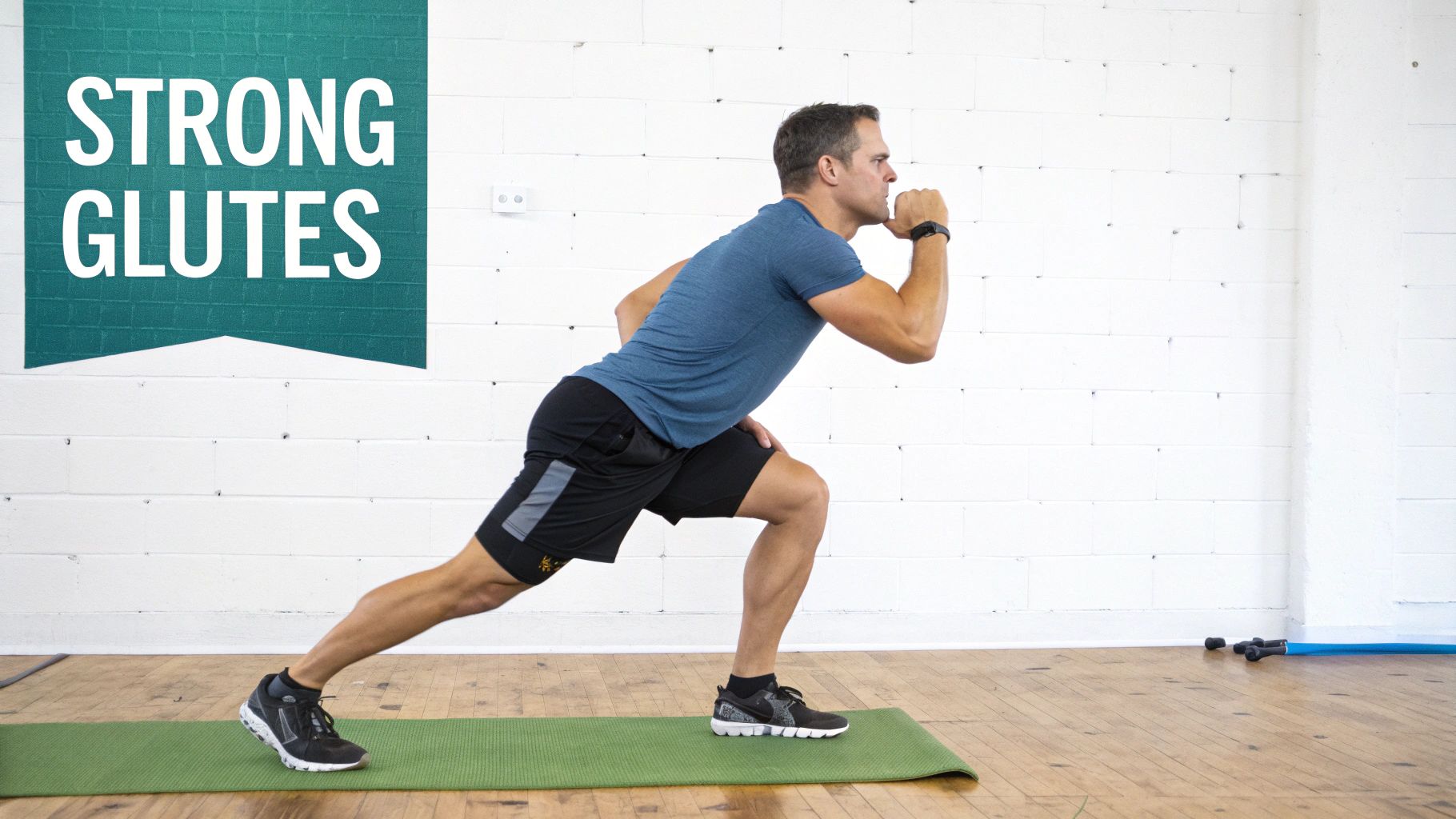
This is why exercises like clamshells and lateral band walks are so fundamental. They isolate and strengthen the key hip stabilizer muscles responsible for keeping your pelvis level and your leg aligned correctly during activities like walking, running, or climbing stairs. By correcting this upstream weakness, you directly reduce the downstream strain on your knees, addressing a root biomechanical cause of chronic pain.
Expert Tip: The key to both exercises is slow, controlled movement. At Bonesetters, we see many patients rush through reps, which allows larger muscles to take over. Focus on feeling the burn on the outside of your hip; this ensures you're activating the gluteus medius, which is essential for restoring proper knee tracking and pelvic stability.
For these exercises to be effective, proper form and consistency are paramount.
When hip weakness is linked to underlying pelvic or spinal misalignments, combining these exercises with targeted professional care yields the best results. A comprehensive approach ensures both the muscular and skeletal systems are working in harmony to protect your knees.
Maintaining hamstring flexibility is a fundamental component of a routine featuring exercises to prevent knee pain. The hamstrings, the powerful muscles running along the back of your thigh, directly influence knee joint mechanics. When these muscles are tight, they pull on the tibia (shin bone), increasing pressure within the knee joint and altering how the kneecap tracks. This imbalance can lead to patellofemoral pain and place excessive strain on other structures like the meniscus and ligaments.
For individuals with sedentary jobs or lifestyles, chronic hamstring tightness is a common precursor to knee issues. By regularly performing targeted stretches, you can restore proper muscle length, reduce posterior knee tension, and allow the joint to move through its full, intended range of motion. This simple practice helps distribute forces more evenly across the joint, preventing compensatory stress during activities like walking, squatting, and climbing stairs.
Expert Tip: For a deeper, more effective stretch, actively engage your quadriceps (the muscle on the front of your thigh) while performing a hamstring stretch. This concept, known as reciprocal inhibition, helps the opposing hamstring muscle relax more fully. At Bonesetters, we teach patients this technique to ensure they are correcting the muscular imbalance, not just passively pulling on tight tissue.
To see lasting benefits, incorporate hamstring flexibility into your daily routine.
Beyond simple muscle strength, your knee relies on a sophisticated sense of position and stability called proprioception. This is your brain's awareness of where your joint is in space, allowing for micro-adjustments that prevent instability and injury. Poor proprioception is a major risk factor for chronic knee pain, as it allows for small, damaging movements to occur during daily activities.
Single-leg balance exercises are a powerful way to enhance this neuromuscular connection. By challenging your stability, you train the nerves and muscles surrounding the knee to react faster and more effectively, creating a more stable joint. This type of training is essential for athletes returning to sport after an ACL injury to reduce re-injury risk and for older adults looking to improve confidence and lower their risk of falls.
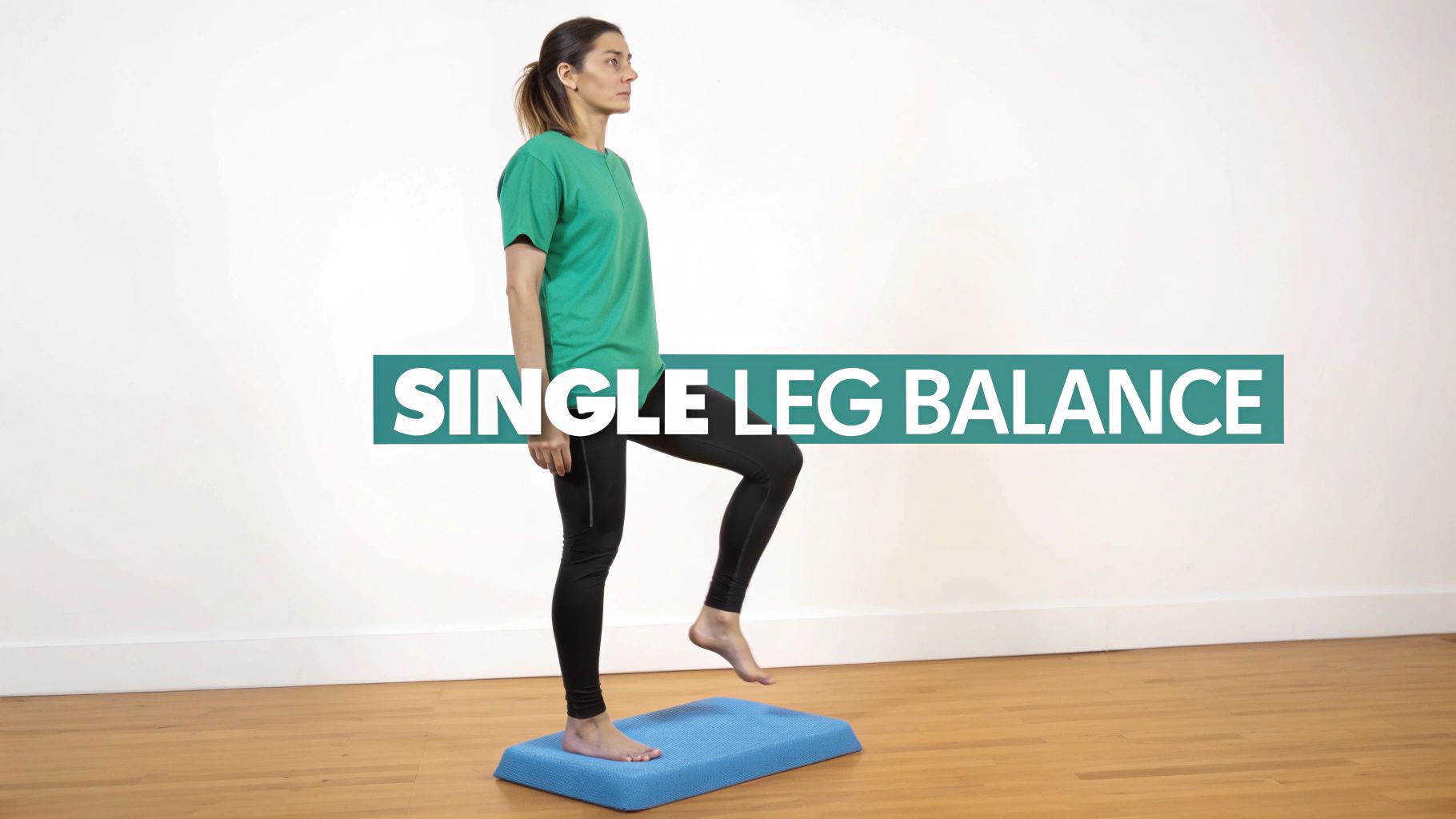
Expert Tip: To maximize neuromuscular re-education, begin by standing on an unstable surface like a foam pad or pillow with both feet, then progress to a single leg. At Bonesetters, we find that combining proprioceptive exercises with chiropractic adjustments optimizes outcomes. The adjustments restore proper joint mechanics, while the exercises teach the nervous system to maintain that corrected alignment.
Start slowly and prioritize good form over duration.
A strong, stable core is the foundation of efficient movement, and it's a frequently overlooked component in a list of exercises to prevent knee pain. Your core muscles are responsible for transferring force between your upper and lower body and maintaining proper pelvic and spinal alignment. When this foundation is weak, the kinetic chain breaks down, forcing your knees to absorb excessive rotational stress and impact they were not designed to handle.
Anti-rotation exercises like the Pallof press and bird dogs are particularly effective because they train your core to resist twisting forces. This is crucial for preventing the subtle pelvic drop or trunk rotation during activities like walking, running, or climbing stairs that can lead to poor knee tracking and eventual pain. By stabilizing the body's center, you ensure that movement is controlled and balanced, protecting peripheral joints like the knee from compensatory strain.
Expert Tip: The goal of these exercises is to prevent motion, not create it. For the bird dog, imagine balancing a glass of water on your lower back. This mental cue, which we often use at Bonesetters to teach functional stability, forces you to engage the deep core muscles essential for protecting your spine and, by extension, your knees.
Integrating core stability work ensures your body moves as a cohesive unit.
Focusing on the ankle joint and calf muscles is a frequently overlooked yet powerful strategy in the list of exercises to prevent knee pain. Your ankles and calves form the foundation of the kinetic chain; when they are weak or immobile, the knee joint is forced to compensate for the instability. This leads to improper movement patterns and increased stress on the knee during activities like walking, running, or squatting.
Strengthening the gastrocnemius and soleus muscles through calf raises improves shock absorption from the ground up, while dedicated ankle mobility work ensures proper knee alignment. Limited ankle dorsiflexion (the ability to pull your toes toward your shin) forces your knee to move inward or forward excessively, straining ligaments and cartilage. Addressing these issues at the source is critical for long-term knee health.
Expert Tip: To maximize the benefit of a calf raise, perform them on the edge of a stair or step. This allows your heel to drop below the level of the step, increasing the range of motion and providing a deeper stretch and more complete muscle activation. This principle aligns with the Bonesetters kinetic chain assessment, where we identify and correct foundational imbalances to resolve upstream joint pain.
Integrating both strength and mobility work is essential for a balanced approach.
Functional movements like step-ups and lateral step-downs are powerful exercises to prevent knee pain because they focus on eccentric strength. Eccentric contraction happens when a muscle lengthens under tension, such as when you lower your body during a squat or walk down a hill. This phase places the most stress on the knee, so strengthening the quadriceps and glutes to control this movement is essential for joint protection.
These exercises mimic real-world activities like climbing stairs or navigating uneven terrain, effectively bridging the gap between isolated gym exercises and pain-free daily function. For hikers, this can mean descending a trail without discomfort, while for older adults, it translates to greater confidence and safety on stairs. By training the nervous system to control knee alignment during these functional patterns, you build resilience and reduce the risk of injury.
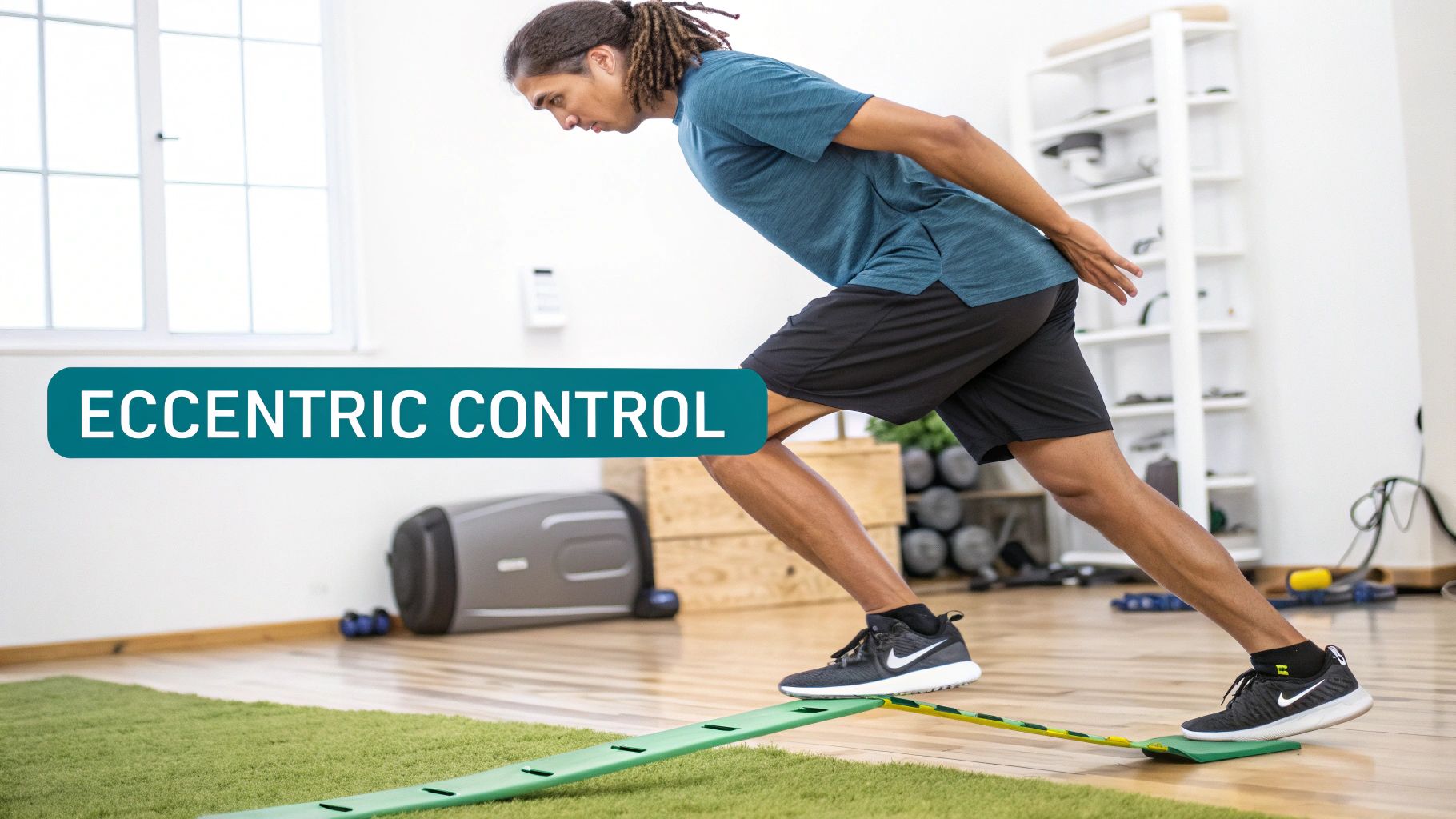
Expert Tip: The magic is in the descent. For lateral step-downs, think about sitting your hips back as if you are lowering into a single-leg chair. This engages the glutes and prevents your knee from drifting forward over your toes, a key principle we use at Bonesetters to reinforce proper biomechanics and protect the joint.
To safely build eccentric strength, start slow and prioritize form.
Integrating these controlled movements with professional therapies can accelerate recovery. For persistent inflammation, patients can learn more about innovative treatments like laser therapy for knee pain that complement a functional strengthening program.
Chronically tight hip flexors are a frequently overlooked source of knee pain. Muscles like the iliopsoas, which connect the lower spine to the thigh bone, can become shortened from prolonged sitting. This tightness pulls the pelvis into an anterior tilt, which alters the biomechanics of your entire leg and places excessive stress on the kneecap (patellofemoral) joint.
Releasing this tension is a critical component of a holistic plan of exercises to prevent knee pain. By restoring proper pelvic alignment and muscle length, you reduce the abnormal forces acting on the knee joint. This is especially vital for desk workers, cyclists, or anyone who spends significant time in a seated position, as it addresses a root cause of compensation patterns that lead to knee discomfort.
Expert Tip: To intensify the low lunge stretch, actively engage the glute of your back leg. This action creates reciprocal inhibition, forcing the opposing hip flexor to relax more deeply. At Bonesetters, we guide patients through this precise activation to ensure they are correcting muscular imbalances, not just passively stretching.
To effectively counteract the effects of sitting, incorporate these movements daily.
Addressing hip tightness can be a game-changer for knee health. When these foundational imbalances are corrected, the knee can function as it was designed to, free from undue stress. If you suspect that pelvic or spinal misalignment is contributing to your knee issues, our practitioners can perform a thorough assessment to identify and address the underlying cause.
Building muscular endurance is a critical component of any effective plan of exercises to prevent knee pain. While strength is about generating force, endurance is the ability to sustain that force over time. Wall sits are a premier isometric exercise that targets the quadriceps, glutes, and even hamstrings, training them to stabilize the knee joint for prolonged periods, such as when standing, walking, or descending stairs.
This sustained stability is especially vital for office workers or individuals with arthritis. Weak endurance leads to muscle fatigue, causing poor movement patterns that shift stress directly onto the knee joint. By holding a static position, wall sits enhance the supportive capacity of these key muscle groups without aggravating sensitive joints through repetitive motion, making them a safe and powerful tool for building foundational knee resilience.
Expert Tip: Proper alignment is everything. If you notice your hips are tight or uneven during a wall sit, it can compromise your form and strain your knees. To specifically address tension in this crucial area, consider exploring the benefits of unveiling the secrets of foam rolling for tight hip flexors.
To build true endurance, the duration of the hold is more important than the number of repetitions.
While it may seem simple, a controlled walking program is one of the most powerful and accessible exercises to prevent knee pain. Walking strengthens the entire lower-body muscular system, including the quads, hamstrings, and glutes, which all work together to support and stabilize the knee. This low-impact activity improves joint lubrication and blood flow without the high-impact stress of running, making it ideal for long-term joint health.
A progressive approach is key. Controlled walking allows the body to adapt gradually, building functional strength and enhancing proprioception, which is your brain's awareness of your body's position in space. For aging adults, sedentary individuals, or those in recovery, it's a foundational activity that maintains cardiovascular fitness, supports mobility, and builds the muscular endurance necessary to protect the knee joint from daily stress.
Expert Tip: Proper footwear is non-negotiable. Your shoes should provide adequate cushioning and support to absorb shock effectively. At Bonesetters, we often see how incorrect footwear contributes to poor biomechanics, which can directly lead to knee discomfort. Investing in the right shoes is a simple, proactive step to protect your joints.
A structured, gradual approach ensures you build strength safely and effectively.
Combining a walking routine with targeted strengthening is a cornerstone of conservative care. This holistic approach supports the joint from all angles, a philosophy central to achieving lasting results. To better understand how this fits into a broader strategy, explore the various options for knee pain relief without surgery that complement an active lifestyle.
| Exercise | Implementation complexity | Resource requirements | Expected outcomes | Ideal use cases | Key advantages |
|---|---|---|---|---|---|
| Quadriceps Strengthening (Isometric Quads & Straight Leg Raises) | Low — simple movements, attention to form | None (bodyweight) | Improved VMO activation, quad strength, better patellar tracking (4–6 weeks) | Post-op rehab, knee sensitivity, desk workers | Low-impact, adaptable, complements decompression/chiropractic care |
| Glute Activation & Hip Strengthening (Clamshells & Lateral Band Walks) | Low–Moderate — requires hip isolation technique | Resistance band optional | Increased glute medius strength, reduced internal knee rotation (6–8 weeks) | Runners, gait dysfunction, proximal weakness | Corrects upstream biomechanics, improves walking/running mechanics |
| Hamstring Stretching & Flexibility Work | Low — straightforward stretching progressions | None; foam roller optional | Restored posterior chain flexibility, reduced posterior knee tension | Sedentary workers, cyclists, tight-hamstring individuals | Non‑invasive, improves ROM and spinal/pelvic positioning |
| Single-Leg Balance & Proprioceptive Training | Moderate — progressive difficulty, supervision advised | Balance pad/board optional | Enhanced proprioception and dynamic knee stability (weeks to months) | Athletes post-ACL, older adults, chronic instability | Trains neuromuscular control, reduces re‑injury risk |
| Core Stability & Anti‑Rotation Exercises (Pallof Press & Bird Dogs) | Moderate — requires precise activation and control | Minimal; cable/band optional | Improved core stability, reduced compensatory knee stress (4–6 weeks) | Individuals with core/spinal dysfunction, athletes | Improves force transfer and spine alignment; reduces knee/low‑back strain |
| Calf Raises & Ankle Mobility Work | Low — simple progressions and mobility drills | Step or stair optional | Increased dorsiflexion, stronger calves, improved gait mechanics (3–4 weeks) | Runners, jumpers, those with limited ankle ROM | Prevents knee valgus, enhances ankle stability and propulsion |
| Step‑Ups & Lateral Step‑Downs (Eccentric Control) | Moderate — requires controlled eccentric technique | Step/platform; optional weights | Increased eccentric strength, improved functional control | Hikers, aging adults, post‑surgical rehab | Highly functional, translates directly to daily activities and stair safety |
| Hip Flexor Stretching & Iliopsoas Release | Low — stretches and soft‑tissue release techniques | Foam roller/lacrosse ball optional | Reduced anterior pelvic tilt, improved hip extension (4–6 weeks) | Desk workers, cyclists, postpartum patients | Addresses pelvic alignment, reduces patellofemoral loading and back pain |
| Wall Sits & Isometric Quads (Endurance Building) | Low — time‑based isometric holds | None (wall only) | Improved quad endurance and sustained knee stability (4–6 weeks) | Sedentary individuals, mild OA, endurance support | Time‑efficient, measurable progress, safe when performed correctly |
| Walking & Low‑Impact Aerobic Activity (Controlled Progression) | Low — easy to start, requires progression planning | Good footwear; no equipment needed | Maintained cardio fitness, gradual lower‑body strengthening, proprioception | Rehab maintenance, aging adults, sedentary beginners | Accessible, low‑risk, promotes circulation and long‑term habit change |
Your journey toward resilient, pain-free knees is an active one, built on a foundation of consistent effort and intelligent movement. This guide has provided you with a comprehensive toolkit of ten powerful exercises to prevent knee pain. These movements are not just random activities; they are a strategic, evidence-based system designed to fortify the entire kinetic chain that supports and protects your knee joints.
By diligently practicing exercises like Quad Sets, Clamshells, and Lateral Band Walks, you are building strength in the precise muscles that stabilize the knee. Incorporating hamstring and hip flexor stretches enhances flexibility, allowing for a greater, smoother range of motion and reducing strain on the joint. Meanwhile, balance work and core stability exercises like Bird Dogs and the Pallof Press improve your proprioception and control, teaching your body to move more efficiently and safely during everyday activities.
Mastering this routine is about more than just going through the motions. It’s about understanding the "why" behind each movement and integrating these principles into your life.
While these exercises to prevent knee pain are a cornerstone of joint health, they are most powerful when part of a holistic and personalized strategy. For many, especially those with pre-existing conditions, chronic discomfort, or a history of injury, self-guided exercise alone may not be enough to address the root cause of their vulnerability. Underlying issues like spinal misalignment, pelvic imbalance, or nerve interference can create dysfunctional movement patterns that continually place undue stress on the knees.
This is where expert guidance becomes invaluable. At Bonesetters Critical Chiropractic, Dr. Leonard Hayes takes a research-based, whole-body approach. We understand that your knee pain might be a symptom of a larger issue originating elsewhere in your kinetic chain. A professional evaluation can identify these root causes, ensuring that your strengthening efforts are not undermined by unresolved structural problems.
Our conservative, non-surgical treatment options are designed to complement and enhance your active care. We may integrate specific, prescribed exercises into a plan that includes advanced therapies such as:
By combining a proactive exercise regimen with specialized care, you create a powerful synergy that fosters true, lasting healing and prevention. You empower your body to not only become stronger but to function in correct alignment, paving the way for a future of confident, pain-free movement. Take the first step today by integrating these exercises into your routine, and take the next step by ensuring your body’s foundation is sound.
Are you ready to build a comprehensive, personalized plan to protect your knees for the long term? Schedule a consultation at Bonesetters Critical Chiropractic to see how our whole-body approach can identify and address the root cause of your discomfort, integrating advanced therapies with your exercise routine for lasting relief. Visit us online at Bonesetters Critical Chiropractic to learn more.