
If you're looking to fix forward head posture, the plan is actually pretty straightforward: you need to strengthen the weak muscles in your neck and upper back while also stretching out the tight ones in your chest and neck. The stakes are higher than you might think. For every single inch your head drifts forward, you're adding about 10 extra pounds of strain to your spine. That's why targeted exercises and smart ergonomic adjustments are the only way to get lasting relief.
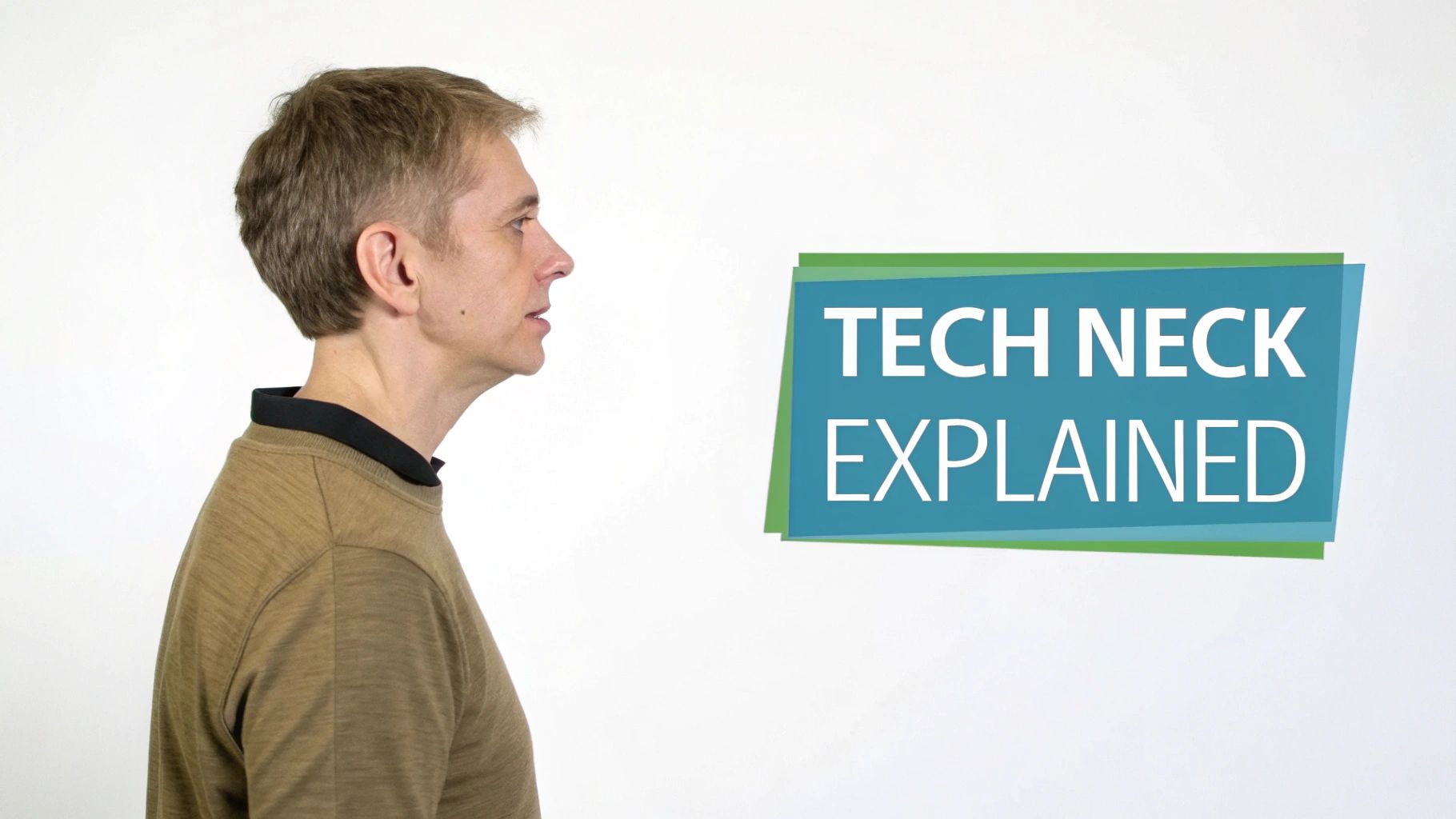
You’ve probably heard it called 'tech neck' or 'text neck'. It’s that all-too-common posture where your head juts out in front of your shoulders. When everything is aligned correctly, your ears should sit right over your shoulders, hips, and ankles. This lets your spine do its job efficiently, effortlessly supporting the weight of your head.
But when your head pushes forward, the muscles in your upper back and neck have to work overtime just to hold you up. Think about it this way: holding a bowling ball close to your chest is easy. Now, imagine holding it with your arms stretched straight out. It feels a lot heavier, right? The same principle applies to your head. The further it drifts forward, the more strain it puts on your cervical spine.
This constant tension is more than just a bad look; it's a biomechanical problem that can kick off a domino effect of other issues that mess with your daily life and long-term health.
This isn't a rare problem. I see it every day in my practice. The research backs it up, too, with studies showing that forward head posture affects a huge number of people—anywhere from 47.9% to 62.1% of young adults. That posture can add up to 27 pounds of extra force on the spine for every inch the head is forward. You can dive into the research on these FHP statistics here, but the takeaway is clear: this strain accelerates wear and tear on your discs.
Because your body is an interconnected system, that sustained pressure doesn't just stay in your neck. The effects often ripple outward, causing a whole host of symptoms you might not have guessed were linked to your posture.
Let's look at the connection between forward head posture and its consequences versus the benefits of getting it corrected.
| Symptom or Risk of FHP | Benefit of Correction |
|---|---|
| Chronic Neck and Shoulder Pain: Constant strain leads to tight, sore muscles and trigger points. | Pain Relief: Easing muscle tension brings immediate and lasting comfort. |
| Tension Headaches: Strain at the base of the skull triggers persistent headaches. | Fewer Headaches: Proper alignment reduces the frequency and intensity of headaches. |
| Reduced Range of Motion: Stiffness makes turning your head difficult or painful. | Improved Mobility: Regain the freedom to move your neck and shoulders without restriction. |
| Nerve Compression: Misalignment can pinch nerves, causing tingling or numbness in the arms. | Restored Nerve Function: Relieves pressure on nerves, eliminating pins-and-needles sensations. |
The symptoms can get even more complex. For instance, I'm often asked if neck problems can cause dizziness, and the answer is a definite yes. FHP can disrupt the delicate balance systems housed in the upper cervical spine, leading to feelings of unsteadiness.
Key Takeaway: A proactive approach to forward head posture correction isn't just about getting rid of today's pain. It's an investment in preventing long-term degenerative changes to your spine, boosting your mobility, and seriously improving your overall quality of life.
So, knowing the risks is step one, but finding a real solution is the goal. This is where evidence-based chiropractic care fits perfectly into the forward head posture correction journey. A chiropractor can get to the root cause of your misalignment, which almost always involves a combination of muscle imbalances and joint restrictions in your neck and upper back.
Through gentle, precise adjustments and other targeted therapies, a chiropractor helps restore proper motion to the joints. This lets the muscles finally relax and function the way they're supposed to. This guide is built on those very principles, giving you practical strategies grounded in a solid understanding of spinal biomechanics to help you get real, lasting results.
Before diving into exercises, you need to know exactly where you're starting from. Getting a clear picture of your current alignment is the first real step toward making a change. It takes the problem from a vague sense of "my neck hurts" to a concrete, measurable baseline.
These two simple checks take less than five minutes and you don’t need any special equipment. They give you instant, honest feedback on where you stand—literally. Think of this as snapping the "before" photo for your posture journey.
This is a go-to method I’ve used with clients for years to quickly gauge head and shoulder alignment. It gives you an objective look at your resting posture, showing just how far your body might have strayed from its natural center of gravity.
Here’s how to do it right:
If it does, your alignment is in a pretty good spot. If you notice a gap of one to two inches, you’re likely dealing with a mild forward head posture. A gap larger than two inches points to a more significant imbalance that definitely needs consistent work.
The wall test is great for a quick feel, but a photo provides undeniable visual proof. It’s hard to argue with a picture. Grab your phone and have a friend take a shot, or just use the self-timer.
If your ear is clearly sitting in front of your shoulder, that’s it. That’s the visual confirmation of forward head posture. The bigger that gap is between your ear and that ideal midline, the more severe the strain on your neck and upper back.
Don't let these results get you down. Use them as your motivation. Having this clear starting point is what makes the progress you'll see in the coming weeks feel so rewarding. Keep these initial findings in mind as we move on to the good stuff—the corrective exercises.
Alright, you've figured out your starting point. Now, let's get to work. Fixing forward head posture isn't about finding one miracle exercise; it's a two-pronged attack. First, we need to release the tight, overworked muscles that are literally pulling your head forward. Second, we have to wake up and strengthen the weak, neglected muscles in your back and neck that are supposed to be holding you upright.
This combination of stretching and strengthening is the real secret sauce. It retrains your body to find its natural alignment so you don't have to constantly think, "sit up straight!"
The quick self-assessment you did earlier—the Wall Test and the Profile Check—is your baseline. It's crucial to know where you're starting from before you dive in.
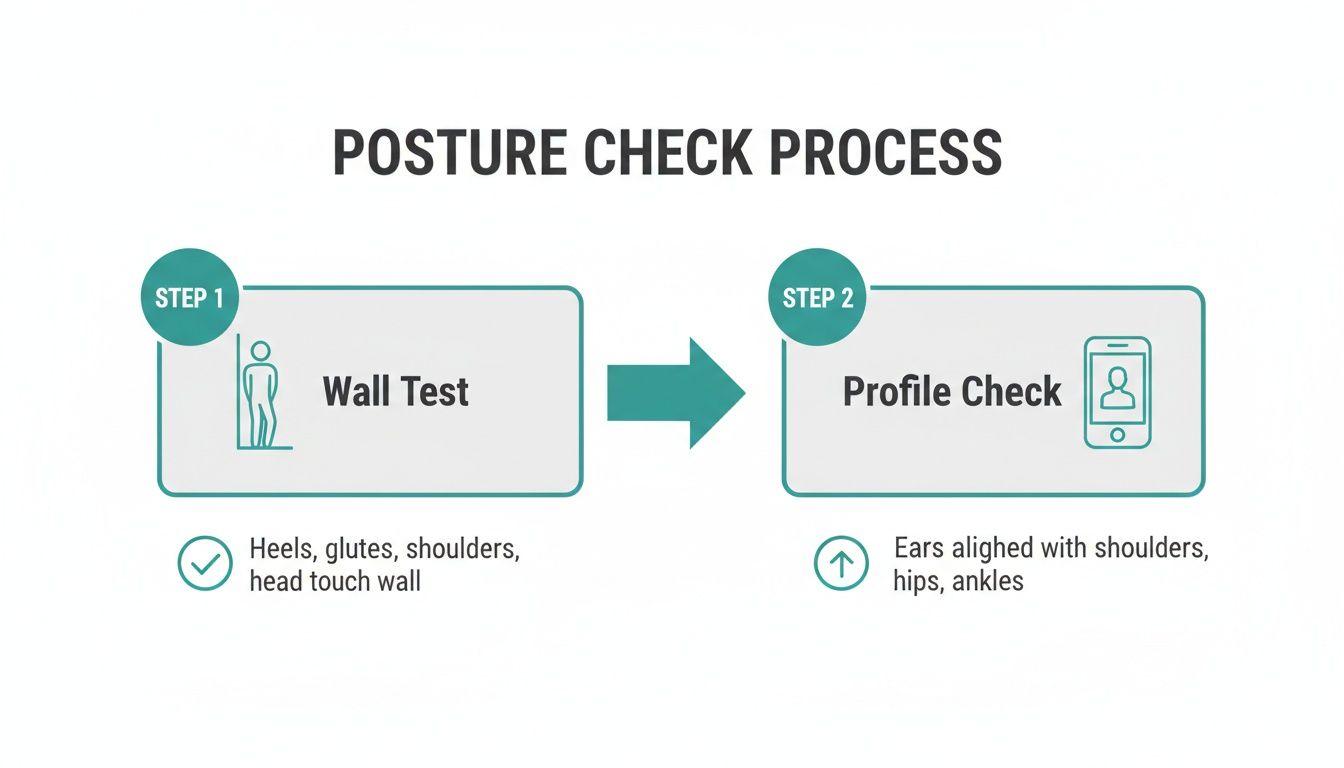
Think of that picture as a reminder: you can't get where you're going if you don't know where you are.
The muscles across the front of your neck, your chest, and your upper shoulders are probably screaming. They get incredibly tight from holding your head forward all day. Our first job is to give them a break.
For these stretches, hold each one for about 20-30 seconds. Breathe deeply and never, ever push into sharp pain. A gentle pull is what you're after. Try to run through this simple routine every single day.
1. Upper Trapezius Stretch
This is the muscle that connects your neck to your shoulder, and it's a major player in tension headaches.
2. Levator Scapulae Stretch
This one runs from the top of your shoulder blade up into your neck. If you work at a desk, I guarantee this muscle is tight.
Pro Tip: If you've got really stubborn knots, stretching alone might not be enough. Grab a lacrosse ball and gently roll it against a wall over those tight spots in your upper back and shoulders. This can help break up the gunk and give you more relief. If you're curious about this, you can look into techniques known as myofascial release.
Now for the other half of the battle. The deep muscles at the very front of your neck and the ones between your shoulder blades have likely gone on vacation. We need to wake them up and get them working again.
The key here is control, not brute force. Consistency is way more important than how hard you work.
Aim to do these exercises daily, or at least five times a week. Focus on perfect form—it's everything.
1. Chin Tucks (Deep Neck Flexor Activation)
Honestly, if you only do one exercise from this list, make it this one. It directly targets the deep stabilizing muscles your neck desperately needs.
2. Scapular Squeezes (Rhomboid Strengthening)
This exercise gets those muscles between your shoulder blades working to pull your shoulders back where they belong.
Did you know that up to 86.8% of people in some groups report experiencing neck pain in their lifetime? Studies have repeatedly shown a direct link between how far forward your head is and how much pain and disability you experience. This is precisely why a dedicated program like this works—it addresses the root mechanical problem.
After you've been consistent for about 2-3 weeks and the basic exercises feel easy, it's time to progress. This is how you keep getting stronger and avoid hitting a plateau.
Progression 1: Prone Cobra
This move is fantastic because it strengthens your entire upper back and neck against gravity.
Progression 2: Wall Angels
This exercise is a game-changer for shoulder blade control and opening up your mid-back (thoracic spine), both of which are critical for good posture.
Don't forget that a strong core is the foundation for everything. Incorporating practices like Pilates for Posture can be incredibly effective, as it specifically targets the deep muscles that support your spine. When your core is strong, it gives your neck and shoulders the stable base they need to stay in the right alignment all day long.
While the exercises you're doing are the engine for change, your daily environment is the road you're driving on. If that road is full of postural potholes, you're just spinning your wheels. Lasting forward head posture correction is just as much about optimizing your surroundings as it is about strengthening your muscles.
Think about it this way: your environment either reinforces good habits or it perpetuates the very ones that caused the problem. By making a few intentional tweaks to your desk, tech habits, and even your bedroom, you create a system that supports your spine 24/7—not just during your 15-minute exercise routine.
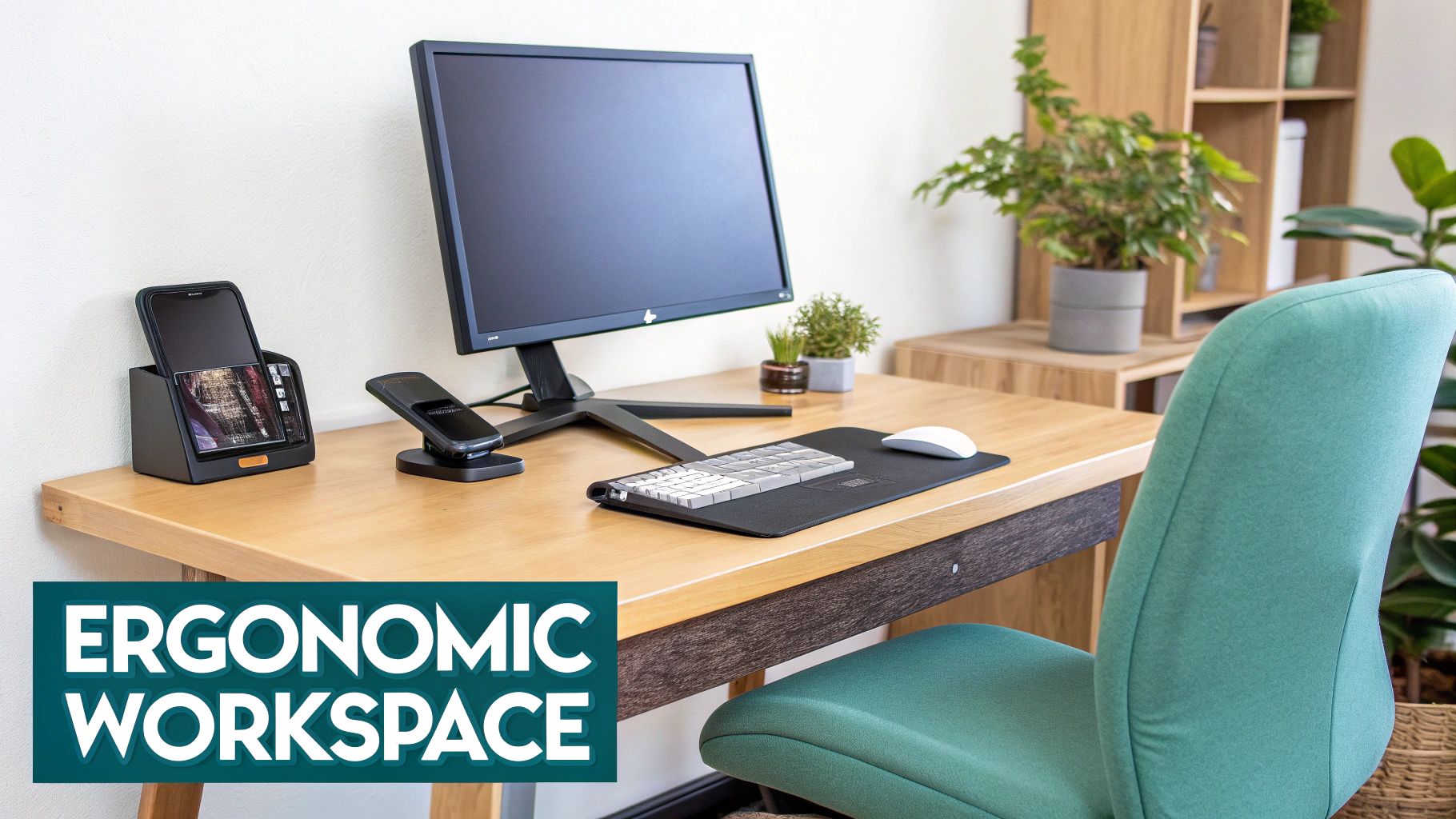
For most of us, the desk is where forward head posture really takes root. Hunching over a laptop or craning your neck to see a poorly positioned monitor for eight hours a day is a recipe for disaster. It's time to redesign your command center for better alignment.
The monitor is almost always the main culprit. It should be positioned so the top third of the screen is directly at eye level. This one simple adjustment prevents you from tilting your head down, which is the primary trigger for that forward drift. If you're on a laptop, a separate keyboard and mouse are non-negotiable. This allows you to elevate the screen on a stand or even a sturdy stack of books.
Your chair is the next piece of the puzzle. Adjust its height so your feet can rest flat on the floor with your knees bent at roughly a 90-degree angle. The goal is to sit all the way back in the chair, letting its lumbar support cradle the natural curve of your lower back. A solid base makes it so much easier to keep your upper back and neck where they belong. For a deeper dive, check out this ultimate guide to your ergonomic home office setup.
A Quick Tip: The 20-20-20 Rule
To fight off postural fatigue, set a timer. Every 20 minutes, look away from your screen at something 20 feet away for at least 20 seconds. This little break gives your eyes a rest and is the perfect reminder to check in with your posture.
Your workstation isn't the only place where "tech neck" thrives. How you use your smartphone and tablet can be just as damaging. Most of us instinctively drop our heads to look down at our phones, placing a massive amount of strain on the cervical spine.
The fix is simple, but it takes conscious effort: bring the phone up to eye level. Stop dropping your head to the device. This might feel a little awkward at first, but it completely changes the forces acting on your neck.
Even relaxing on the couch can be a postural trap. Be mindful of how you're sitting. Try to avoid sinking into a deep slouch that pushes your head forward to watch TV or scroll through your phone. Use a couple of pillows to support your lower back and help keep your spine in a more neutral, happy position.
We spend about a third of our lives sleeping, which makes your bed a critical, and often overlooked, part of your posture-friendly environment. The wrong pillow or sleeping position can undo all the good work you put in during the day.
Your pillow’s only job is to keep your head and neck aligned with the rest of your spine.
Stomach sleeping is by far the worst position for your neck, as it forces your head to be twisted to one side for hours on end. If this is your go-to, making a conscious effort to switch to your back or side is one of the most powerful changes you can make for your cervical health.
Don't underestimate these lifestyle factors. Research has shown that people with over 6.50 hours of daily lying time face three times higher odds of developing forward head posture, while staying active can slash that risk by 60%.
A solid routine of daily stretches and smart ergonomic changes can work wonders. But sometimes, you hit a wall. If you've been consistent and your symptoms are either stuck in place or getting worse, that's a clear sign it's time for a more hands-on, professional approach.
This isn't a failure on your part. It just means the root of the problem might be more complex than a simple muscle strain. Think of it this way: you can change the oil and tires on your car, but if the alignment is off, you need a mechanic with specialized equipment. The same goes for your spine.
Certain symptoms are more than just a nuisance—they're your body's alarm system. Ignoring them can allow issues like nerve compression or joint dysfunction to worsen.
Be on the lookout for any of these signs:
When you experience these, the problem has likely moved beyond simple muscle tightness and into the territory of irritated nerves or even spinal disc issues.
When you see a chiropractor for forward head posture, the goal is to find the specific spinal joints that are stuck or out of alignment and get them moving properly again. Modern chiropractic care has moved beyond just forceful twisting or popping.
For instance, our clinic uses computer-guided adjustment tools like the FDA-backed PulStar. This lets us analyze each vertebra with incredible precision to find the exact source of the restriction. The adjustments are then delivered as gentle, targeted impulses that are not only comfortable but also highly effective at restoring healthy motion.
In cases where disc issues are a factor, a chiropractor might suggest treatments designed to create more space between the vertebrae. You can learn more about decompression of the cervical spine and see how it works to relieve pressure on sensitive nerves.
This kind of forward head posture correction gets to the structural source of the problem in a way exercises alone can't. By fixing the underlying joint mechanics, we create an environment where tight muscles can finally let go and weak muscles can start firing correctly. It’s about setting your body up for long-term healing and proper alignment.
Whenever you start a new routine to fix something like forward head posture, a few questions are bound to pop up. It's totally normal. Getting clear, honest answers is key to sticking with it, so let's walk through some of the things people wonder about most.
Think of this as your personal FAQ. When you feel a little uncertain, just circle back here. My goal is to keep you motivated and focused on the real prize: better alignment and less pain.
This is the big one, isn't it? The most straightforward answer is that it really comes down to how consistent you are. You'll probably feel some relief from tight muscles right away—like after your first few stretching sessions—but lasting, visible changes take a bit more time. Your body is essentially unlearning years of muscle memory and building a new foundation.
Here’s a realistic breakdown of what you can expect:
A Quick Tip from Experience: Don't just focus on what you see in the mirror. Pay close attention to how you feel. Are you having fewer tension headaches? Is turning your head to check a blind spot easier? Those are huge signs that your forward head posture program is doing its job.
For a lot of people, the answer is a resounding yes. If you’ve caught it relatively early or you're younger, achieving a near-complete reversal is absolutely on the table with dedicated exercises and better daily habits. The spine and the muscles around it are incredibly resilient and have an amazing capacity to adapt.
Now, if you've been dealing with this for decades or have underlying issues like spinal degeneration or arthritis, the goal might shift a little. In those situations, we focus more on functional improvement. That means dramatically cutting down on pain, getting your mobility back, and stopping the problem from getting any worse. A "perfect," textbook posture might not be the final destination, but living a pain-free, active life certainly is. This is often where professional care can make a huge difference by addressing those deeper structural problems.
You’ve probably seen them everywhere—gadgets that promise a quick fix for slouching. It's important to know what they can and can't do. A posture corrector or brace can be a helpful tool, but it's not a cure.
Think of a posture brace like training wheels for a bike. It gives you a physical nudge to pull your shoulders back and sit up, which is great for building that initial awareness. The big downside? It does the work for your muscles. If you wear it all the time, you risk weakening the very postural muscles you're trying to strengthen for long-term support.
On the other hand, some tools are fantastic complements to your routine:
Just remember, these tools should always be used to support your efforts, not replace them. The real, lasting change comes from the stretching and strengthening exercises that build the foundation for proper forward head posture correction.
At Bonesetters Critical Chiropractic, we focus on getting to the root of your pain with personalized, evidence-based care. If persistent neck pain, headaches, or other symptoms of forward head posture are holding you back, our advanced diagnostics and gentle, precise treatments can help restore your body's natural alignment. Ready to find lasting relief? Schedule your consultation at https://bonesetters.org.