

When that sharp, searing pain shoots down your leg, it feels like everything stops. Simple things you took for granted—walking to the mailbox, sitting at your desk, even just standing up—suddenly become major hurdles. This is the reality of sciatica, a condition that happens when something, often a bulging or herniated disc in your low back, irritates or presses on your sciatic nerve.
Many treatments just try to quiet the symptoms, but the McKenzie Method is different. It's an active, evidence-based approach that puts you in the driver's seat of your own recovery. Think of it less as a list of generic exercises and more as a logical system for finding and fixing the root mechanical problem.
This guide will walk you through it. We're going to explore how the McKenzie treatment for sciatica helps you become a detective, moving beyond just managing the pain to actually resolving its source.
At its heart, the McKenzie Method—also known as Mechanical Diagnosis and Therapy (MDT)—is all about assessment and empowerment. Developed by New Zealand physiotherapist Robin McKenzie, it’s founded on a powerful idea: your body often has the ability to heal itself, provided it gets the right mechanical signals. The goal here isn't to create a dependency on endless therapy; it’s to give you the specific tools and understanding to manage your pain on your own.
It's a bit like finding the one key that fits a tricky lock. A trained practitioner will guide you through a series of specific, repeated movements and postures, carefully observing how your symptoms change. This systematic process is designed to uncover your unique "directional preference"—the one direction of movement that consistently makes your pain decrease or move out of your leg and back toward your spine.
The ultimate goal of the McKenzie Method is not just temporary relief but long-term independence. By learning to identify your specific directional preference, you gain the tools to manage flare-ups and prevent recurrence, putting you back in control of your health.
To give you a clearer picture, here’s a quick overview of the method's core principles and what they mean for you.
| Core Principle | What It Means for You | Primary Goal |
|---|---|---|
| Mechanical Assessment | You'll be guided through a series of repeated movements to see how your pain responds. It's a structured test to find the root cause. | To identify a specific movement pattern that consistently reduces your sciatica symptoms. |
| Directional Preference | We’ll find a single direction of movement (like bending backward or forward) that centralizes or lessens your pain. | To find the "right key for the lock"—the one motion that provides immediate and lasting relief. |
| Centralization | The tell-tale sign of success is when your pain retreats from your foot or leg and moves closer to your lower back. | To move the pain from a peripheral area (leg/foot) back to its source (the spine), indicating the nerve pressure is being relieved. |
| Patient Empowerment | You learn the specific exercises and postures that work for you, giving you the power to treat yourself. | To equip you with the knowledge to manage your symptoms independently and prevent future episodes. |
By focusing on these principles, the McKenzie Method offers a structured and logical path to recovery, moving you away from passive treatments and toward active, self-directed healing.
This guide is designed to break down everything you need to know about using the McKenzie Method to get a handle on your sciatica. You'll discover:
This isn't just about doing a few stretches. It's about learning the unique mechanics of your body and how to restore its natural function. By the end, you’ll see why this approach offers a clear, hopeful, and non-surgical path toward getting your life back from sciatica.
The McKenzie Method might sound complicated, but at its heart, the idea is refreshingly simple. Think of your sciatica as a jammed lock. You could try to jiggle a bunch of different keys, hoping one works, or you could find the one specific key that fits perfectly. The McKenzie approach is all about systematically finding that one, unique movement that "unlocks" your pain.
This highly effective system is officially called Mechanical Diagnosis and Therapy (MDT), and it’s built around a powerful concept known as directional preference. All this means is that for most people struggling with sciatica, there's one specific direction you can move your spine that dramatically reduces—or even completely eliminates—your pain. The entire method is designed to find that unique direction for you.
Unlike a generic list of exercises you might find online, MDT is an active, patient-focused system. It guides you through three clear phases, creating a logical path toward lasting relief.
The McKenzie Method isn't just a handful of exercises; it's a step-by-step process that takes you from diagnosis all the way to self-management. Each step builds on the one before it, making sure the treatment is perfectly matched to what your body is telling you.
This structured flow is exactly why the method is so successful. This flowchart helps visualize the logical path from start to finish.
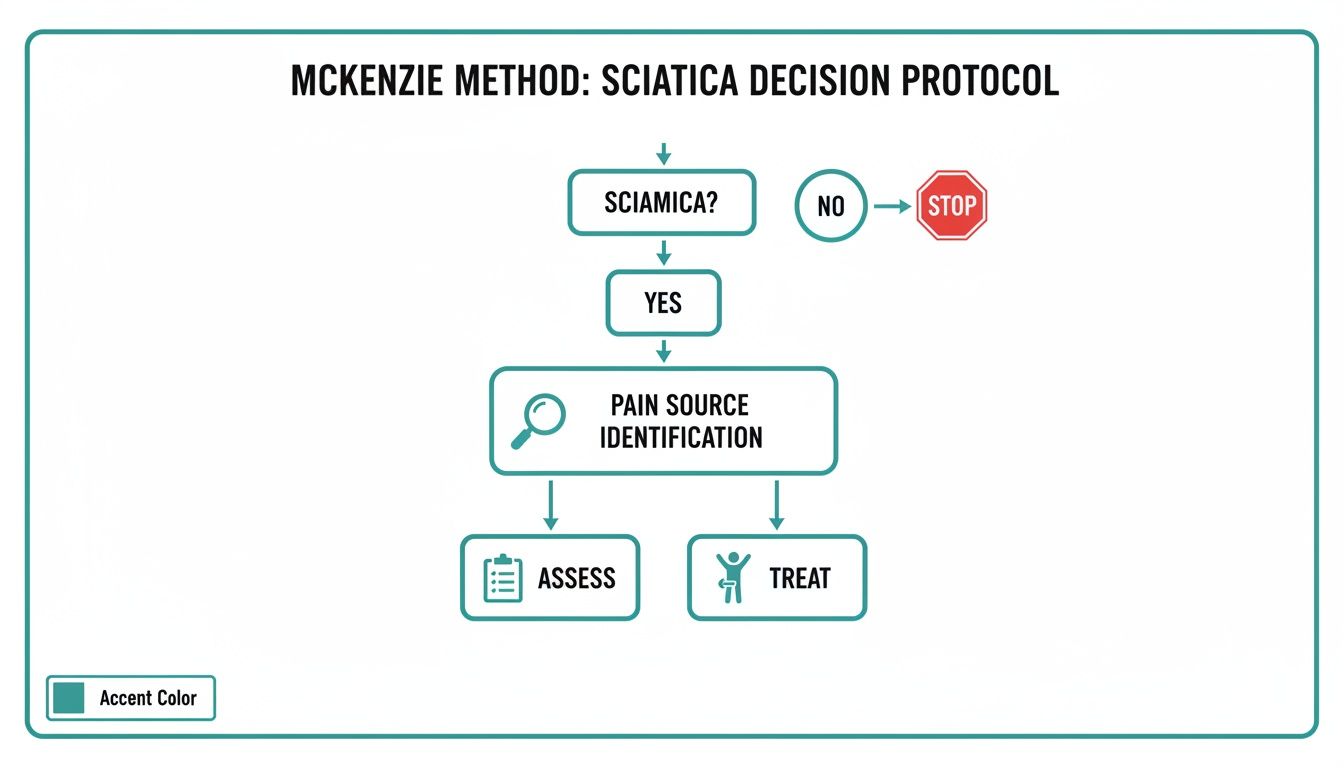
As you can see, it all starts with finding the mechanical source of the pain. That discovery informs the entire assessment and, ultimately, points directly to the precise treatment you need.
The real magic of the McKenzie Method is how personal it is. For one person, the "key" movement might be bending backward (extension). For someone else, it could be bending forward (flexion) or even a side-to-side gliding motion. Here’s the catch: performing the wrong movement can actually make things worse, which is why a professional assessment is so important.
A certified McKenzie practitioner acts like a detective, using your body's own feedback as clues. Their main goal is to find the single movement pattern that centralizes your pain—that is, moves the pain out of your leg and back toward your spine—and then empower you to use it for self-treatment.
This is a huge departure from more passive treatments. Instead of just relying on a practitioner to do all the work, you become an active partner in your own recovery. When you understand how chiropractic adjustments work, you can really see the value of combining that kind of hands-on care with an empowering self-treatment plan like MDT.
This isn't just theory; the effectiveness of this system is backed by solid research. Systematic reviews consistently show the method has real advantages for chronic low back pain and sciatica when compared to other types of manual therapy.
One major meta-review of multiple trials found that patients using the McKenzie Method felt a significant drop in pain in the short term. Even better, several studies showed that patients had better disability scores at 6 months and even 12 months after treatment. This points to a powerful combination of immediate relief and genuine, long-term improvement in function.

When we use the McKenzie Method, there's one sign that tells us we're on the right track more than any other: centralization. Think of it as the gold standard for success. It’s the single most reliable signal that your chosen exercise is hitting the mark and addressing the root cause of your sciatica.
So, what does it feel like? Centralization is when pain that was shooting down your leg—to your foot, ankle, or calf—starts to retreat. It literally moves back up your leg and becomes more focused in your lower back, closer to the spine.
Imagine your sciatic pain is like a wave that has washed all the way up a beach, reaching your toes. Performing the correct McKenzie movement is like causing that wave to recede. The water pulls back from the furthest point first, then from the shin, then the thigh, until it's just a ripple at the shoreline—your lower back. That's centralization in action.
This isn't just a random change in where you feel the pain. It's a clear, physical signal that pressure is coming off the sciatic nerve. When the pain leaves your leg and consolidates in your back, it means the disc bulge or other mechanical issue is actually improving and moving back into place. The nerve is finally getting some relief.
This process is critical for two main reasons:
It's worth noting that as your leg pain disappears, you might feel a temporary increase in your lower back pain. Don't panic—this is usually a fantastic sign! It means the problem is localizing back to its source, which is exactly what needs to happen before it can heal completely.
The most powerful sign that the McKenzie treatment for sciatica is working is the presence of centralization. It’s real-time feedback that you are actively fixing the mechanical problem, not just chasing symptoms.
The opposite of centralization is peripheralization. This is when your pain does the exact opposite—it spreads further down your leg, moving away from your spine and toward your foot. You might also notice new or worsening numbness or tingling in your extremities.
Peripheralization is a red flag. It’s your body’s way of shouting, "Stop! This movement is making things worse!" It means the current posture or exercise is increasing pressure on the nerve. If you ever feel your symptoms spreading down your leg, you should stop what you’re doing immediately.
This built-in safety feedback is a core principle of the McKenzie Method. By learning to listen to your body and recognize these signals, you become an active participant in your own recovery. It empowers you to avoid harmful movements and focus only on what helps. This is also why having professional guidance is so important, to make sure you're reading the signals correctly and adjusting your plan safely.
The real power of the McKenzie Method is that it puts you in the driver's seat. While an expert diagnosis is the essential first step, the treatment itself is built around a simple set of exercises you can do right at home. For the vast majority of sciatica cases that originate from a lumbar disc problem, the "directional preference" is almost always extension—that is, gently bending your lower back backward.
This section walks through that typical progression. The idea is to carefully and systematically encourage the disc material to migrate away from the sciatic nerve root it's irritating. Each exercise builds on the last, gradually deepening the extension in your lumbar spine.
But a word of caution: this is for educational purposes only. Never begin an exercise program without a proper diagnosis. Jumping into the wrong movement can make things significantly worse.
This is where it all begins. It’s the most passive and gentle form of extension you can do. All you’re doing is letting gravity help your spine find a neutral, slightly extended position.
Simply lie face down on a firm surface (the floor is perfect). You can turn your head to one side or rest your forehead on your hands. Let your arms relax by your sides and just breathe. Your job is to let your back and hip muscles completely release their tension.
Stay here for 2-3 minutes. The only goal is to let go. You shouldn't feel any pain increase; if you do, that's your cue to stop.
Once you’re completely comfortable lying flat, it’s time to introduce a gentle, active curve into your lower back.
From the prone position, just prop yourself up on your forearms, with your elbows roughly under your shoulders. The key here is to keep everything from the waist down totally relaxed on the floor. Think of your lower back as a hammock, just letting it sag toward the ground. Gravity is doing all the work.
Hold this "sphinx" pose for 2-3 minutes. Just like before, make sure your glutes and back muscles stay soft and relaxed. What you're looking for is a sign that your sciatica symptoms are centralizing—receding from your leg and moving closer to your spine.
Crucial Reminder: Centralization is the name of the game. If at any point your leg pain, numbness, or tingling starts to travel further down your leg (this is called peripheralization), stop immediately. It’s a clear signal that this movement isn't right for you at this moment.
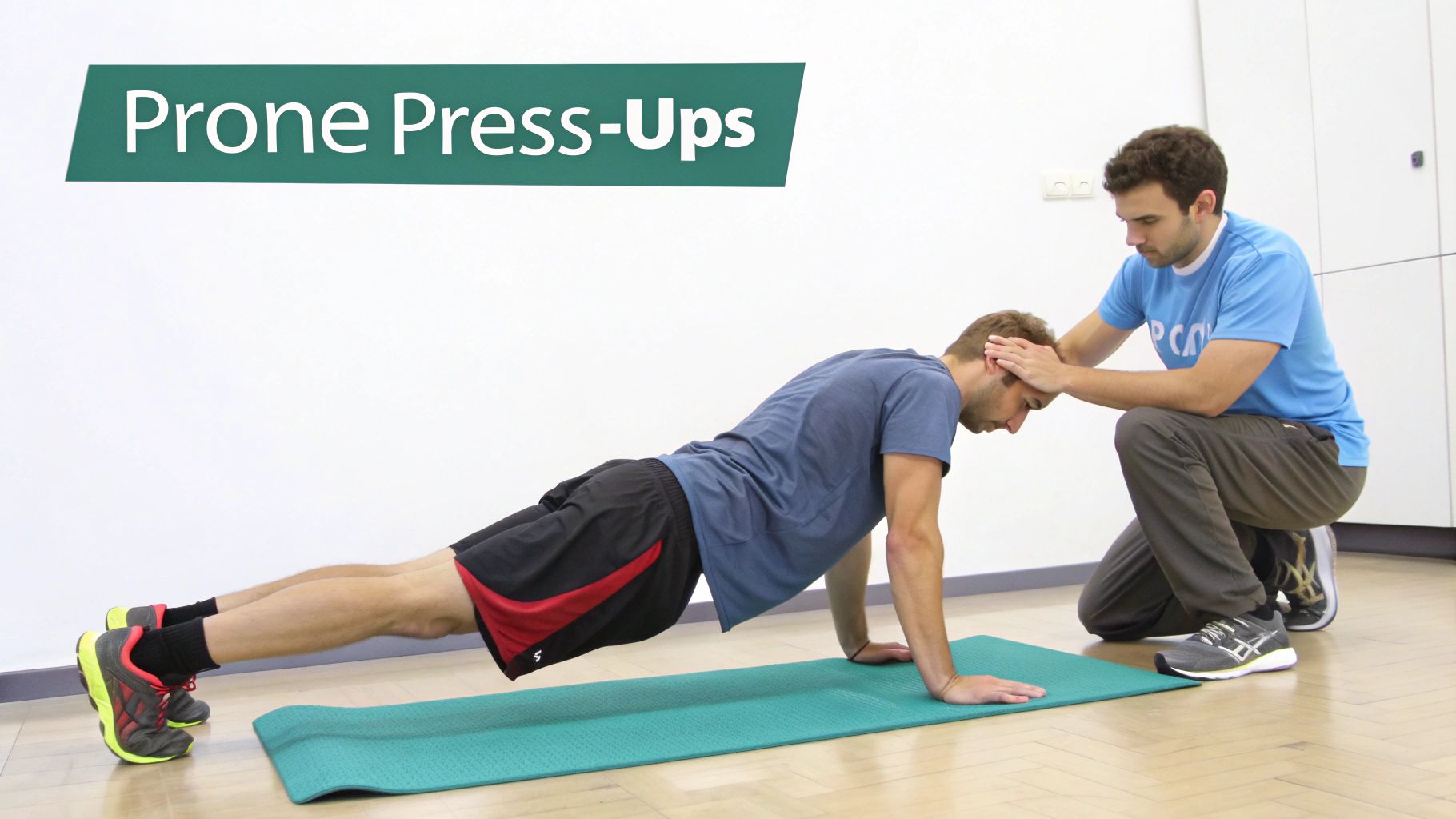
This is the most active and powerful exercise in the standard extension series. It creates the most significant extension in the lumbar spine, providing the greatest potential to push that disc material back into place and relieve nerve pressure.
Your lower back and glutes should be completely passive during this movement. Your arms do all the work. You should feel a sense of pressure—not sharp pain—in your low back at the top of the movement.
To help you visualize this path, here is a quick summary of the lumbar extension progression:
| Exercise | Starting Position | Key Action | Goal |
|---|---|---|---|
| Prone Lying | Lying face down, arms at sides | Deep breathing, muscle relaxation | Use gravity to allow the spine to settle into a neutral position |
| Prone on Elbows | Lying face down | Propping upper body on forearms | Introduce a gentle, sustained extension curve into the lower back |
| Prone Press-Ups | Lying face down, hands under shoulders | Pressing the upper body up with arms, hips stay down | Create a maximum, repeated extension to actively reduce nerve pressure |
This table shows how each step carefully increases the amount of extension, allowing your body to adapt gradually.
While extension is the hero for most disc-related sciatica, it’s not a one-size-fits-all solution. Some people, particularly those with conditions like spinal stenosis, actually find relief by bending forward (flexion).
This is precisely why a professional assessment is non-negotiable. Trying to guess your directional preference is the single biggest risk when self-treating sciatica.
While extension exercises are often the answer, our guide on the best stretches for sciatica relief provides more context on different movements. Ultimately, the brilliance of McKenzie treatment for sciatica lies in finding the one specific direction that brings you relief.
When you're in the grip of sciatica, you don't just want a treatment; you want one that's proven to work. The good news is that the McKenzie Method isn't based on guesswork. It’s a system backed by decades of clinical research that shows it gets real, measurable results for people just like you.
The research consistently shows that this approach is highly effective at dialing down both back and leg pain, often surprisingly quickly. But it’s not just about short-term relief. Studies that follow patients for months, and even years, find that these improvements stick, leading to lasting function and a real drop in disability.
Perhaps one of the most compelling aspects is its power to help people sidestep more aggressive treatments. By teaching you how to manage your own symptoms, the McKenzie Method often reduces the need for things like steroid injections or even surgery.
When researchers analyze the data, they focus on what truly matters to patients: less pain, better movement, and a higher quality of life. The McKenzie Method consistently delivers on these fronts. A big reason for this success comes down to the detailed initial assessment, which ensures the treatment plan is perfectly matched to your specific problem from the very beginning.
This evidence-based foundation is precisely why the McKenzie Method has become a trusted pillar in modern non-surgical spine care.
The real magic of the McKenzie Method is its ability to predict success. If your pain starts to "centralize" — meaning it retreats from your leg and moves closer to your spine — during the first few sessions, that's one of the strongest signs we have for a great long-term outcome.
This means a skilled practitioner can often tell with a high degree of confidence, right from the start, if this approach is going to work for you. That provides a clear, hopeful path forward, which is a huge advantage over many other treatments that involve a lot of waiting and seeing.
The ultimate test for any treatment is how it performs against other established methods. Here, the McKenzie Method really proves its worth. A major multi-center clinical trial published in 2023 offered some fantastic insight.
The study directly compared McKenzie treatment to standard guideline-based patient education for people with sciatica caused by a confirmed lumbar disc herniation. The results were clear: both groups saw dramatic reductions in pain and disability and a big boost in their quality of life. After a two-year follow-up, the overall surgery rate was 29%, with no real difference between the two groups.
What does that mean for you? It shows that the McKenzie treatment for sciatica is just as effective as the best expert advice out there, helping an incredible 71% of patients avoid surgery in the long run. You can dive into the specifics by reading the full study in Clinical Rehabilitation.
This kind of high-quality evidence gives you the confidence to know that choosing this path is a sound, scientifically-backed decision for getting a handle on your sciatica and getting back to your life.
While the McKenzie Method is all about empowering you to treat yourself, its success—and your safety—really boils down to one crucial first step: a professional assessment. It's so easy to find exercises online and give them a shot, but trying to guess your "directional preference" is a risky game.
Picking the wrong movement can do more than just not help; it can actually make your sciatica worse by pushing the pain further down your leg.
Think of it like this: a certified McKenzie practitioner is a skilled detective for your spine. They know exactly what clues to look for. They'll guide you through a very specific series of movements and positions, carefully watching how your symptoms change with each one. This isn't just about finding a magic exercise; it's a diagnostic process to understand the mechanical problem in your back.
This initial assessment is everything. It makes sure the exercises you're about to do are the right ones for you, setting you on a path to healing instead of making things worse by mistake.
A certified expert does way more than just hand you a sheet of exercises. Their skill is essential for a few key reasons. They perform a thorough mechanical evaluation to figure out which specific movements will bring you relief.
This is what makes the McKenzie treatment for sciatica so powerful. It takes the guesswork out of the equation and gives you a clear, proven plan. This is especially vital when the right direction of movement isn't obvious, which happens more often than you'd think.
The biggest risk with the McKenzie Method isn't the exercises themselves, but doing the wrong ones. A certified practitioner is your guide, ensuring every movement you do helps centralize your pain and bring relief, rather than pushing it further away and making it worse.
Working with a professional also just gets you better results. Studies have shown that when the McKenzie Method is combined with other therapies under professional supervision, patients see even better outcomes.
For example, one study with acute sciatica patients found that when the McKenzie Method was used alongside interferential therapy, people experienced greater relief from low back pain, saw better lumbar extension, and even walked faster than those who only had the therapy. It’s a perfect example of how an expert can blend different treatments for a stronger, more complete recovery. You can explore the full study findings on sciatica treatment efficacy to see the data for yourself.
Ultimately, picking the right professional is a huge part of your healing journey. A great practitioner gives you an accurate diagnosis and, just as importantly, equips you with the confidence and knowledge to manage your back health for the long haul. If you’re looking for some guidance, our guide on how to choose a chiropractor can help you find the right fit.
Starting any new treatment for sciatica can feel a bit uncertain. It’s completely normal to have questions, and getting clear answers is the first step toward feeling confident in your recovery plan. Let's walk through some of the most common things patients ask about the McKenzie Method.
This is probably the number one question we hear, and the answer is often surprisingly quick. Many people start to feel their leg pain retreat—a process we call centralization—within just the first few sessions. The pain literally starts to move out of the leg and back toward its source in the lower back.
Of course, everyone is different. How fast you progress will depend on things like how severe your symptoms are and, most importantly, how consistent you are with your assigned exercises at home. The ultimate goal is to get you independent as fast as possible. A typical plan might involve a handful of visits over a few weeks, with the main focus shifting to a self-care strategy you can use for life.
When you're working with a certified McKenzie practitioner, the risk is incredibly small. The entire approach is built around listening carefully to your body's feedback in real-time.
If any movement or position starts to make the pain travel further down your leg (a sign of peripheralization), we stop immediately. That's a clear signal from your body that it's not the right direction for you.
This built-in safety mechanism is precisely why a professional evaluation is so crucial. The biggest risk comes from trying to guess your directional preference on your own. Doing the wrong movement for your specific issue could definitely aggravate your symptoms.
That's one of the biggest myths out there! While extension movements like the press-up are very common for certain types of disc-related sciatica, they are far from the whole story. MDT is a full diagnostic system, not just a list of exercises.
The specific movements you're given—whether it's extension (bending backward), flexion (bending forward), or even a side-glide—are determined entirely by what we find during your assessment. It all comes down to your body's unique "directional preference." The real magic of the method isn't in any one exercise; it's in its ability to accurately find the one specific direction of movement that brings you relief.
At Bonesetters, we don't just treat symptoms; we find the source. By integrating the diagnostic power of the McKenzie Method into our non-surgical treatment plans, we can pinpoint the mechanical cause of your pain. This allows us to build a personalized recovery plan that puts you in control and provides the tools for lasting relief. See how our evidence-based approach can work for you at https://bonesetters.org.