

Chiropractic adjustments are all about applying a specific, controlled force to a joint that isn't moving the way it should. This isn't random; it's a precise technique that works on two fundamental levels. It physically restores the joint's natural movement while also calming down irritated nerves, effectively helping to reset the body's pain signals.

Think of your spine as a complex electrical circuit. When a single joint gets "stuck" or misaligned—what we call a subluxation—it’s like a faulty switch disrupting the flow of information through your nervous system. This interference can lead to pain, stiffness, and a whole host of other functional problems.
The goal of a chiropractic adjustment is to find that switch and flip it back on. It's a targeted intervention, not just "back cracking," that's built on a solid understanding of how the body is supposed to work. At Bonesetters Critical Chiropractic, Dr. Leonard Hayes uses an evidence-based approach to take the mystery out of this process for patients who want real, non-surgical solutions for everything from nagging back pain to complex neuropathy.
So, what’s really happening under the surface during an adjustment? The benefits all boil down to two powerful mechanisms that work in tandem to reduce pain and restore your body's natural function.
To make this clear, let's break down how an adjustment delivers its one-two punch against pain and dysfunction.
| Mechanism | What It Does | Patient Benefit |
|---|---|---|
| Biomechanical Restoration | Physically restores movement to a "stuck" or restricted joint. Breaks up minor scar tissue (adhesions) and improves joint lubrication. | You experience a better range of motion, less stiffness, and smoother, more comfortable movement. |
| Neurophysiological Reset | The quick movement of the adjustment stimulates nerve endings (mechanoreceptors) that sense motion, not pain. | This flood of new sensory input can override and "gate" the chronic pain signals, telling your brain to calm the area down. |
By addressing both the joint's mechanics and the nervous system's response, we get to the root of the problem instead of just chasing symptoms.
The science behind this is compelling. A major 2018 study in JAMA Network Open looked at military personnel with low back pain. The ones who received chiropractic care alongside their standard medical treatment saw significantly bigger drops in both pain and disability. They were also much happier with their overall care. You can dive into the full findings of this study on chiropractic care to see the data for yourself.
By addressing both the physical joint mechanics and the neurological pain signals, a chiropractic adjustment provides a comprehensive solution that helps your body heal itself from the inside out.
At Bonesetters, this scientific foundation is the bedrock of every treatment plan we create. It ensures your care is not only effective but also completely aligned with the latest clinical evidence.
Most people know the "popping" sound that can happen during a chiropractic adjustment. It's distinctive, and for many, it's the sound of relief. But what's actually going on inside your body to make that happen, and how does it translate to less pain? It all comes down to a fascinating conversation between your body's structure and your nervous system.
When a chiropractor delivers a quick, precise thrust to a joint that isn't moving right, it's not just about shifting bones back into place. It's about sending a powerful signal directly to your nervous system, changing how your brain processes pain and tells your muscles what to do.
Think of your nervous system as a highway system with a limited number of lanes leading to your brain. Pain signals are like big, slow trucks, taking up all the space and causing a major traffic jam. When a joint is stuck or inflamed, it's constantly sending these "pain trucks" up the highway, keeping your brain in a state of high alert.
This is where the adjustment works its magic. The quick movement of the joint stimulates a completely different type of nerve ending called a mechanoreceptor. These are the sensors that detect movement and position, not pain. Their signals travel on much bigger, faster nerve fibers—picture them as high-speed bullet trains on an express track.
This sudden rush of movement information zips to the brain, getting there long before the slow-moving pain signals. The brain gets so busy processing all this new movement data that it essentially ignores the pain signals. This idea is called the gate control theory of pain.
By flooding the brain with positive sensory information (healthy movement), the adjustment effectively "closes the gate" on the negative, painful information. That’s why an adjustment can bring such immediate and sometimes dramatic relief.
But this neurological reboot does more than just block pain for a moment. It helps calm the entire system.
When you have an injury, the muscles around the area instinctively tighten up to protect it. This is called muscle guarding. It’s a useful reflex in the short term, but if it goes on for too long, it creates a vicious cycle of stiffness, spasms, and even more pain.
The adjustment helps break that cycle.
By firing up those mechanoreceptors, the adjustment also resets the nerve signals that are keeping the muscles in a constant state of high alert. It’s like hitting the reset button on a glitchy computer. The nervous system gets a new message: the joint is moving correctly now, so it's safe to let go. This is a big reason why people often feel looser and more relaxed right after being adjusted.
Let’s clear up one of the biggest myths. The "pop" is not the sound of bones cracking or grinding. That couldn’t be further from the truth. The sound is a completely normal and harmless process called cavitation.
Here’s a simple breakdown of what happens:
It’s the exact same thing that happens when you crack your knuckles. The sound is just a byproduct of restoring motion and isn't even necessary for an adjustment to work. In fact, many gentle instrument-based techniques get the same great results without making any sound at all.
At its core, the science of a chiropractic adjustment is all about restoring clear communication within the body. By improving how your joints move and calming down irritated nerves, we help your body find its balance again, allowing it to function better, feel better, and heal itself.
Just like no two people are the same, not all chiropractic adjustments are created equal. An experienced chiropractor knows how to match the right technique to your specific condition, comfort level, and health goals. Understanding these different approaches can demystify the process and help you see a clear path to feeling better, whether you’re dealing with a nasty disc injury or just feel a bit nervous about the whole idea.
The world of chiropractic care is broad, ranging from the classic hands-on methods most people recognize to incredibly precise, instrument-based techniques. Each one has the same goal: to get your joints moving properly and calm down your nervous system.
When you picture a chiropractor at work, you're probably thinking of a manual adjustment. The most common of these is the Diversified technique, a hands-on approach that involves a high-velocity, low-amplitude (HVLA) thrust.
In plain English, that means a quick, shallow, and very precise push to a specific joint that isn't moving right. This is what often creates that "popping" sound (an effect called cavitation, which is just gas being released from the joint fluid). The aim is to restore normal motion, take pressure off irritated nerves, and improve how your spine functions as a whole. While it’s a powerhouse for many conditions, the twisting and direct force isn’t for everyone, especially those with acute disc problems or severe inflammation.
For anyone who needs a gentler touch or simply doesn’t like the idea of manual thrusts, modern technology offers a fantastic alternative. Instrument-assisted adjustments use specialized tools to deliver a targeted force without any twisting or popping. This is where the evidence-based philosophy we follow at Bonesetters Critical Chiropractic really comes into play.
We use the FDA-backed PulStar system, a computer-guided instrument that’s a huge leap forward in chiropractic care. It isn't just a treatment tool; it's a powerful diagnostic device, too.
Here’s a breakdown of how it works for you:
This approach takes the guesswork out of the equation, creating a highly personalized treatment that is both remarkably effective and incredibly comfortable.
The PulStar system allows for a highly specific and controlled adjustment, making it an ideal choice for sensitive conditions like severe disc herniations, sciatica, and for patients who simply prefer a non-twisting, gentle technique.
This next diagram shows the core principle behind how all adjustments—whether manual or instrument-assisted—actually work to relieve your pain.
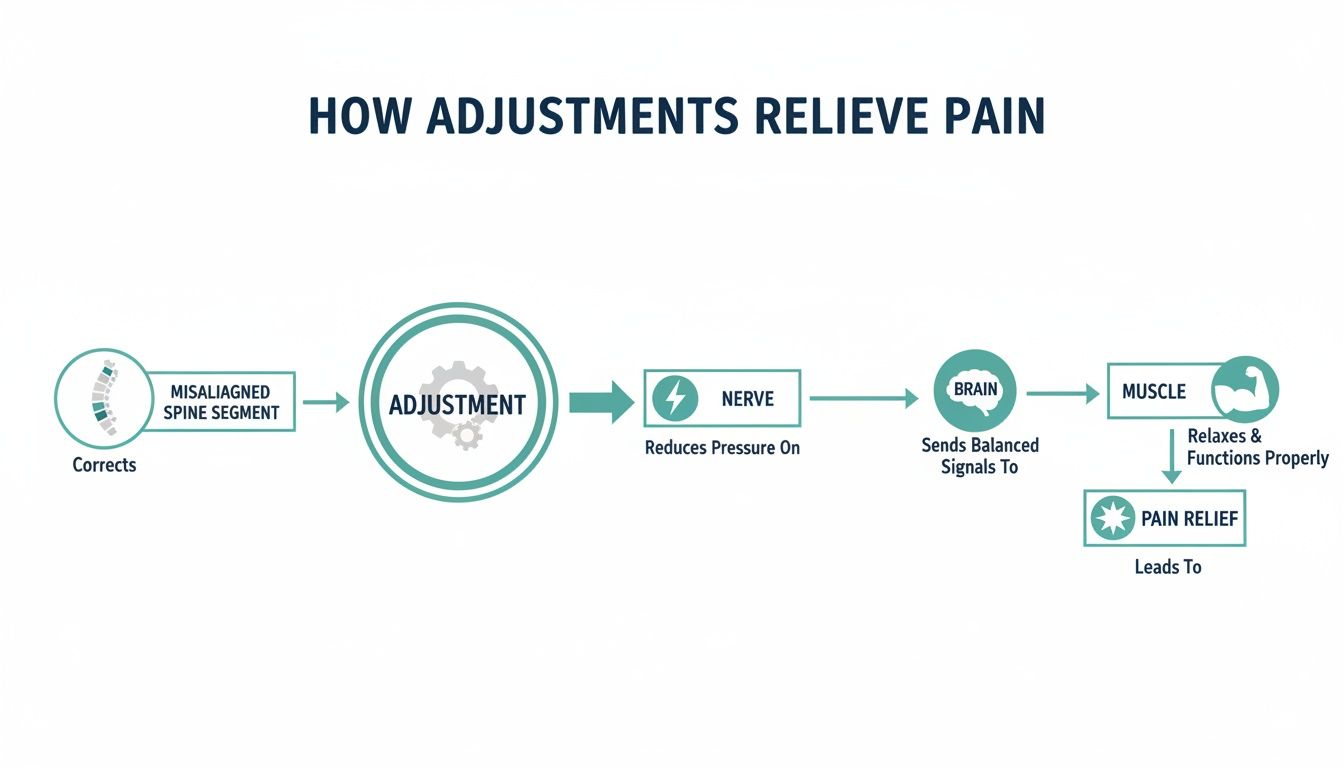
As you can see, getting the joints moving correctly sends positive signals up the nerves to the brain. In response, the brain helps relax those tight, painful muscles and dials down your perception of pain.
The research backs this up. Systematic reviews have shown that spinal manipulation therapy (SMT) leads to significant pain reduction. For example, studies found mean differences of -0.47 for short-term low back pain and -0.73 for neck pain intensity when comparing SMT to a placebo. Following a structured plan, such as having eight sessions over four weeks, can boost these positive outcomes—which is why evidence-based clinics like ours stick to proven protocols. You can find more patient outcomes from chiropractic adjustments in a deeper dive. By offering a range of adjustment styles, we make sure your care is the perfect fit for your body’s unique needs.
When you hear "chiropractor," you probably think "back pain." It's a fair association, but it's only a tiny piece of the puzzle. The spine isn't just a stack of bones; it's the protective housing for your central nervous system—the master communication highway for your entire body.
Think of it like this: if there’s a kink in a garden hose, the water flow is weak and inconsistent. A restricted spinal joint creates a similar "kink" for nerve signals traveling to your limbs, organs, and head. Chiropractic adjustments are designed to undo that kink, clearing the lines of communication so your body can function the way it's supposed to.
Neck pain is one of the top reasons people walk through our doors, and it often brings chronic headaches along for the ride. When joints in your cervical spine (the neck) get stuck or misaligned, they can irritate sensitive nerves and trigger the surrounding muscles to tighten up in self-defense. This creates a miserable cycle of pain and tension.
A precise chiropractic adjustment restores proper movement to these neck joints. This isn't just about getting a "pop." It's about taking direct pressure off the nerves and giving those tense muscles the "all-clear" signal to finally relax. The result is often a dramatic reduction in both neck pain and the frequency of tension headaches or even certain migraines. We're aiming for the root cause, not just covering up symptoms.
The data backs this up. A study from the University of Pittsburgh, for instance, found that patients saw a 50% improvement in neck range of motion after just six to eight weeks of adjustments. The broader health benefits of chiropractic care backed by statistics show just how impactful this approach can be.
Restoring proper motion in the cervical spine can not only reduce local pain but also address related issues like dizziness. You might be interested in our guide that explores if neck problems can cause dizziness and how adjustments can help.
Sciatica is that unmistakable, radiating pain that travels from the lower back down the leg. It’s the tell-tale sign of an irritated or compressed sciatic nerve, often caused by a herniated or bulging disc pushing right where it shouldn't.
Our approach often combines chiropractic adjustments with non-surgical spinal decompression to gently create space between the vertebrae. This powerful, one-two punch works to:
This provides a powerful, non-invasive alternative to more aggressive treatments. A landmark trial in the European Spine Journal found that chiropractic care for sciatica had a 72% success rate—a figure that significantly outperformed physical therapy (20%) and injections (50%).
Peripheral neuropathy is a condition involving damage to the nerves outside the brain and spinal cord. It often leads to weakness, numbness, and a burning pain, most commonly felt in the hands and feet. While chiropractic care can't cure an underlying cause like diabetes, it can play a huge supportive role in managing the symptoms.
By making sure the spine is correctly aligned, adjustments help improve the overall function of the nervous system. This enhances the communication between the brain and those peripheral nerves, which can help dial down the severity of the symptoms. When we pair this with therapies like Class IV cold laser to promote cellular repair, patients often experience profound relief.
This one might come as a surprise, but chiropractic care can absolutely help with issues like knee osteoarthritis. Your body is a kinetic chain—everything is connected. A misalignment in your spine or pelvis can throw off your entire gait, forcing you to walk differently and place uneven, excessive stress on your knees. Over time, this accelerates wear and tear.
A whole-body chiropractic approach looks beyond just the knee. By correcting the alignment of the spine and pelvis, we can help normalize the mechanical load on your knees. When combined with targeted therapies, we can improve joint function, reduce inflammation, and alleviate pain, showing just how versatile a truly comprehensive care plan can be.

It’s one thing to understand the science behind an adjustment, but knowing what your visits will actually look like can make a huge difference. Feeling comfortable and informed is a big part of the healing process. Here at Bonesetters Critical Chiropractic, we’ve built a clear, structured path to recovery that focuses on finding the root cause of your problem and getting you real, measurable results.
Forget about a quick "crack and go." Your first visit is all about taking a deep dive into your health history and what’s bothering you right now. Dr. Leonard Hayes will sit down with you for a comprehensive consultation and examination to get the complete picture.
We start by figuring out the true source of your pain, not just chasing symptoms. This often means using advanced diagnostic tools like the PulStar analysis system. This FDA-backed technology lets us scan your spine and measure the mobility of each individual joint, giving us a clear, digital map of how your spine is functioning.
This objective data takes all the guesswork out of the equation. We know exactly which segments are stuck or restricted before we even perform the first adjustment. To see more about how this works, check out our guide on how chiropractors know where to adjust.
This initial diagnostic phase is absolutely crucial. By pinpointing the specific areas of dysfunction, we can create a highly targeted and efficient treatment plan. It ensures every adjustment is both gentle and maximally effective.
After the analysis, you’ll receive your first adjustment. For many people, especially those dealing with sensitive issues like a bad disc injury or neuropathy, we use the computer-guided PulStar. You’ll feel a series of light, tapping impulses aimed only at the problem joints. There's no twisting or popping involved. The whole point is to gently restore motion and calm down those irritated nerves.
Based on these initial findings, Dr. Hayes will map out a personalized treatment plan for you. This isn't just about temporary relief; it's a roadmap designed for long-term improvement in how your body functions. Your plan will likely integrate a mix of powerful, evidence-based therapies to speed up your healing.
This could include things like:
Right after an adjustment, it's common to feel a sense of relief, lightness, or even just more mobility. It’s also perfectly normal to feel a bit tired or have some mild soreness, similar to how you’d feel after trying a new workout. This is actually a good sign—it means your body is adapting to its new, corrected alignment.
Following any at-home advice we give you, like specific stretches or icing instructions, is a huge part of your care. These recommendations are designed to support the adjustments you get in the office, helping your body hold its proper alignment longer and speeding up your recovery. Your active participation really is the key to getting the best possible outcome.
If you're going to get lasting relief, you need to understand how a chiropractic adjustment actually works. This isn't about a quick fix or just masking your symptoms for a little while. Real chiropractic care is a science. It's all about finding and correcting the root mechanical and neurological causes behind your pain.
Think of it this way: your body is a single, interconnected system. Lasting relief only happens when you address the source of the problem, not just the pain it creates.
An adjustment does so much more than just move a joint. When a chiropractor restores proper motion, it sends a powerful signal straight to your nervous system. This helps calm down irritated nerves, tells tense muscles it's okay to relax, and fundamentally improves the communication flowing between your brain and the rest of your body. It's a two-pronged attack—fixing the physical structure and the neurological function—that lets your body do what it does best: heal itself.
Modern chiropractic care is incredibly safe. It's also remarkably effective, which is why it has such high patient satisfaction rates and a growing mountain of clinical research to back it up. When you choose an evidence-based practice, you're choosing a path that focuses on real, measurable results and creating long-term stability. The whole point is to get you back to living your life, fully and without pain.
This is particularly true for complex spinal issues. To really grasp what we're targeting with an adjustment, you can read our detailed article on what is vertebral subluxation and see how it can affect your overall health. It's a core concept that helps explain why the care we provide is so precise.
True healing is about restoring function, not just silencing symptoms. By correcting the underlying cause of your pain, an evidence-based chiropractic plan empowers your body to maintain its own health for the long term.
If you've been fighting a losing battle with chronic pain, neuropathy, or a disc injury that just won't heal, it might be time to try a new strategy. A non-surgical, evidence-based approach can provide the answers you've been searching for. We strongly encourage you to schedule a consultation and find out how a personalized care plan can help you get your mobility back and achieve lasting wellness without resorting to invasive procedures.
Stepping into a chiropractor's office for the first time naturally comes with questions. Getting straight answers about what an adjustment involves, how safe it is, and what to expect is key to feeling confident in your care. Here are some of the most common questions we hear from new patients.
Absolutely. Chiropractic care is widely considered one of the safest, non-invasive, drug-free therapies for spine and joint problems. Think of it this way: Doctors of Chiropractic go through years of rigorous training focused specifically on the musculoskeletal system, making them true specialists in this area.
The overwhelming majority of patients feel relief and move better right away. Some might feel a little sore afterward, similar to how you feel after a good workout, but this usually disappears within 24 hours. When you stack that up against the well-known risks of long-term pain medication or surgery, the safety record of chiropractic care is excellent.
At Bonesetters Critical Chiropractic, we take safety a step further. We use gentle, instrument-assisted methods like the computer-guided PulStar system. This technology allows for incredibly precise adjustments without any of the traditional twisting or popping, making it a great and exceptionally safe choice for everyone, from young children to seniors.
This is a great question, and the honest answer is: it depends entirely on you. There's no magic number because every person's body and situation is unique.
Your personalized care plan will be based on a few key things:
Dr. Hayes will map out a clear plan after your first comprehensive evaluation. Someone with a recent, straightforward issue might feel a world of difference in just a handful of visits. On the other hand, a long-term, chronic problem will likely need a more structured plan to create lasting stability. Our goal is always to get you back to living your life, not to keep you coming in forever.
Most people find adjustments to be a relief, not a pain. The entire point is to ease pressure and help you feel better.
That "popping" sound you might associate with a chiropractic visit is completely harmless. It’s a process called cavitation, which is just the sound of a tiny gas bubble being released from the fluid in your joints when the pressure changes. It’s the exact same thing that happens when you crack your knuckles. It’s important to know that the sound isn't the goal—it’s just a side effect of some adjustment techniques.
In fact, many of the most effective methods don't make any sound at all. At Bonesetters Critical Chiropractic, our go-to tool is often the PulStar system. It uses a series of gentle, precise impulses to get your joints moving correctly without any cracking or popping. This makes the entire experience comfortable, especially for patients who are in a lot of pain or simply prefer a gentler approach.
Ready to get to the root cause of your pain with a non-surgical, evidence-based approach? The team at Bonesetters Critical Chiropractic is here to build a plan that works for you. Schedule your consultation today.