
Yes, neck problems can absolutely cause dizziness. It’s a condition known as cervicogenic dizziness, and it’s not a problem with your inner ear. The real issue starts in the complex structures of your cervical spine—your neck. When your neck isn't functioning correctly, it can send scrambled signals to your brain, creating a confusing sensory mismatch that leaves you feeling unsteady on your feet.
Have you ever felt dizzy or off-balance and, at the same time, noticed a nagging pain or stiffness in your neck? That’s no coincidence. Your neck is a critical part of your body's internal GPS, constantly feeding your brain information about where your head is in relation to your body and the world around you. This intricate system is called proprioception, and it depends on tiny sensors embedded in your neck muscles and joints.
Think of your brain as an air traffic controller responsible for keeping you upright and balanced. To do its job, it needs accurate, real-time data from three key systems: your eyes (vision), your inner ears (vestibular system), and your neck (proprioception). When all three are in sync, your balance is solid.
But what happens when neck issues—like a misaligned vertebra, muscle tension from poor posture, or an old whiplash injury—disrupt the signals coming from those neck sensors? The air traffic controller in your brain gets conflicting reports. Your eyes might be telling it you're sitting perfectly still, but your faulty neck signals are screaming that you're turning.
This sensory conflict is the very essence of cervicogenic dizziness. Your brain gets confused by the contradictory information, and the result is that disorienting feeling of lightheadedness, unsteadiness, or the sensation that you're swaying on a boat.
This isn't some rare, obscure condition. Research suggests that anywhere from 5% to 40% of people with chronic neck pain also deal with this unsettling dizziness. That's a wide range, but the numbers tend to be higher in specific groups, such as women aged 40 to 70 and people who have experienced a whiplash injury.
One detailed analysis of 443 patients with neck complaints found that 8.1% had confirmed cervicogenic dizziness, often linked directly to issues like cervical disc herniations or myofascial pain syndrome. For more details, you can discover more insights about the prevalence of neck-related dizziness and its causes.
This connection is precisely why addressing the root mechanical problem in the neck is so important. Trying to fix the dizziness without fixing the neck is like trying to fix a blurry photo by adjusting the screen—you have to go to the source. Treatments that focus on restoring proper joint alignment and muscle function can correct these faulty signals. By understanding how a chiropractic adjustment works, you can see how targeted care aims to resolve this sensory mismatch, allowing your brain to receive clear, accurate information once again.
To help you tell the difference at a glance, here’s a quick comparison of the two most common types of dizziness.
This table breaks down the typical feelings associated with dizziness originating from the neck versus the inner ear. While not a diagnostic tool, it can help you start to recognize the patterns in your own symptoms.
| Symptom Type | Neck-Related Dizziness (Cervicogenic) | Inner Ear Dizziness (Vestibular) |
|---|---|---|
| Primary Sensation | Unsteadiness, lightheadedness, or feeling "off-balance." More of a floating or swaying feeling. | True rotational spinning (vertigo). The room feels like it's moving around you. |
| Triggers | Specific neck movements, prolonged head positions (like working at a computer), or head turning. | Often sudden and unprovoked, or triggered by rolling over in bed or looking up. |
| Associated Symptoms | Neck pain, stiffness, headache (especially at the base of the skull), and limited neck motion. | Nausea, vomiting, hearing loss, tinnitus (ringing in the ears), and ear fullness. |
| Duration | Can be constant and low-grade for hours or days, or come in fleeting moments with movement. | Episodes are often intense and can last from seconds (BPPV) to hours or days (Meniere's disease). |
Keep in mind that some people can unfortunately have both types of dizziness at the same time. The key is that if your dizzy spells are consistently accompanied by neck pain or stiffness, it’s a strong sign that your cervical spine is involved.
Ultimately, validating the link between your neck pain and dizziness is the first real step toward getting better. Your symptoms are real, they point to a specific mechanical problem, and with the right diagnosis and treatment, you can find lasting relief.
To get a grip on how a stiff, sore neck can make your head spin, it helps to picture your brain as the pilot of your body. It’s constantly taking in data from multiple sources to keep you upright and steady. But when something goes wrong in the neck, it can throw off the entire navigation system, leaving you feeling dizzy and disoriented.
This isn't just a single issue; a few different problems in the neck can scramble the signals your brain needs to maintain balance. Let’s walk through the three main ways this happens.
The most frequent reason neck problems cause dizziness is something called a proprioceptive mismatch. Your brain relies on a constant stream of information from three key systems to know where you are in space:
Normally, these three systems work in perfect harmony, sending matching signals. But when your neck is affected by an injury, arthritis, or even just chronic bad posture, its proprioceptors can start sending faulty information. Suddenly, your brain is getting mixed messages. Your eyes and inner ear might be saying, "We're sitting perfectly still," while the messed-up signals from your neck are screaming, "The head is turning!"
This sensory conflict is confusing for your brain. It doesn't know which signal to believe, and that neurological confusion is what you feel as dizziness, lightheadedness, or a general sense of being "off."
This chart shows how that signal conflict works. A bad signal from the neck throws the whole system out of whack.
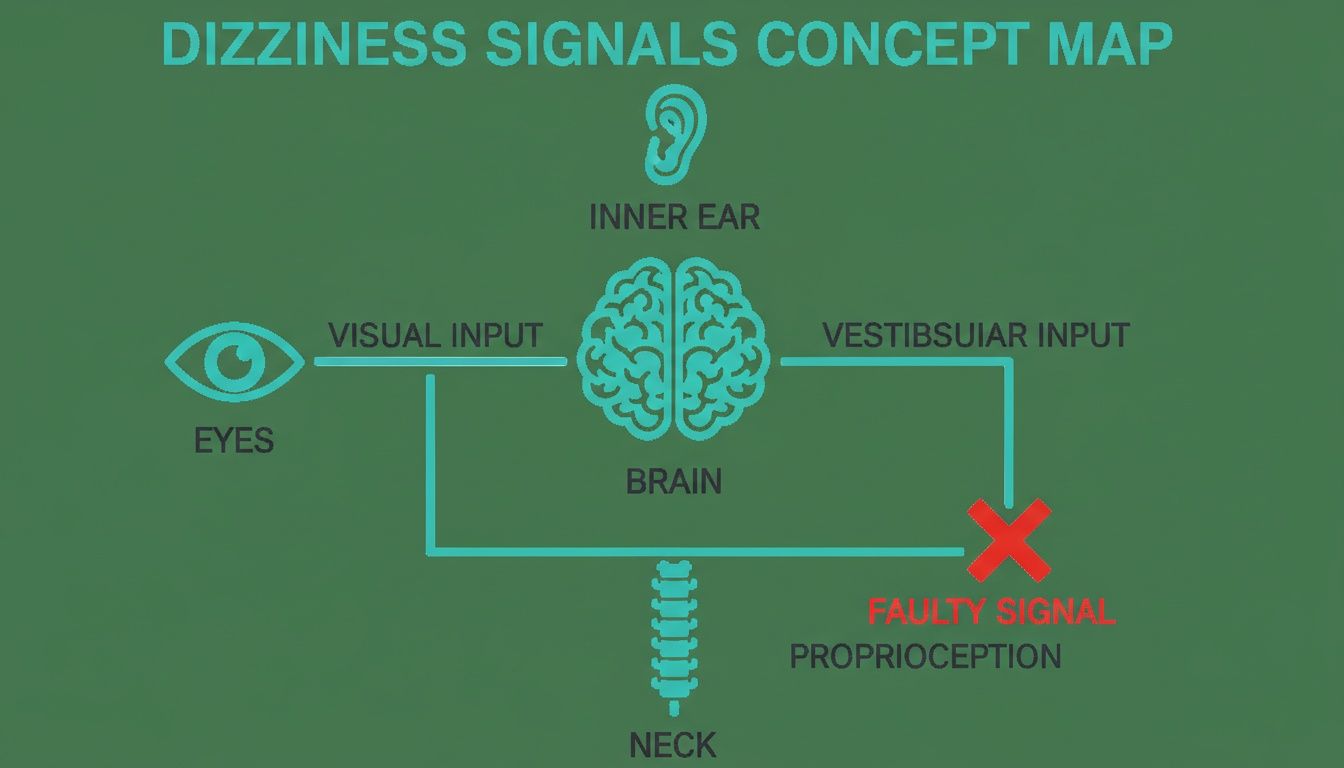
When the neck's input is unreliable, the brain struggles to create a clear picture of your body's position, leading directly to the symptoms we call cervicogenic dizziness.
Another way neck problems can cause trouble is by interfering with blood flow. The vertebral arteries, which are critical blood vessels, run up to the brain through small bony channels in your cervical vertebrae. They supply blood to the brainstem and cerebellum—the very parts of your brain that manage balance and coordination.
If neck vertebrae are misaligned or if arthritis creates bone spurs, these arteries can get pinched or compressed. This is especially likely to happen when you make certain movements, like looking straight up or turning your head sharply.
This condition, called vertebrobasilar insufficiency, can temporarily cut down the supply of oxygen-rich blood to your brain's balance centers. The result can be a sudden wave of dizziness, lightheadedness, or even a frightening "drop attack," where your legs feel like they give out. It's a classic example of a mechanical problem in the neck directly impacting the brain's vital functions.
Finally, don't overlook your neck muscles. Chronic tension, poor posture, or an old injury can create tight, painful knots in the muscle tissue known as myofascial trigger points.
These aren't just simple sore spots. Trigger points are hyper-irritable areas that can send their own bizarre nerve signals, often referring pain and other sensations to completely different areas. When these knots form in key neck muscles like the sternocleidomastoid (the big one on the side of your neck) or the upper trapezius, they can generate signals that your brain mistakes for movement.
It’s like static on a radio channel. The trigger point creates "noise" in the nervous system, and the brain interprets that junk data as a sensation of unsteadiness or dizziness. This is why targeted therapy to release these trigger points often provides significant relief—it clears up the static, allowing the real signals to come through clearly again.
So, how can you know if that disorienting, off-balance feeling is actually coming from your neck? It's a great question. While dizziness can spring from many sources, the kind that originates in the neck—what we call cervicogenic dizziness—has a very distinct personality. Learning to recognize its classic clues is the first real step toward getting the right help.
The biggest giveaway is the direct link between your neck and your symptoms. Unlike inner ear problems that can pop up out of the blue, cervicogenic dizziness is usually provoked by specific neck movements. Think about it: does turning your head to check a blind spot while driving set it off? How about tilting your head back to look up, or just holding one position for too long at your desk? If the answer is yes, you're on the right track.
This connection is so tight because the dizziness starts with faulty signals coming from the joints and muscles in your neck. When movement or bad posture irritates these structures, they send scrambled messages to your brain, creating that confusing, dizzy sensation.
When most people think of dizziness, they imagine the room spinning violently, a sensation known as vertigo. While that can happen with neck issues, it’s not the most common experience. Cervicogenic dizziness is usually more subtle. It’s often described as a feeling of unsteadiness or lightheadedness.
Patients often tell me it feels like they’re on a boat, gently swaying even when they’re standing perfectly still. Others describe a weird sense of being "off" or disoriented, almost like their head is floating separately from their body. This feeling can last for just a few minutes or hang around for hours as a low-grade sense of imbalance.
The bottom line is this: if your dizziness almost always shows up with neck pain, stiffness, or a headache that creeps up from the base of your skull, your cervical spine is the prime suspect. The two are almost always a package deal.
Several underlying neck problems are notorious for triggering these dizzying symptoms. The common thread among all of them is that they disrupt the normal mechanics and sensory feedback of the upper neck.
Here are a few of the most frequent culprits:
The link between neck arthritis and dizziness isn't new. A landmark 1996 study found that among elderly patients with dizziness, 30% had symptoms tied directly to cervical spondylosis. Fast forward to a 2018 study of 1,000 outpatients, which found that a staggering 90% of general dizziness cases were traced back to the neck, with cervical spinal canal stenosis being a major contributor. If you want to dive into the data, you can read the full research about the prevalence of cervicogenic dizziness.
By simply paying attention to when and how your dizziness happens, you can start connecting the dots. Try keeping a simple symptom diary, just jotting down what you were doing when an episode started. This kind of information is gold for your doctor and can lead to a much faster and more accurate diagnosis.
Figuring out if your neck is the real reason you're feeling dizzy isn't always straightforward. It's rarely a one-and-done test. Because dizziness from the neck—what we call cervicogenic dizziness—can feel a lot like dizziness from other causes, your doctor has to play detective. They'll systematically rule out other culprits to zero in on your neck as the source. This methodical approach is called a diagnosis of exclusion, and it's the gold standard for making sure you get the right treatment.
It all starts with a simple conversation. Your healthcare provider needs to hear the full story of what you've been experiencing, so get ready to share the details.
Your personal account of what's been happening is probably the most important clue we have. Your doctor will ask pointed questions to find patterns that suggest a neck-related problem:
This history is incredibly helpful for distinguishing your symptoms from inner ear (vestibular) problems, which often hit you out of the blue without any clear mechanical trigger.
After listening carefully, your clinician will move on to a thorough physical exam. This is where the rubber meets the road—it’s how we connect the symptoms you're describing to what's physically happening in your neck.
We'll check your neck's range of motion, gently feel for tender muscles and trigger points, and take a look at your overall balance and posture. A key part of this involves specific manual tests. For instance, the cervical flexion-rotation test is a common one. While you're lying down, we gently rotate your head to see if that specific motion brings on your familiar dizziness. If it does, that’s a strong sign the joints in your upper neck are involved. Practitioners are trained to perform these assessments safely, using their hands as diagnostic tools. If you're curious about this skill, you can learn more about how chiropractors know where to adjust from these kinds of detailed exams.
While a hands-on exam tells us a lot, sometimes we need a look under the hood. Diagnostic imaging helps us rule out other potential issues and see if there are any structural changes in your neck that could be playing a role.
An X-ray or MRI doesn’t diagnose cervicogenic dizziness directly. Instead, it provides essential context by showing conditions like cervical spondylosis (arthritis), degenerative disc disease, or a disc herniation that could be contributing to your symptoms.
These scans are also crucial for making sure nothing more serious is going on, like a tumor or vascular problem that could also cause dizziness. This careful, step-by-step process—combining your story, a physical exam, and imaging when needed—is what allows your medical team to confidently pinpoint your neck as the source of the problem and build a treatment plan that actually works.
Once we’ve pinpointed your neck as the culprit behind your dizziness, we can finally shift from guessing to targeted action. The real goal isn't just to make the dizzy spells go away for a little while; it's to fix the mechanical issues in your cervical spine that are causing them in the first place.
Modern, evidence-based care is all about restoring proper function, calming down irritated nerves, and essentially rebooting your brain's balance system. It's a holistic approach that moves past just covering up the symptoms. We get to the root of why your neck is sending those scrambled signals to your brain. By carefully combining a few powerful therapies, we can address joint alignment, muscle strain, and neurological feedback all at once.
To really understand the modern approach, it helps to see how it stacks up against older, symptom-focused methods. One is a long-term solution, while the other is often just a temporary fix.
| Treatment Approach | Primary Goal | Techniques Used | Focus |
|---|---|---|---|
| Modern Root-Cause | Correct the underlying spinal dysfunction. | Precise adjustments, decompression, vestibular rehab. | Restoring normal function and lasting stability. |
| Traditional Symptom Management | Reduce or mask the sensation of dizziness. | Medications (e.g., meclizine), general exercises. | Temporary relief without addressing the cause. |
Focusing on the root cause is the only way to achieve genuine, lasting relief and prevent the problem from coming back.
Often, the problem starts with misaligned vertebrae in the upper neck, which scrambles the proprioceptive signals your brain relies on for balance. Correcting this requires an incredibly gentle and precise touch. That’s where advanced systems like the FDA-backed PulStar come in, using computer guidance to analyze and treat spinal restrictions without any of the forceful twisting or popping people sometimes worry about.
This technology allows us to deliver a highly specific adjustment, restoring mobility to "stuck" joints and clearing up the communication highway between your neck and your brain. By fixing the alignment, we help your body’s internal GPS recalibrate, leading to clearer signals and fewer dizzy spells.
If your dizziness is tied to compressed discs or pinched nerves, a non-surgical therapy called spinal decompression can be a game-changer. It uses a specialized table to apply a gentle, controlled stretch to the neck.
Think of it like letting a compressed sponge slowly expand and soak up water again—that's what decompression does for your spinal discs. This creates a negative pressure inside the disc, which helps pull back bulging material and takes the heat off sensitive nerves. By creating more space and boosting circulation, we can address a key structural driver of neck-related dizziness. You can take a deeper look at this gentle therapy and learn more about decompression of the cervical spine to see how it works.
Chronic inflammation is a silent partner in crime for both neck pain and the nerve irritation that triggers dizziness. Class IV Cold Laser Therapy is a non-invasive tool that uses specific wavelengths of light to penetrate deep into your neck tissues.
This light energy gives your cells a jump-start, helping them repair themselves, dial down inflammation, and improve blood flow. It’s a fantastic way to calm the deep muscle tension and joint inflammation that contribute to those faulty nerve signals.
Fixing the neck is step one, but sometimes your brain needs a little help re-learning how to interpret balance signals correctly. This is where vestibular rehabilitation shines. It’s a specialized type of physical therapy using specific exercises to sharpen your gaze stability and improve overall balance.
These exercises are designed to help your brain adapt to the sensory mismatch between your neck, eyes, and inner ear. By safely and intentionally triggering mild symptoms in a controlled setting, we teach your brain to become less reactive to the movements that used to send you spinning.
The evidence for this combined approach is compelling. Research shows that integrating manual therapies with vestibular rehab delivers an incredible 70-90% success rate, helping to normalize the proprioceptive signals from the neck to the brain. Neck pain and dizziness are frequent companions, with one large study of over 2,300 patients finding that 40.1% with neck pain also had dizziness. The good news? Rehab significantly improved their symptoms within three months. You can discover more insights about the success of combined therapies in published research.
By integrating these powerful treatments, we can build a plan that not only stops the dizzy spells but truly restores your confidence in your body and its movements.

While getting professional treatment is key, what you do every day plays a massive role in how well you recover. Think of it this way: your daily habits can either support the work your clinician is doing or undermine it. Taking an active role with these self-care strategies helps you build resilience and manage your own health effectively.
Often, the neck issues that lead to dizziness are aggravated by small, repetitive strains we don't even think about. By making a few simple, consistent tweaks to your daily routine, you can create an environment that encourages healing and stops you from re-injuring those sensitive tissues in your neck.
These steps are about more than just temporary relief; they’re about changing the day-to-day mechanical stress on your neck for good.
Poor posture is a huge culprit, especially that "forward head" position so many of us fall into at our desks. Fixing your workspace setup can take a surprising amount of load off your neck.
When your neck muscles are flexible and strong, they provide better support for your cervical spine. This helps stabilize the very structures that, when irritated, can cause dizziness. Just remember to perform these movements slowly and stop immediately if you feel any sharp pain.
Remember, the goal here is gentle, controlled movement—not aggressive stretching. You're essentially re-educating your neck muscles on how to hold your head in a healthier, more balanced position.
Beyond your desk setup and specific exercises, your broader lifestyle choices can either help or hurt your recovery. A couple of key adjustments can make a real difference in keeping inflammation and muscle tension in check.
First, stay hydrated. The discs between your vertebrae are mostly water, and they need plenty of it to stay healthy and cushion the bones. Dehydration can actually contribute to disc problems and stiffness.
Finally, get a handle on your stress. When we're stressed, we instinctively tense our neck and shoulder muscles. This can be a direct trigger for dizziness or make existing symptoms much worse. Even simple things like deep breathing exercises or taking short walks can help break that tension cycle before it starts.
It's completely normal to have a lot of questions when you're trying to figure out the link between neck issues and that unsettling dizzy feeling. Let's walk through some of the most common concerns to give you a clearer picture of what to expect on your road to recovery.
Everyone's journey is a bit different, but the good news is that many people start to feel a real difference pretty quickly. It's common to notice your dizzy spells become less frequent and less intense within just a few weeks of starting a consistent, targeted treatment plan.
Getting to the root of the mechanical problem in the neck is key. While full recovery depends on things like how long you've had the issue and how closely you follow your care plan, that initial relief often shows up faster than you might think.
Absolutely. In fact, it's not unusual for someone to have overlapping conditions, which is exactly why getting a precise diagnosis is so important. For instance, you could have an inner ear problem like Benign Paroxysmal Positional Vertigo (BPPV) that gets aggravated by the stiffness and pain from a neck issue.
Untangling the two can feel confusing, but a clinician with experience in this area knows how to tell them apart. Through specific tests, they can pinpoint all the contributing factors and create a plan that addresses every piece of the puzzle, so you get the comprehensive relief you need.
It's not uncommon for one problem to aggravate the other. Relieving the neck strain can sometimes even reduce the severity of vestibular symptoms by improving overall sensory input to the brain.
While most neck-related dizziness is more frustrating than dangerous, there are definitely some "red flag" symptoms you should never ignore. These can point to a much more serious underlying condition that needs immediate medical attention.
Get to an emergency room right away if your dizziness comes on suddenly and is severe, or if it shows up with any of these signs:
These could be signs of a stroke or another serious neurological event where time is critical. If you're ever in doubt, playing it safe and getting checked out immediately is always the right call.
At Bonesetters Critical Chiropractic, we specialize in diagnosing and treating the root causes of neck pain and dizziness. If you're ready to find lasting relief without surgery, you can learn more about our evidence-based care plans.