

A chiropractic adjustment is far more than just "cracking your back." It’s a precise, skillful technique designed to restore your body’s natural movement and reset your nervous system. By applying a controlled, specific force to spinal joints that have become restricted or "stuck," we can improve how your body moves (biomechanics) and fine-tune the critical communication pathways between your brain and body (neurophysiology). This powerful, two-pronged approach is what helps alleviate pain and unlock your body's incredible capacity to heal itself.

To really get how an adjustment works, picture your spine as the main communication highway for your entire body. Every joint is meant to move smoothly, giving you flexibility and strength while protecting the vital nerves branching out to every organ and muscle. But when these joints get stiff or misaligned from an injury, daily stress, or even just poor posture, they create a "traffic jam" that can disrupt this crucial flow of information.
This is exactly where chiropractic science steps in. An adjustment isn't about just forcing a bone back into place; it’s a highly specific procedure that targets these dysfunctional joints to restore healthy, functional movement. By getting to the root of the problem, the treatment can resolve many common health complaints.
When a chiropractor performs an adjustment, it triggers two primary responses in your body. Think of it as a physical and neurological "reboot" that gets you back on track.
This whole process is incredibly targeted. Many patients wonder about the precision involved, and you can learn more about how chiropractors know where to adjust by understanding our diagnostic process. Put simply, every single adjustment is carefully planned to address a specific problem area.
An adjustment doesn't just silence pain—it restores the conversation between your brain and body. By clearing up the "static" caused by joint restrictions, it allows your nervous system to function more efficiently, coordinating healing and improving overall stability.
To put it all together, here is a quick summary of what's happening during an adjustment.
| Mechanism | What It Means for Your Body | Primary Patient Benefit |
|---|---|---|
| Biomechanical Restoration | The adjustment restores motion to a "stuck" spinal joint. | Improved flexibility, reduced stiffness, and less pressure on discs. |
| Neurophysiological Effect | Nerve receptors around the joint are stimulated, sending new signals to the brain. | Decreased pain perception and better muscle coordination. |
This table shows how a single, specific action can create a ripple effect of positive changes throughout your body, addressing both the physical structure and the nervous system's function.
Ultimately, a chiropractic adjustment creates an internal environment where your body can heal itself more effectively. By improving joint mechanics and calming irritated nerves, we remove the very barriers that were holding your body back. This foundational shift leads to reduced inflammation, more relaxed muscles, and better coordination.
Whether you're struggling with chronic back pain, nerve-related issues like neuropathy, or recovering from a recent injury, understanding this process shows why adjustments are a cornerstone of restoring long-term health—not just a temporary fix.
Let's start with a simple analogy to understand the physical side of what a chiropractic adjustment does. Think about a door with a rusty, stiff hinge. Just one stuck hinge makes the whole door a nightmare to open and close. You end up yanking on it, which puts a ton of stress on the doorframe and even wears out the other, healthy hinges.
A restricted joint in your spine—what we sometimes call a vertebral subluxation—is a lot like that rusty hinge. When even one of your vertebrae isn't moving as it should, your entire spine has to compensate. This chain reaction puts extra strain on the muscles, ligaments, and the shock-absorbing discs between your vertebrae.
The adjustment itself is a very specific, controlled force applied right to that "stuck" joint. The goal isn't about forcing something back into place. It’s about gently freeing up that restriction to get the joint moving through its natural, intended range again.
Think of the adjustment as the key that unlocks that frozen hinge. A joint that can't move properly doesn't just sit there quietly; it kicks off a whole cascade of problems.
By precisely targeting the restricted area, the adjustment helps break up tiny adhesions that form within the joint capsule, allowing it to glide smoothly again. This simple act of restoring motion takes an enormous amount of pressure off the surrounding tissues.
What’s that "popping" sound? It’s not your bones cracking. That sound, called cavitation, is just the release of a tiny gas bubble (mostly nitrogen) from the fluid inside the joint. It's the same thing that happens when you crack your knuckles—a harmless and often satisfying sign that the joint has been mobilized.
Getting that movement back is critical, especially for conditions driven by nerve compression. For someone with sciatica, for instance, freeing up a locked-up joint in the lower back or pelvis can immediately take the pressure off that irritated sciatic nerve.
When you restore proper movement in one joint, it creates a positive ripple effect throughout your entire body. Once that "rusty hinge" is moving freely, the muscles around it can finally let go, and the rest of the structure can work the way it was designed to. The door can finally swing open without straining the frame.
This is the core of how an adjustment works on a physical level. It’s not a temporary fix; it’s about correcting the root mechanical issue that’s causing the pain in the first place.
Here’s how that improved motion translates into real-world benefits:
At the end of the day, the biomechanical goal of an adjustment is simple: get your body moving the way it was built to. By addressing the physical roadblocks, we clear the way for your nervous system to function properly, helping you find lasting comfort and get back to doing what you love.
While getting joints moving again is a big piece of the puzzle, the most powerful effects of a chiropractic adjustment happen on a much deeper level: inside your nervous system. Your spine is more than just a stack of bones; it’s the main highway for every signal traveling between your brain and the rest of your body. Billions of messages fly down this highway every second, controlling every muscle, organ, and cell.
When a spinal joint gets stuck or restricted, it’s like creating static on that communication line. The brain starts getting garbled or incomplete information from that area. An adjustment acts like a hard reset, clearing the static and rebooting the entire brain-body connection.
Tucked away in the muscles and ligaments around every spinal joint are tiny, specialized nerve endings called mechanoreceptors. Their whole job is to sense movement and position, constantly telling your brain where your body is in space. When a joint gets stuck, these sensors pretty much go silent.
The quick, precise force of an adjustment instantly wakes up these dormant sensors. This sends a sudden flood of positive, clear movement data rushing up to the brain. It's like your brain gets a fresh, high-definition update on how that joint is supposed to move and feel.
This rapid influx of movement signals does something amazing—it can actually drown out pain signals. This is based on a well-known concept called the "Gate Control Theory of Pain." Think of it like this: the positive movement signals rush through the nerve "gates" and close them before the slower, duller pain signals can get through.
An adjustment isn't really about forcing a bone back into place. It’s more like a conversation with your brain, using the language of movement to restore balance and dial down the volume on pain.
Ever wonder why you have muscles that are chronically tight and just won't seem to let go? It's often a direct result of that poor brain-body communication. If the brain isn't getting clear feedback from a joint, it panics and tells the nearby muscles to lock down in a protective spasm. That’s where that stubborn stiffness and achiness comes from.
By waking up the mechanoreceptors, an adjustment breaks this vicious cycle. The brain gets accurate, up-to-date information, realizes the threat is gone, and finally sends the "all clear" signal to those overworked muscles, allowing them to relax. It’s why so many people feel an immediate sense of release right after a treatment.
But it goes beyond just relaxing muscles. This process actually retrains your brain's ability to control your body. Improving the quality of sensory information from the spine boosts your brain's corticomotor excitability—basically, its direct line of command to your muscles. This isn't just a theory, either.
A fascinating 2021 study, for example, found that a single chiropractic adjustment significantly increased the brain's drive to muscles by as much as 30-50% in patients recovering from chronic stroke. The researchers believe this happens by rebalancing the "go" and "stop" signals in the brain, which counters the negative patterns caused by things like vertebral subluxations. You can read the full research about these neurological findings to see the data for yourself.
This chart shows how the process begins at the joint level, which is the key to recalibrating all those nerve signals.
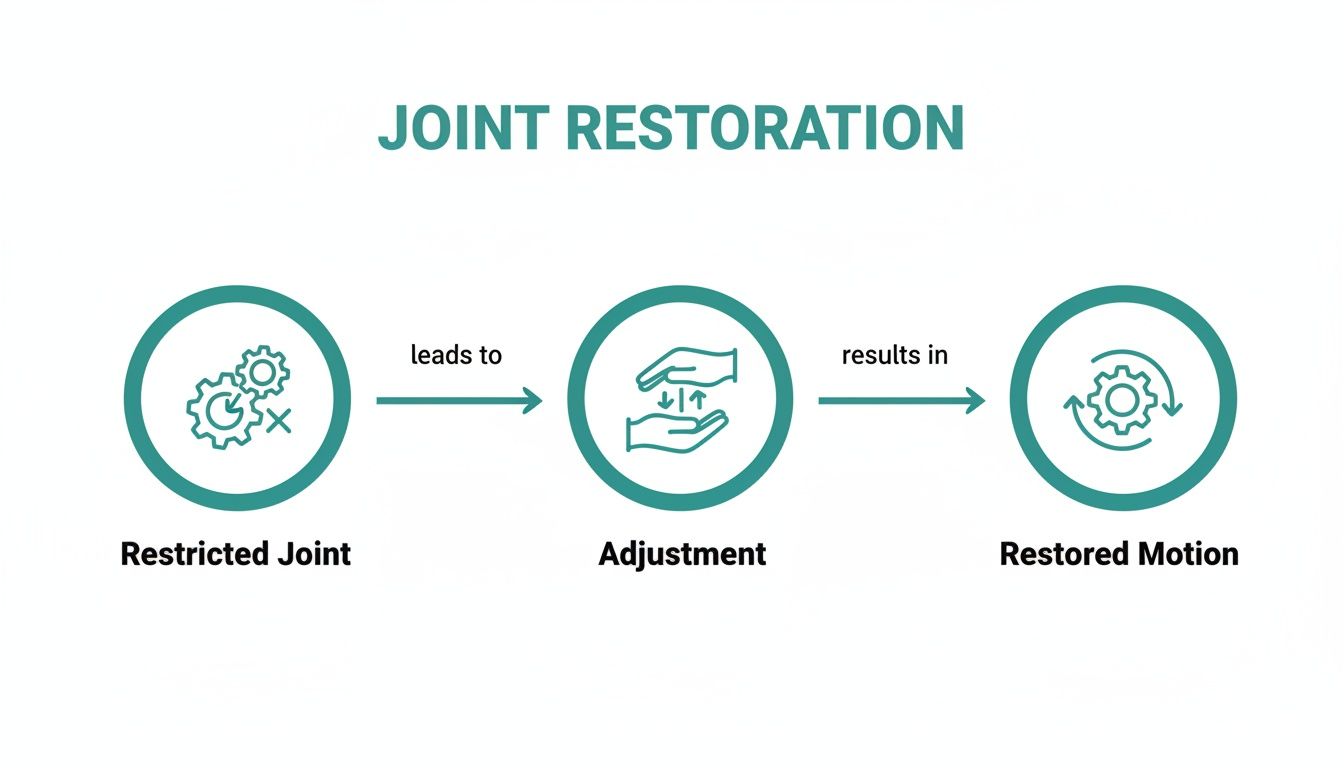
As you can see, the targeted input from an adjustment turns a stiff, restricted joint into one with fluid motion, setting the stage for much clearer neurological communication.
At the end of the day, the goal of an adjustment's neurological effects is to improve your body's overall stability and performance. When your brain and body are talking to each other clearly, your movements become smoother, your posture improves without you having to think about it, and you become far more resilient to re-injury.
This improved nerve function is why adjustments can help with such a wide variety of issues:
The root cause of this nerve interference is often a vertebral subluxation—a misalignment or restriction that messes with nerve signals. You can learn more about what is vertebral subluxation in our in-depth guide. Correcting these subluxations is the key to restoring the integrity of your nervous system. By fixing the underlying mechanical problem, we trigger a powerful neurological reset that supports genuine, long-term healing.
When we talk about a chiropractic adjustment, it’s easy to focus on the physical side of things—the movement of a joint or the relief of a pinched nerve. But what’s happening on a chemical level is just as important. An adjustment does more than just move bones; it kickstarts a powerful chemical chain reaction that shifts your body from a state of chronic inflammation to one of active healing.
Think of it this way: when joints are stuck and nerves are irritated, your body sounds the alarm by flooding the area with pro-inflammatory chemicals called cytokines. These are the culprits behind the persistent pain, swelling, and stiffness you feel with conditions like arthritis or a herniated disc. A well-placed adjustment helps to hit the mute button on that alarm.
The quick, gentle force applied to the joint stimulates the surrounding tissues, sending a new message to your neuroendocrine system—the command center that regulates hormones and immunity. This prompts your body to dial back the production of those inflammatory cytokines, creating a calmer, less hostile environment internally so healing can begin.
While the adjustment is busy fighting inflammation, it's also telling your brain to release its own built-in pain relievers. The stimulation of nerve receptors during the adjustment triggers the release of powerful neurochemicals called endorphins.
You've probably heard of endorphins in the context of a "runner's high." They act a lot like opioids, binding to receptors in your brain to block pain signals and create a feeling of well-being. This is why so many people feel an immediate sense of relief and calm right after an adjustment. It's not just in your head; it’s your body's own pharmacy going to work.
This one-two punch—turning down inflammatory chemicals while turning up natural painkillers—is what makes adjustments so effective. We're tackling the pain from two different angles, creating the perfect conditions for your body's tissues to heal without being constantly irritated.
This isn't just theory; we have solid research backing up how manual therapies change your body's chemistry. The specific force of an adjustment has a profound biochemical effect that goes far beyond simple mechanics.
A landmark 2008 study revealed that spinal manipulation did more than just calm down overactive muscle sensors. It triggered a significant biochemical cascade that slashed pro-inflammatory cytokines while boosting the body’s anti-inflammatory response. You can read more about these findings on the Kocken Chiropractic blog.
This shows us that the adjustment acts as a catalyst. The chiropractor isn't "fixing" the problem directly but is instead enabling your body to activate its own powerful, innate healing systems.
When you understand this chemical response, it’s easy to see why chiropractic care can help with so many conditions, especially those driven by chronic inflammation.
Ultimately, this chemical shift is a vital piece of the puzzle. By helping your body reduce inflammation and boost its own pain relief, we create an environment where tissues can finally repair, function can be restored, and you can achieve a more complete and lasting recovery.

Just as no two patients are exactly alike, no two chiropractic adjustments are identical. A skilled chiropractor has a whole toolbox of techniques to choose from, which allows us to tailor every single treatment to your specific condition, your body, and even your comfort level.
Knowing a little about these different approaches can demystify the process and help you feel more at ease. Let's walk through the two main categories: the classic hands-on adjustments and the more modern, gentle instrument-assisted methods.
When most people picture a chiropractic adjustment, this is what they think of. We use our hands to apply a quick, precise, and gentle thrust to a specific joint that isn't moving as it should. The goal is simple: get that joint moving again.
The Diversified technique is perhaps the most common hands-on method you'll encounter. It’s what often produces that familiar "popping" sound (cavitation) as we restore motion to a stuck joint. This direct approach gives us immediate, tactile feedback on how your body is responding.
But not all hands-on methods are high-velocity. For example, the Logan Basic Technique involves a very light, sustained pressure at the base of the spine. If you're curious about gentler options, you can read more about what is the Logan Basic Technique to see how it contrasts with other manual styles.
For some people, a traditional adjustment just isn’t the right fit. This could be due to acute pain, a specific condition like osteoporosis, or simply a personal preference for a gentler approach. That's where instrument-assisted techniques come in, and they are a fantastic alternative.
These methods use specialized tools to deliver a very light, rapid impulse to the joint. It achieves the same goal of restoring proper motion but without any of the twisting or popping that comes with some manual adjustments.
Instrument-assisted adjustments are perfect for patients who need a highly targeted and gentle force. This includes older adults, children, and anyone recovering from a recent injury where manual manipulation might be uncomfortable.
One of the most sophisticated examples of this is the PulStar system. This is a computer-guided tool that actually analyzes the spine’s mobility, delivers a precise adjustment, and then re-analyzes it to confirm the results.
Here’s a quick look at how it works:
To make the differences clearer, here’s a simple breakdown of the two main approaches.
| Feature | Manual Adjustment (e.g., Diversified) | Instrument-Assisted (e.g., PulStar) |
|---|---|---|
| Method | Practitioner's hands apply a controlled thrust. | A specialized tool delivers a rapid, light impulse. |
| Force | Higher-velocity, low-amplitude thrust. | Very low force, but extremely fast impulse. |
| Sensation | Often produces a "popping" sound (cavitation). | Feels like a light, quick tapping. No popping sound. |
| Precision | Relies on the chiropractor's tactile skill and experience. | Computer-guided for pinpoint accuracy on specific joints. |
| Best For | Most patients without specific contraindications. | Patients with osteoporosis, acute pain, children, or those nervous about manual adjustments. |
| Feedback | Immediate tactile feedback for the chiropractor. | Objective, measurable data shown on-screen before and after treatment. |
Ultimately, having access to both manual and instrument-assisted techniques means we can always choose the safest, most comfortable, and most effective method to help you reach your health goals.
It's one thing to understand the science behind a chiropractic adjustment, but it’s just as important to know what the experience will actually feel like. Knowing what’s coming can make all the difference in helping you relax and get the most out of your care.
Your first visit with us always starts with a real conversation. We’ll go over your health history, listen to what you've been experiencing, and conduct a careful examination to get to the root of the problem. No adjustments happen until we have a clear picture of what’s going on.
Once we’ve located the specific joints that aren’t moving correctly, the adjustment itself is surprisingly quick. It’s just a gentle, controlled thrust applied to the restricted area. Many people describe feeling a sense of release or lightness almost instantly. You might also hear a “popping” sound—that’s just a harmless release of gas from the joint fluid, much like cracking your knuckles. The whole thing is over in minutes.
Most of our patients feel better right away, but everyone’s body responds a little differently.
That feeling of immediate relief so many people talk about? It's real. It comes from restoring proper motion to the joint and sending a flood of calming signals to your nervous system.
After an adjustment, your body begins a process of recalibration. The improved joint movement and clearer nerve signals allow your brain to better control muscle function and stability, laying the foundation for long-term healing and strength.
In the 24 to 48 hours after your visit, it’s completely normal to feel some mild soreness. Think of it like the feeling you get after a good workout you haven't done in a while. Your body is adapting to its new, healthier alignment, and muscles that have been “asleep” are being activated again. This is a positive sign that real change is happening.
To keep the momentum going, it’s a good idea to follow a few simple guidelines:
The benefits go far beyond just feeling better. Research consistently shows that adjustments do more than just relieve pain. For instance, studies have demonstrated that chiropractic care can improve sensorimotor integration and proprioception—your brain’s awareness of your body's position—by 15-25%. Learn more about the science behind these findings to see how we’re helping the brain and body communicate better.
It's completely normal to have questions when you're considering a new approach to your health. Getting answers you can trust is a huge part of feeling comfortable and confident. Let's walk through some of the most common questions we hear from people just starting their journey with us.
Absolutely. When performed by a licensed Doctor of Chiropractic, adjustments are considered one of the safest, non-invasive therapies available for back and neck pain. Think of it this way: our entire education is focused on the spine and nervous system. We spend years mastering anatomy and learning precise, controlled techniques to ensure patient safety above all else.
Before we even consider an adjustment, we conduct a detailed health history and a thorough examination. This helps us pinpoint the problem and make sure chiropractic care is right for you. The risk of a serious issue is incredibly small, which is why millions of people rely on chiropractic care to get out of pain and back to their lives.
The guiding principle in our clinic is safety first. We build your care plan around the gentlest, most effective methods for your body, whether that's a classic hands-on adjustment or a precise, computer-guided treatment with the PulStar system.
That's the big question, isn't it? The honest answer is: it really depends on you. There's no one-size-fits-all timeline because every person and every condition is unique.
A few things that influence your care plan include:
Someone with a recent flare-up might feel a world of difference after just a few sessions. On the other hand, a more deep-rooted problem like degenerative disc disease or chronic neuropathy will naturally require a more structured plan to create lasting change. We'll lay out a clear roadmap for you right from the start.
While we're definitely known as the "back pain doctors," that's really just the tip of the iceberg. Chiropractic care is about improving the function of your entire nervous system, and since that system controls literally everything in your body, the benefits are far-reaching.
By restoring proper movement in the spine and taking pressure off the nerves, we can help with a whole host of issues. People come to us for relief from chronic neck pain, stubborn headaches and migraines, sciatica, and even joint pain in their shoulders, hips, and knees. At its core, our job is to get your brain and body communicating clearly again.
Nope! You can book an appointment with us directly. In most places, chiropractors are considered primary contact healthcare providers. This means we're fully trained to be your first stop—to diagnose your condition, figure out if chiropractic is the best path forward, and, if not, refer you to the right medical specialist.
At Bonesetters Critical Chiropractic, we find that patients who understand their care get the best results. If you have any other questions or want to see if our evidence-based, non-surgical treatments are right for you, we'd love to talk. You can schedule your consultation and learn more about our personalized approach at https://bonesetters.org.