
When you hear the term “vertebral subluxation,” it’s easy to picture a bone dramatically popping out of place. But the reality is far more nuanced. Think of it less like a complete dislocation and more like a joint that’s stuck, stressed, or not moving the way it should.
This subtle dysfunction can create a cascade of problems, interfering with the communication between your brain and the rest of your body. It’s not a total power outage, but more like a dimmer switch that dials down the flow of vital nerve signals, potentially leading to pain and other health issues.
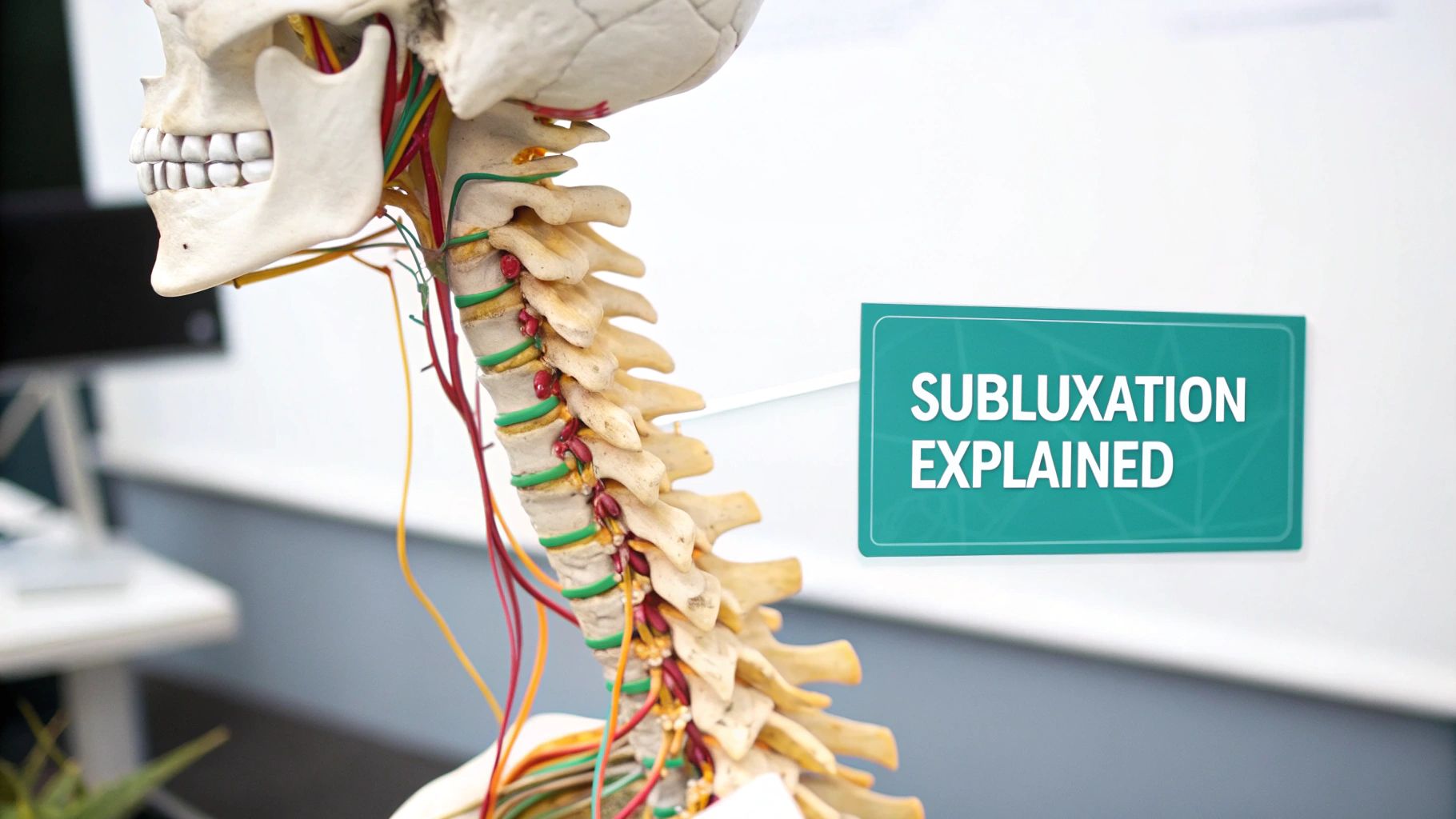
Imagine your spine is the main information highway for your nervous system. Billions of messages constantly zip from your brain down the spinal cord and out to every single organ, muscle, and cell.
Now, if a vertebra gets misaligned or loses its proper motion, it can create interference on this highway—a bit like static crackling over a radio signal.
The message might still get through, but the quality and clarity are compromised. This is what modern chiropractors are talking about when they identify a vertebral subluxation—it’s a state of spinal dysfunction that gets in the way of proper nerve function and biomechanics.
The old-school idea of a "bone on a nerve" has evolved significantly. Today, we understand that a subluxation is a much more complex issue involving several interconnected parts. We call this the vertebral subluxation complex.
It’s a multi-faceted problem that includes:
This complex interaction is why a single spinal issue can sometimes lead to a surprisingly wide range of symptoms that don't seem related to your back at all. The disruption is systemic, affecting the entire communication loop.
The idea that the spine’s health impacts the entire body is the cornerstone of chiropractic. The concept dates back to its founding in 1895 by D.D. Palmer, who theorized that correcting a spinal misalignment could restore function.
While that original model has been refined over the last century, the core principle holds true. By the 1990s, dedicated research began to validate what chiropractors were observing in practice, highlighting neurobiological mechanisms like nerve compression and dysafferentation (faulty nerve signals) as key factors. You can explore the evolution of subluxation theory to see how modern science has deepened our understanding.
To grasp how much our understanding has grown, it helps to compare the historical perspective with the modern, evidence-based view.
| Aspect | Historical View ('Bone Out of Place') | Modern Evidence-Based View (Functional Lesion) |
|---|---|---|
| Primary Focus | Static misalignment of a single bone. | Dynamic dysfunction of a spinal motion segment. |
| Mechanism | A bone directly "pinching" a nerve. | Complex neuro-biomechanical interference. |
| What It Affects | Assumed to cause specific diseases by cutting off nerve supply. | Affects nerve signaling, muscle function, and tissue health. |
| Diagnosis | Primarily through static X-rays to see the "misalignment." | Comprehensive exam including motion palpation, neurological tests, and imaging. |
| Correction | A singular adjustment to "put the bone back." | A targeted adjustment to restore motion and neurological function. |
This shift from a purely structural model to a functional one is critical. It recognizes that the goal isn't just to move a bone, but to restore the health of the entire system.
A vertebral subluxation is essentially a stress response. It's how the body reacts to physical, chemical, or emotional stress, manifesting as a spinal lesion that creates a cascade of neurological and physiological effects.
Ultimately, understanding vertebral subluxation means moving past the static "bone out of place" idea and embracing a more dynamic "functional spinal lesion" perspective. It’s about recognizing how a small, localized problem can have far-reaching consequences—and how correcting it is key to restoring the body's innate ability to communicate and heal itself.
Vertebral subluxations can be tricky. You might expect a sore back or a stiff neck to be the dead giveaway, but the truth is, the symptoms often show up in places you'd least expect. Since spinal misalignments can disrupt your nervous system—the body's main communication highway—the warning signs can pop up almost anywhere.
Imagine a major traffic jam. The problem isn't just felt at the crash site; it causes ripple effects for miles, creating backups and delays. It's the same with your spine. A functional issue in your lower back can send disruptive signals all the way down your leg, while a problem in your neck might be the real reason behind your headaches or arm pain.
Many people live with chronic issues for years, never guessing their spine is the root cause. When a vertebra is out of alignment, it can irritate the nerves branching out from that part of the spinal cord, leading to symptoms felt somewhere else entirely. This is what we call radiating or referred pain.
Here are a few classic examples of how this plays out:
These symptoms are your body's alarm system. If you're dealing with these kinds of unexplained sensations, it's worth learning more about the connection between your spine and tingling in the hands and feet causes to get a better handle on what might be going on.
Not every symptom of a vertebral subluxation is painful. Sometimes, the signs are much more subtle, showing up as a gradual decline in your overall function and well-being. It's easy to write these things off as just "getting older" or stress, but they often point directly back to a problem in the spine.
Your body is incredibly adaptive. It will often compensate for a spinal misalignment for months or even years. However, this compensation comes at a cost, eventually leading to symptoms like muscle stiffness, fatigue, and reduced mobility as the body works harder to maintain balance.
Keep an eye out for these often-overlooked warning signs:
Spotting these symptoms is the first step. Once you understand that your nagging headaches might be connected to your stiff neck, or that a lower back issue could be causing your leg pain, you can get the right kind of help to restore proper function and finally get some lasting relief.
Figuring out what’s really going on with your spine is more than just poking a sore spot. An evidence-based chiropractor uses a systematic, hands-on process to get to the bottom of the problem, making sure your treatment plan is built on solid, objective findings—not guesswork.
Think of it like a skilled mechanic trying to find a problem in a car engine. They don't just listen for a weird noise; they run diagnostics, check specific parts, and test performance to understand the root cause. It's the same idea here. We conduct a thorough examination to understand how your spine is functioning (or not functioning) on every level.
This detailed assessment is the key to creating a treatment plan that actually targets the specific issue causing your pain, leading to better, more lasting relief.
To keep things consistent and thorough, most chiropractors rely on a framework known as the PARTS analysis. The acronym stands for the five key components we look at during a clinical exam, giving us a complete, multi-faceted view of what’s happening in your spine.
You can think of PARTS as a five-point inspection. Each letter gives us a different piece of the puzzle, and when put together, they create a clear picture of the spinal dysfunction.
Here’s what we’re looking for:
This infographic gives you a good idea of how a single issue in the spine can ripple outward, causing a variety of symptoms that we assess during the diagnostic process.
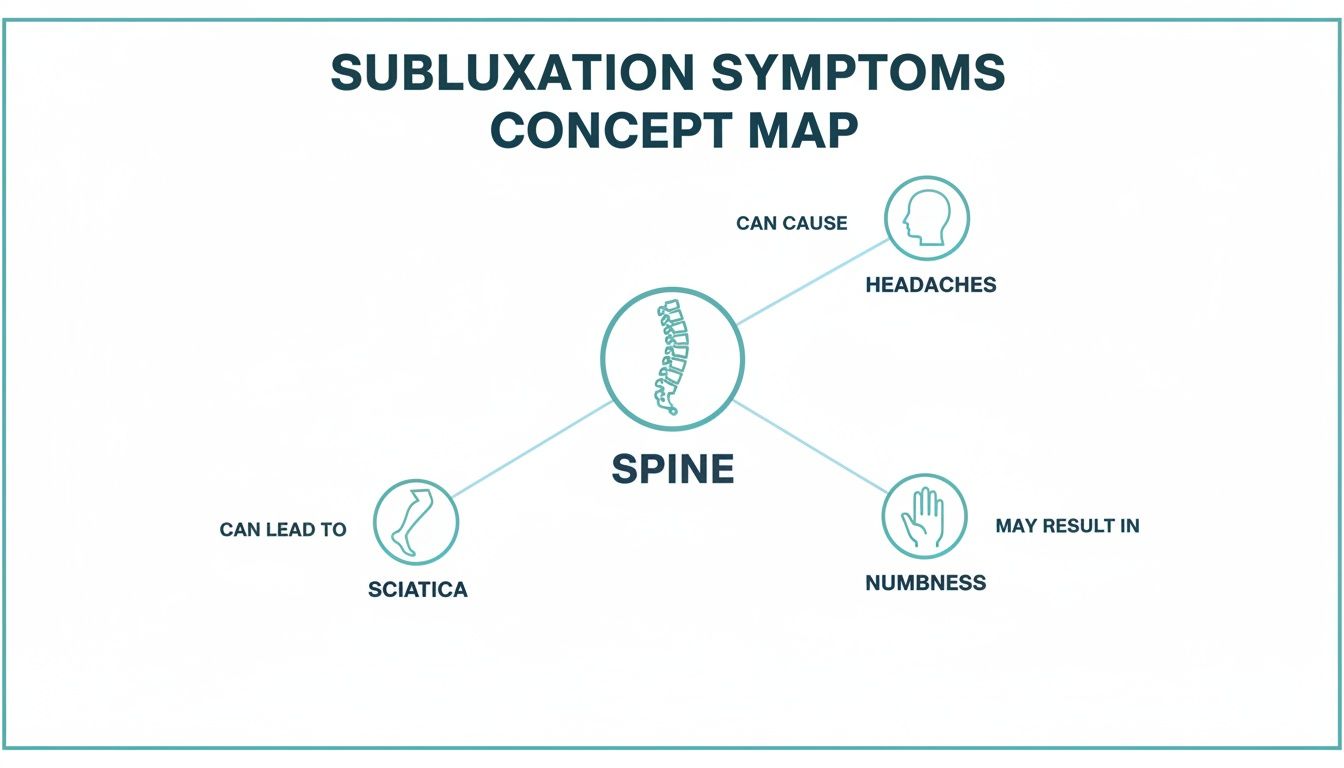
As you can see, the body is incredibly interconnected. A central problem in the spine can easily lead to headaches, sciatica, or nerve pain down your arms and legs.
The way we diagnose these issues has come a long way. Up until the 1980s, much of the evidence for chiropractic care was based on what doctors observed in their practice. A big shift happened in the late 20th century when integrative models like the PARTS analysis were developed and became widely adopted by the mid-1990s. This framework was a huge step in bridging the gap between clinical success stories and measurable, scientific evidence. You can discover more about the evolution of these concepts and the ongoing discussions within the broader healthcare community.
Adopting the PARTS model was a game-changer. It allowed chiropractors to document spinal dysfunction using a consistent, repeatable method that aligned with other healthcare standards. The focus moved away from a simple "bone out of place" idea to a much more defensible diagnosis of how the joint is functioning.
This evolution toward evidence-based practice has been critical for building confidence and showing the real clinical value of chiropractic care for musculoskeletal and neurological problems.
While nothing replaces a skilled hands-on examination, modern clinics like Bonesetters also bring in advanced technology to get an even deeper look at spinal function. For example, we use systems like the FDA-backed PulStar, which gives us objective, computer-guided data that complements our physical assessment.
The technology uses a handheld instrument to send gentle impulses into each spinal joint. The system then measures how each joint responds—its resistance and motion—and displays that data on a screen in real-time. This gives us an incredibly precise map of spinal stiffness and mobility, often revealing problem areas that might be too subtle to detect by touch alone.
Here’s why that matters:
By combining the time-tested PARTS analysis with modern diagnostic tools, we can identify the exact nature of your spinal dysfunction with remarkable accuracy. This ensures your care is not only safe and comfortable but also perfectly tailored to get your body working at its best again.
Once we’ve pinpointed a vertebral subluxation, our focus shifts to correction. The goal isn't just to silence the pain; it's to restore the spine’s natural function so your nervous system can communicate without interference. This means moving beyond the old-school, forceful twisting techniques and embracing gentle, precise, and technologically advanced methods that encourage the body to heal itself from the inside out.
A truly effective care plan understands that the body is an interconnected system. That's why we often combine targeted adjustments with other therapies that address related problems like muscle tension, inflammation, and disc issues. This integrated approach creates a powerful synergy, speeding up recovery and leading to results that actually last.
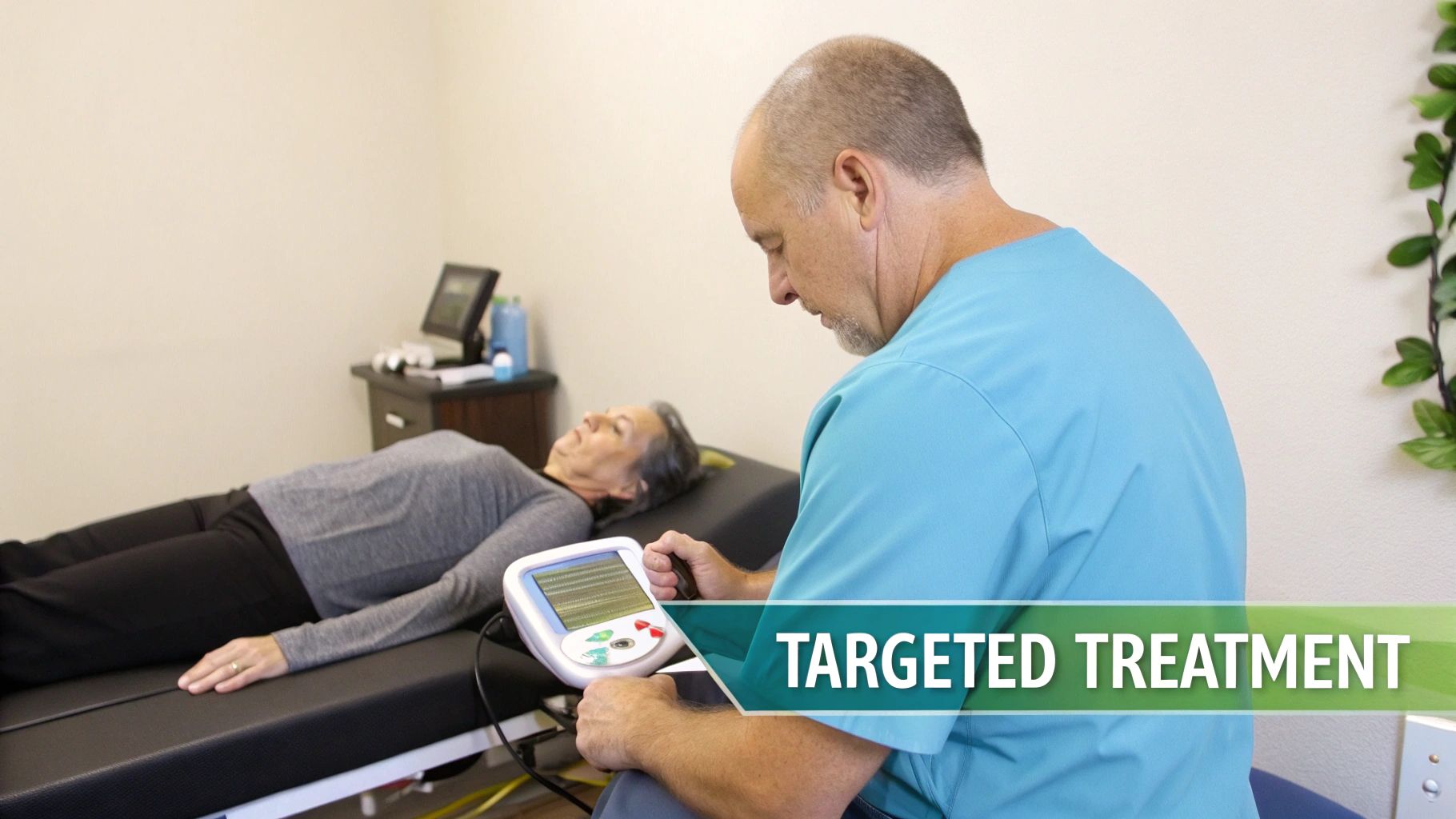
A cornerstone of modern chiropractic care is the computer-guided adjustment. Systems like the FDA-backed PulStar have completely changed how we correct spinal misalignments, offering a treatment that is both remarkably precise and incredibly gentle.
Instead of a traditional manual thrust, the PulStar uses a handheld instrument to deliver a series of soft, targeted impulses directly to the dysfunctional vertebra. The system’s advanced sensors analyze the joint’s motion in real-time and automatically adjust the force. This ensures the correction is just enough to restore mobility without causing any discomfort.
This technology gives us several key advantages:
This approach transforms the correction of a vertebral subluxation into a controlled, comfortable process tailored specifically to your body's needs.
Often, a vertebral subluxation goes hand-in-hand with spinal disc issues, like a bulge or herniation, which can put direct pressure on sensitive nerves. When that's the case, spinal decompression therapy becomes an essential part of the treatment plan.
This non-surgical therapy is quite relaxing. You simply lie on a specialized table that gently and slowly lengthens your spine. This controlled stretching creates a vacuum effect, or negative pressure, inside the targeted disc.
This negative pressure helps draw bulging or herniated material back into the disc and pulls oxygen, water, and nutrients into the area to promote healing. It is a highly effective method for relieving nerve compression and allowing damaged discs to regenerate.
By taking pressure off the spinal nerves, decompression gets right to the source of radiating pain like sciatica and provides significant relief. Many patients find it incredibly effective, and you can see what they are saying by reading spinal decompression therapy reviews from real people who have experienced its benefits.
At Bonesetters, we build our care plans around a suite of these evidence-based treatments. We match the right modality to the specific diagnosis to ensure the most effective and comfortable path to recovery.
| Treatment | How It Works | Primary Conditions Treated |
|---|---|---|
| PulStar Computer-Guided Adjustments | Uses gentle, precise impulses to restore joint mobility without twisting or popping. | Vertebral Subluxation, Joint Restriction, Neck & Back Pain, Headaches |
| Spinal Decompression | Creates negative pressure to retract herniated discs and relieve nerve compression. | Herniated/Bulging Discs, Sciatica, Degenerative Disc Disease |
| Class IV Cold Laser Therapy | Uses light energy to reduce inflammation and accelerate tissue repair at a cellular level. | Inflammation, Arthritis, Soft Tissue Injuries, Neuropathy |
| Shockwave Therapy (ESWT) | Applies acoustic waves to break down scar tissue and stimulate new blood vessel growth. | Chronic Tendinopathies (Plantar Fasciitis, Tennis Elbow), Myofascial Pain |
Each of these therapies plays a distinct yet complementary role in a comprehensive recovery plan, helping us address the root cause of your pain, not just the symptoms.
To give your body's recovery a boost on a cellular level, we often integrate Class IV cold laser therapy. This advanced treatment uses specific wavelengths of light that penetrate deep into the tissues surrounding the subluxation.
This light energy is absorbed by your cells, kickstarting their natural repair processes. It stimulates the production of adenosine triphosphate (ATP), which is the primary fuel for all cellular activity. The result is a powerful, localized healing response.
The benefits are clear:
This science-backed approach is central to modern, evidence-informed care. Bonesetters embodies this evolution, using protocols grounded in research from institutions like Harvard and the Cleveland Clinic. We deliver measurable outcomes, such as our knee decompression protocols for osteoarthritis and neuropathy therapy that has eased tingling in over 80% of cases, consistent with similar studies.
By combining these advanced modalities, we can create a plan that not only corrects the vertebral subluxation but also addresses the entire complex of related issues, paving the way for lasting relief.
If you've ever Googled "chiropractic care," you’ve probably stumbled into the heated debate around the term vertebral subluxation. It's a concept that has, frankly, been a source of major controversy and skepticism in the wider medical world for a long time. It’s important to tackle this head-on.
Much of the friction comes from old, outdated ideas. Decades ago, some early chiropractic theories tried to link specific subluxations to all sorts of internal diseases, like stomach ulcers or heart problems. These were huge claims, and they just didn't have the hard scientific evidence to back them up, which understandably created a deep rift with mainstream medicine.
Thankfully, the chiropractic world has come a long way. Evidence-based practitioners have moved past those historical debates, shifting the focus to something we can actually see, measure, and understand.
Today, we define a vertebral subluxation as a functional spinal lesion. Think of it less as a "bone out of place" and more as a spinal joint that isn't moving correctly, which in turn affects how it communicates with the nervous system.
This isn't just playing with words—it's a complete change in how we approach the problem. It frames the subluxation as a real-world biomechanical and neurological issue that we can identify through a physical exam, not just an abstract theory. This evolution is everything. It allows modern chiropractors to stand on solid scientific ground and collaborate effectively with other healthcare professionals for your benefit.
Instead of getting bogged down in what a subluxation might be connected to, a modern chiropractor focuses on what we can prove. We look for concrete, clinical signs that show us exactly how a dysfunctional spinal joint is impacting your health right now.
This evidence-based approach is all about tracking results that actually matter to you, such as:
By concentrating on these real-world outcomes, we can show you the real value of correcting a vertebral subluxation. It’s about getting your body working the way it's supposed to, which is the foundation for resolving nagging issues like chronic back pain. If that's something you're dealing with, our guide on how to relieve chronic back pain offers a deeper dive into practical, non-surgical strategies.
The goal of a modern, evidence-based chiropractor isn't to treat a specific disease. It's to correct spinal dysfunction. When we restore proper movement and nerve communication, we help unleash the body's incredible ability to heal and regulate itself—and that's often when symptoms begin to disappear.
This patient-first, results-driven mindset is at the core of modern chiropractic education and research. It’s about acknowledging the past, learning from it, and moving forward into a future built on solid evidence and your success.
As we've covered in this guide, that nagging pain, numbness, or stiffness you're feeling isn't something you just have to tolerate. These are often clear signals from your body pointing to a deeper spinal issue. For many people, a vertebral subluxation is the real culprit, and getting to the bottom of it is the only way to find genuine, long-term relief.
At Bonesetters, we focus on one thing: providing personalized, evidence-based care that corrects the source of the problem, not just masking the symptoms. If you’re tired of temporary fixes and ready to get your life back, your path to recovery can start right now.
We take a deep-dive approach from the very beginning. Your first appointment is all about uncovering the "why" behind your symptoms—no guesswork allowed. This thorough examination is the foundation for a care plan built specifically for you.
Here’s a quick look at what that first visit involves:
Once the examination is complete, Dr. Hayes will walk you through the results. He’ll explain what’s going on, show you the source of the issue, and lay out a clear, evidence-based plan to fix it. There are no cookie-cutter solutions here—your treatment is designed for your body and your needs.
Taking that first step toward better health can feel like the hardest part. Our goal is to make it as simple and supportive as possible, giving you the clarity and care you need to finally feel better.
Your journey to a pain-free life starts with understanding the problem. If you're ready for answers, contact Bonesetters today to schedule your consultation and see how modern, non-surgical chiropractic care can make a real difference.
It's completely normal to have questions when you're digging into the specifics of spinal health. To help you get a clearer picture, we’ve answered some of the most common questions our patients ask about vertebral subluxation. My goal here is to give you straightforward, no-nonsense information so you can feel more in control of your health decisions.
Let's dive into some of the practical concerns that often come up.
Absolutely, and it happens all the time. Your body is a master of compensation and can work around spinal issues for a long while before any clear symptoms show up. Pain is usually the last thing to arrive at the party—it’s your body's final signal that a problem has been brewing for some time.
I often compare it to a cavity. A small cavity can form and grow for months or even years without a single twinge of pain, but the decay is still happening. By the time you get a toothache, the problem is much bigger. In the same way, a subluxation can interfere with how your nerves work and how your joints move long before you feel any discomfort, which is why proactive spinal care is so valuable.
This is a really important point to understand, as the two terms describe very different things.
To put it simply: The medical definition points to a major structural displacement. The chiropractic definition focuses on a subtle functional problem that messes with your nervous system.
For the vast majority of people, yes. When performed by a qualified and experienced chiropractor, adjustments are incredibly safe for everyone from babies to grandparents. The most important step is always the initial, thorough examination. This is where we learn your full health history and pinpoint your body's specific needs, allowing for a completely customized treatment.
Modern techniques have made adjustments even safer and more comfortable. For instance, the computer-guided PulStar system we use at Bonesetters is exceptionally gentle. It uses precise, low-force impulses without any of the traditional "cracking" or "popping," making it a great option for people dealing with acute pain, osteoporosis, or other sensitivities.
At Bonesetters, our entire focus is on providing personalized, evidence-based care that gets to the root cause of your pain. If you're looking for a solution that delivers real, lasting results, we'd be glad to help. Schedule your consultation today and let's get started.