

If you’ve spent any time Googling spinal decompression therapy, you’ve probably seen a dizzying mix of reviews. Some people call it a miracle that saved them from surgery, while others are frustrated by a lack of results. So, what’s the real story?
The truth is, patient outcomes can vary wildly. This isn't because the therapy is a gimmick; it's because success hinges almost entirely on getting the right diagnosis and treating the right condition. This is why digging into the "why" behind patient reviews is so important before making a decision.
When you're dealing with back pain, you want straight talk, not a medical textbook. Let's break down the core concept with a simple analogy. Think of your spinal discs as little jelly donuts stacked between your vertebrae. Injury or just the wear and tear of life can cause a donut to get squished, making the jelly bulge out and press on a nerve. That pressure is what causes that searing, debilitating pain.
Spinal decompression therapy works by gently and precisely stretching the spine. This creates a subtle negative pressure—almost like a vacuum—that helps suck that bulging "jelly" back where it belongs, taking the pressure off the nerve. It’s a straightforward idea, and it’s the foundation for countless success stories.
After reading through hundreds of reviews, you start to see patterns. The happiest patients—the ones who rave about their results—tend to have a few things in common. They almost always report a major drop in the sharp, radiating pain that comes with things like herniated discs or sciatica. Many talk excitedly about getting back to simple joys they thought they'd lost, like golfing, gardening, or just picking up their grandkids without wincing.
On the flip side, negative reviews usually circle back to a couple of key issues. A common complaint is the financial and time commitment, which can feel especially draining if the results don't meet expectations. In other cases, it becomes clear that the patient may not have been a good candidate for this specific therapy in the first place, which really highlights the need for a meticulous upfront evaluation. You can learn more about how disc problems are identified in our guide on degenerative disc disease treatment options.
"For years, my low back pain was just a fact of life. I'd tried everything. Spinal decompression therapy truly gave me my life back. The pain is almost gone, and I feel like myself again." - A Common Patient Testimonial
To make sense of the feedback you'll find online, here's a quick summary of what patients are saying.
| Positive Feedback Themes | Negative Feedback Themes |
|---|---|
| Significant Pain Reduction: Especially for radiating nerve pain (sciatica). | Cost & Time Commitment: Can be a major investment without guaranteed results. |
| Return to Normal Activities: Regaining the ability to walk, work, and enjoy hobbies. | Slow or Limited Results: Frustration when improvement isn't fast or dramatic. |
| Avoiding Surgery: Relief at finding an effective non-invasive alternative. | Wrong Diagnosis: Therapy applied to conditions it's not suited for. |
| Improved Mobility: Increased flexibility and less stiffness. | Temporary Relief: Symptoms returning after the treatment course ends. |
This table shows that while the potential for relief is high, the journey isn't always straightforward. Setting realistic expectations is key.
Personal stories are powerful, but it’s nice to have solid data to back them up. The positive outcomes you see in reviews are often reflected in clinical research.
For example, a notable single-center study on motorized decompression systems found an impressive 80% average improvement in pain for participants. That same study showed a 50% improvement in disability scores after a series of 20 treatments. This data lines up perfectly with what satisfied patients report—not just feeling better, but functioning better. You can read more about the full findings from this disc lesion study to see the numbers for yourself.
At the end of the day, the collection of spinal decompression therapy reviews paints a hopeful picture. The most successful outcomes always start with a clear diagnosis, realistic expectations, and confirmation that this therapy is the right tool for your specific problem.
If you’re digging through spinal decompression therapy reviews, it’s easy to get lost in personal stories. To really get what’s happening, you need to look under the hood at the mechanics of it all. This isn't just a fancy stretching machine; it's a highly targeted, computer-driven therapy that goes right to the source of your pain—the specific spinal disc that’s causing all the trouble.
Think of it this way: a sophisticated system gently and rhythmically lengthens your spine. The real magic is in how it pulls. The system is smart enough to outwit your body's natural defense system, applying a gentle force that bypasses the reflexive muscle tightening you’d get from basic stretching.
This intelligent pull creates a vacuum effect inside the disc, a state we call negative intradiscal pressure.
That little vacuum is where the healing begins. As soon as negative pressure is established within the disc, two crucial things start to happen at once.
First, it helps pull back the disc material that has bulged or herniated out of place. This retraction is what gets the disc off the nerve it's been pinching. For anyone who has felt that sharp, searing pain of sciatica shooting down their leg, this is the action that finally provides real relief.
Second—and this is key for long-term health—the vacuum pulls in a flood of healing nutrients. Oxygen, water, and other vital fluids are drawn from the surrounding tissues into the disc itself. Because spinal discs have such a poor blood supply on their own, this influx is absolutely essential for repairing damage and getting the disc healthy again.
This one-two punch of retracting the bulge while rehydrating the disc is what truly sets spinal decompression apart. It doesn't just put a band-aid on the pain. It tackles the core mechanical problem and fosters an environment where the disc can start to heal itself.
This whole process mirrors the journey so many patients take: they start in pain, do their homework on therapies like this, and hopefully, find their way to lasting relief.
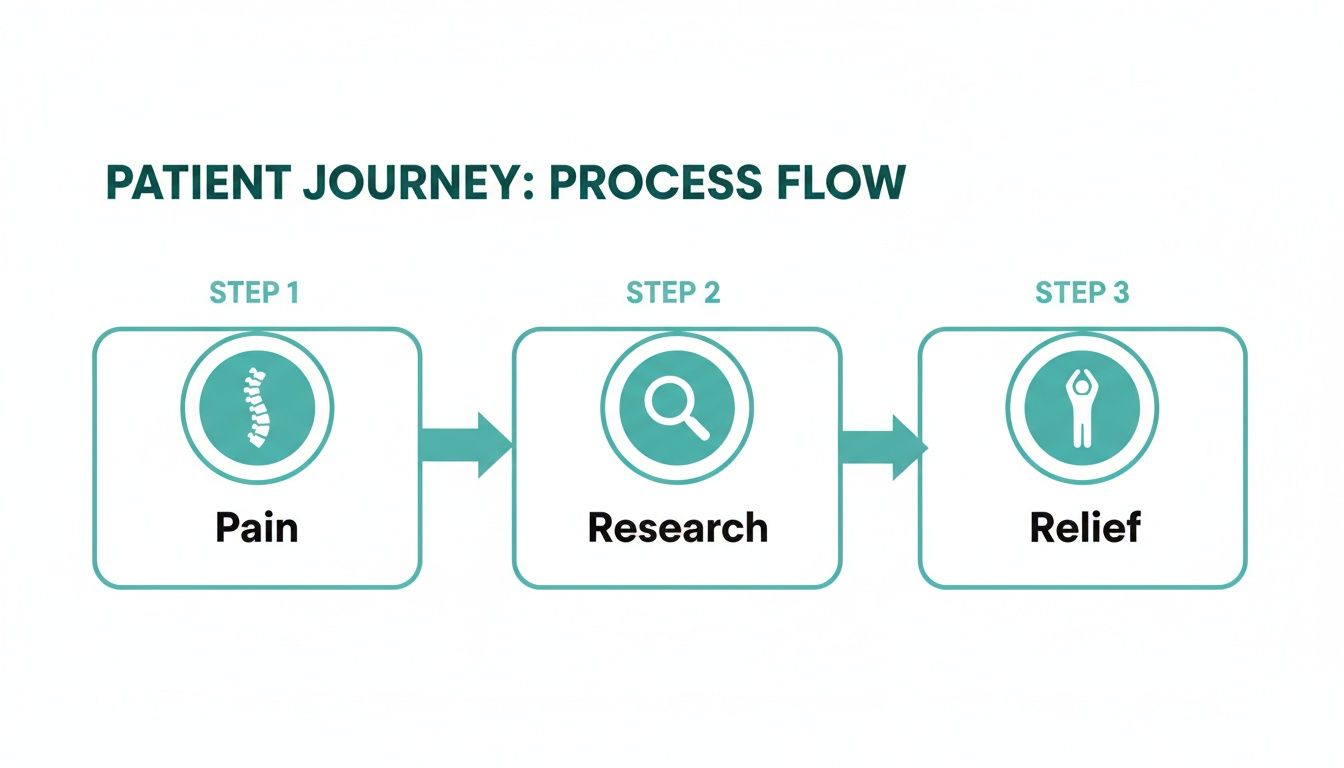
The image above really captures that common path. It’s why understanding the science behind a treatment is so important before you commit.
It’s a common mistake to lump spinal decompression in with old-school traction tables. They both involve stretching the spine, sure, but that’s like comparing a modern smartphone to a rotary phone. They are worlds apart in how they work.
Traditional traction applies a steady, constant pull. The problem is, your body is smart. It feels that pull and instinctively tightens the surrounding muscles to guard against it. This "muscle guarding" often stops the force from ever reaching the deep disc level where the problem lies.
Modern spinal decompression, on the other hand, uses a computer to apply and release tension in a precise, logarithmic cycle. This oscillating pattern is so subtle that your body doesn't see it as a threat. Your muscles stay relaxed, allowing the therapy to get right to the targeted disc. You can read more about a similar treatment in our guide on what intersegmental traction is and how it fits into a comprehensive care plan.
Here’s a quick rundown of the main differences:
At the end of the day, this more advanced approach is built to create real, lasting change inside the disc. By taking the pressure off and kickstarting the healing process, it helps restore the disc's natural function and strength, getting to the root cause of issues like degenerative disc disease and herniations.
Trying to make sense of spinal decompression therapy reviews can feel like an impossible task. You’ll see a glowing five-star success story right next to a one-star horror story, leaving you more confused than ever. The secret isn't just to read reviews; it's to learn how to read between the lines.
A truly helpful review tells a story, it doesn't just offer a star rating. Look for people who get specific about the kind of pain they were in. Was it a sharp, shooting sciatic pain? A dull, nagging ache from a bulging disc? Specificity is almost always a sign of a real person sharing a real experience.
The best reviews will walk you through their journey. They’ll often mention how long they were suffering, what other treatments didn't work, how many sessions they had (e.g., "after 15 sessions over six weeks"), and what their recovery was actually like. This kind of detail gives you a realistic benchmark, not just a quick emotional reaction.
When you're scrolling through testimonials, it helps to have a mental checklist. A genuinely useful review will contain a few key ingredients that give you the full picture.
Here’s what to look for:
The most credible online reviews focus on the journey, not just the destination. They talk about the ups and downs, the commitment required, and the specific functional improvements they noticed, like being able to walk the dog without pain again.
On the flip side, certain red flags should give you pause. Vague, super-emotional language without any concrete details is a big one. Also, watch out for testimonials that sound more like a sales pitch than a personal story or make promises of "guaranteed results." Those are often just marketing pieces dressed up as patient feedback.
It’s just human nature: people who have an amazing experience or a terrible one are the most likely to write a review. This creates a "vocal minority" effect, where the most common outcome—slow, steady improvement—is often underrepresented. You see the extremes, not the average.
Money is another huge factor that shapes the reviews you read. The cost of care and what insurance covers can dramatically color a patient's perception of the treatment. Things like reimbursement policies and the high cost of the equipment can influence which clinics even offer the therapy and how they price it. You might notice that reviews cluster by area; wealthier suburbs with great insurance coverage might have more positive feedback, while areas where more people pay out-of-pocket could have more comments about the cost. You can learn more about these market dynamics in spinal decompression.
Once you understand these built-in biases, you can read reviews with a more critical eye. Don't let a single dramatic story—good or bad—be your guide. Look for the consistent themes you see across multiple balanced, detailed reviews. That’s where you’ll find the truth.

Spinal decompression can feel like a lifeline for people with chronic back and neck pain, but it's not a cure-all for every spinal problem. The success stories you see in positive spinal decompression therapy reviews almost always boil down to one critical factor: matching the right treatment to the right condition.
Think of it as a specialized tool. It's incredibly effective for its intended job, but you wouldn't use a screwdriver to hammer a nail. This therapy is specifically designed to relieve pain caused by mechanical compression of your spinal discs. When a disc bulges, herniates, or wears down, it often squeezes surrounding nerves, triggering that familiar, debilitating pain.
Spinal decompression directly addresses this by gently creating space and negative pressure within the disc, encouraging it to retract and heal. That’s why a precise diagnosis isn't just a formality—it’s the absolute foundation of a successful outcome. Without it, any treatment is just a shot in the dark.
Certain spinal issues are perfectly suited for the gentle, targeted pull of spinal decompression. If your pain comes from a compressed nerve root or a disc that’s breaking down over time, there's a good chance you're an ideal candidate. These are the diagnoses we see responding best to treatment.
Here are the classic conditions where we often see fantastic results:
A proper diagnosis from a qualified professional is non-negotiable. Trying to figure it out yourself based on online searches can lead you down the wrong path, wasting time and money on treatments that won't work for your specific issue.
Just as important as knowing who can benefit is knowing who can't. Patient safety is our number one priority, and there are specific medical situations where the gentle pulling forces of decompression could do more harm than good. These are known as contraindications.
Attempting therapy with one of these conditions could lead to serious complications. It highlights why a thorough exam, complete with a deep dive into your medical history and often supported by imaging like X-rays or an MRI, is a mandatory first step.
To make it simple, here’s a clear breakdown of who is a good fit versus who should steer clear.
The table below offers a clear comparison to help you understand who typically benefits from spinal decompression and who should avoid it for safety reasons.
| Conditions That Often Respond Well | Conditions That Are Contraindicated |
|---|---|
| Herniated or bulging discs | Pregnancy |
| Sciatica or pinched nerves | Severe osteoporosis or osteopenia |
| Degenerative disc disease | Spinal fractures or recent breaks |
| Posterior facet syndrome | Spinal tumors or infections |
| Failed back surgery syndrome (without fusion) | Spinal fusion or metallic hardware |
If you have any of the conditions listed on the right, this therapy is not a safe option for you. Any responsible clinic will perform a comprehensive evaluation to rule out these contraindications before ever recommending a treatment plan. Your health history is truly the most important piece of this puzzle.
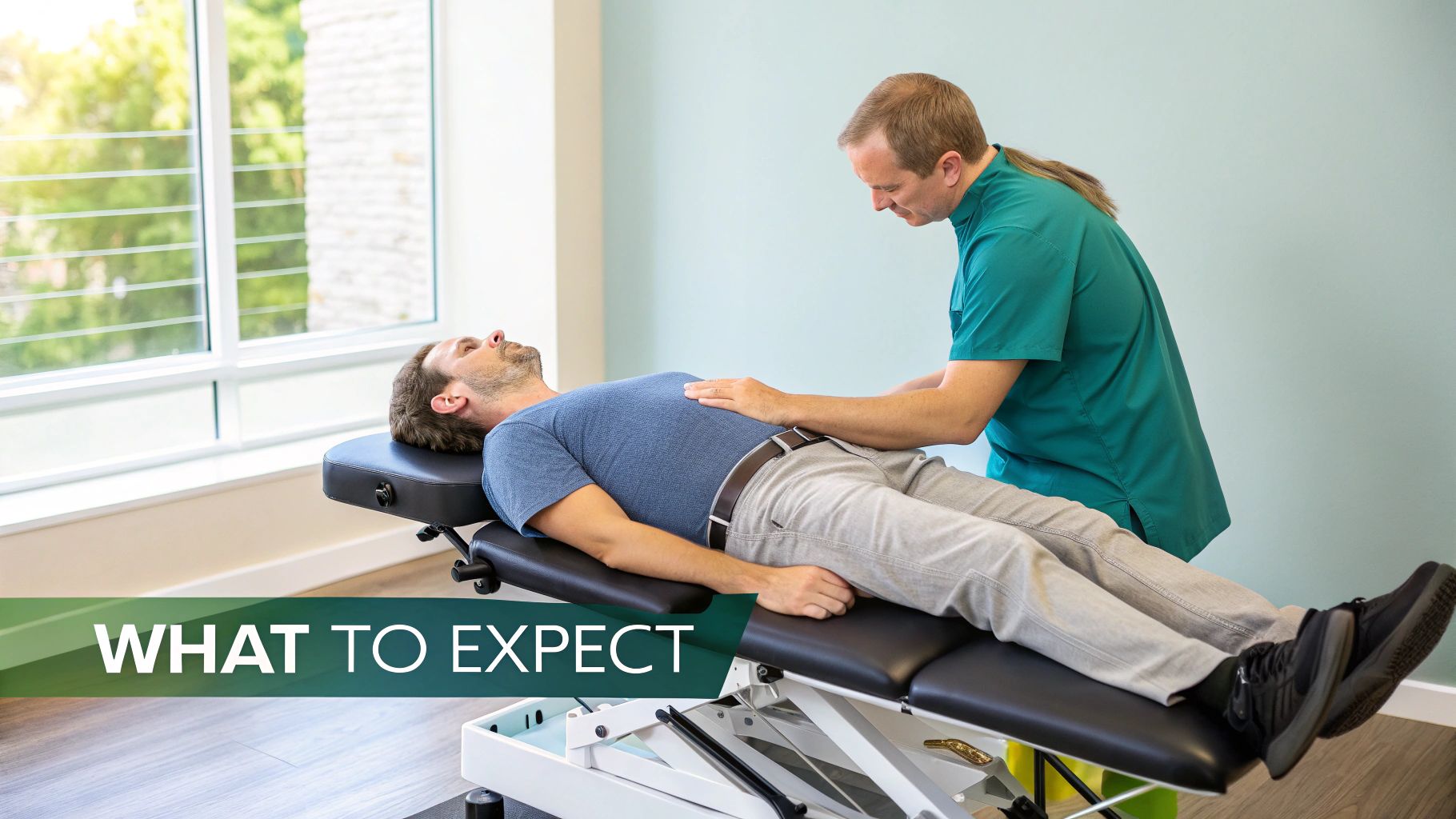
It's completely normal to feel a bit apprehensive before your first spinal decompression session. Let's walk through the entire process, step by step, so you know exactly what’s coming and can feel at ease. The whole experience is designed to be controlled, comfortable, and even relaxing.
You'll start by getting settled on a specialized, computer-controlled table. We'll secure you with a soft harness system, either around your pelvis for lower back issues or your neck. This is key because it ensures the gentle traction is isolated precisely to the problem area of your spine, which makes the therapy so effective.
Once the session starts, you'll feel the table slowly and smoothly cycle through periods of gentle stretching and then relaxation. Most patients simply describe it as a light, painless pull where they normally feel pain. The technology is smart enough to work subtly, bypassing the body's natural tendency to guard the muscles, which allows for a much deeper and more effective decompression.
It's important to understand that spinal decompression isn't a one-and-done fix. The real magic happens over time. Think of it like physical therapy—the effects are cumulative, with each session building on the progress of the last one to promote real healing.
Every patient's plan is tailored to their specific needs, but most follow a similar structure:
The effectiveness of this therapy is no secret, and the numbers show it. Industry analysis valued the global spinal decompression device market at around $1.5 billion in 2023. With its growing popularity, it's projected to climb to $2.5–$2.6 billion by the early 2030s, and North America is leading the charge. You can dig into the trends shaping the decompression table market to see the data for yourself.
What you do between sessions is just as crucial as the time you spend on the table. Spinal decompression is a powerful tool, but it works best as part of a comprehensive recovery plan. To protect your investment and ensure your results last, you need to support the healing process.
Lasting relief isn't just about what happens on the table—it's about creating an environment where your spine can stay healthy. This involves strengthening supporting muscles and adopting habits that protect your back from future injury.
Your practitioner will almost certainly give you a post-treatment protocol. This usually includes simple, targeted exercises to strengthen your core and back muscles. A strong core acts like a natural corset for your spine, providing stability and taking a huge amount of pressure off your discs.
You'll also get advice on small lifestyle adjustments that make a big difference—things like proper lifting techniques, setting up your workspace ergonomically, and staying hydrated to keep your spinal discs plump and healthy. This holistic approach doesn't just relieve your current pain; it builds a strong foundation for long-term spinal health.
It's completely normal to have a few more questions rattling around as you consider your options. Let's tackle some of the most common ones we hear from patients to give you the clarity you need.
Not at all. In fact, most people find it quite relaxing. Patients often describe the sensation as a gentle, targeted stretch in their neck or lower back.
The computer-controlled system is designed to be incredibly smooth, applying and releasing tension so gradually that your body’s natural muscle-guarding reflex isn't triggered. Many of our patients feel so calm and comfortable that they end up taking a short nap during the session.
This is a big one, and the honest answer is: it depends. Coverage varies wildly between insurance providers and individual plans. Some policies will cover a portion of the therapy, but many still consider it an elective treatment, which would make it an out-of-pocket expense.
The most important step is to verify your benefits directly with your insurance company. Any good clinic will also work with you to provide a clear, upfront breakdown of all potential costs before you begin treatment. No one likes financial surprises when they're trying to heal.
It's a common point of confusion, but spinal decompression and old-school traction are worlds apart in terms of technology and effectiveness.
Traditional traction applies a simple, static pull. The problem is, your body often fights back against this constant force by tightening the very muscles you're trying to relax—a reflex called muscle guarding. This can prevent the treatment from ever reaching the deep spinal discs.
Spinal decompression, on the other hand, is much smarter. It uses a sophisticated, computer-guided system that applies force in a precise, oscillating pattern. This intelligent approach is specifically designed to bypass the body's muscle-guarding response.
This key difference is a major reason for the therapy's success. As more people seek out effective, non-surgical solutions for chronic pain, the demand for this kind of advanced technology is growing. You can even see this reflected in the market trends for decompression devices, which show a clear shift toward treatments that address the root cause of disc problems.
At Bonesetters Critical Chiropractic, we're committed to giving you clear, straightforward answers. If you have more questions or want to find out if our evidence-based protocols are a good fit for you, we encourage you to schedule a comprehensive evaluation. Take the first step toward lasting relief by visiting us at https://bonesetters.org.